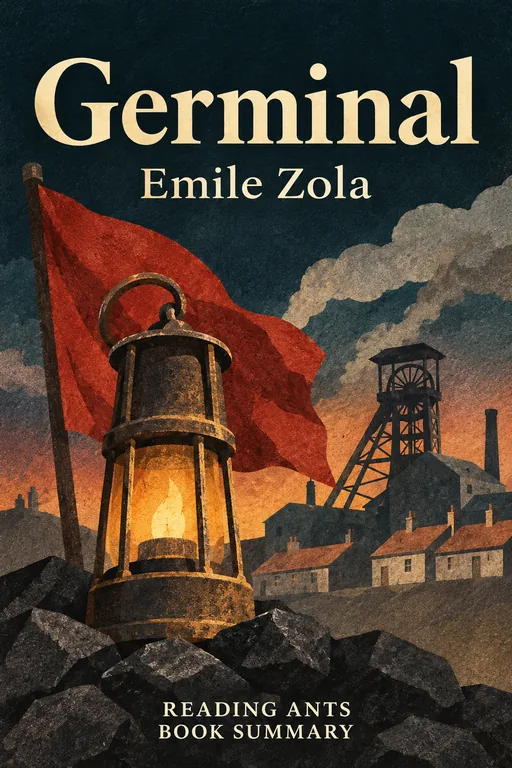
Germinal
When a coal-mining village in northern France goes on strike against starvation wages, the workers' hope and anger lead to disaster, but also to the first stirrings of change.
Overview
Germinal is a novel by the French writer Emile Zola, published in 1885. It is set in a coal-mining region in northern France, in the 1860s, during the rule of Emperor Napoleon III. It is part of Zola’s large cycle of twenty novels about one extended family, the Rougon-Macquart. Zola researched mining life carefully, and he described it in a style called naturalism, which treats people as products of their surroundings and their heredity. The book asks a hard question about industrial society: when workers are pushed to the edge, is rebellion justified, and what does it cost?
Main Characters
- Etienne Lantier: a young machinist who loses his job and comes to work in the mine. He becomes a leader of the strike.
- Maheu: a miner and head of a large family.
- La Maheude: Maheu’s wife, who struggles to feed her children.
- Catherine Maheu: Maheu’s teenage daughter, a hard-working miner.
- Chaval: a rough young miner who fights with Etienne over Catherine.
- Souvarine: a quiet Russian anarchist, who works in the mine and believes in destruction.
- Rasseneur: a former miner who now runs a tavern and favors moderate reform.
- Hennebeau: the manager of the mining company.
Full Summary
A Stranger in Montsou
Etienne Lantier walks into the mining district of Montsou on a cold night, desperate for work after losing his job elsewhere. He finds a job at a pit called Le Voreux, and he is taken in by the Maheu family, who rent him a bed. He sees how the miners live: crowded into company housing, always hungry, with children going underground as soon as they are old enough to work.
Etienne works alongside Catherine and her father, in narrow tunnels, in heat and dust. He is moved by her courage, but she is tied to Chaval, a crude man who treats her harshly and abuses her.
Dreams and Anger
Etienne is intelligent and has read about socialism. In the evenings, he talks with the miners at Rasseneur’s tavern, and he starts to share ideas about justice, and about how the workers could control their own fate. Souvarine, the Russian, listens in silence, and thinks that only complete destruction can change anything.
The company then changes the way it pays for the timber that supports the tunnels. In effect, this lowers the wages, and the miners are already barely surviving. Etienne persuades them to strike.
The Strike
At first the miners have hope. They have a small fund, and Etienne is full of energy. But the company does not give in, and the weeks pass. The families grow hungry. Shops stop giving credit, and the children weaken. La Maheude has to beg for food, and she feels deep shame at it.
Tensions rise. Strikers march from pit to pit to force other workers to stop, and the crowd becomes violent. They break into the shops and attack the manager’s house. A grocer, Maigrat, who has been cruel to the women of the village, falls from a roof as he tries to flee, and the crowd abuses his body in its rage.
The Soldiers
The company brings in soldiers. In a tense confrontation outside the Voreux, the crowd throws stones, and the soldiers open fire. Many are killed, including Maheu. Etienne and the others are devastated. The strike is broken, and the miners start going back to work, ashamed and defeated.
Some of the young people also commit terrible acts: Jeanlin, a boy of the village, kills a young soldier in a fit of senseless violence. Etienne, who has lost the confidence of the miners, thinks of leaving.
The Flood
Souvarine takes matters into his own hands. He sabotages the mine’s supports, so that water pours in and floods the Voreux. Etienne, Catherine and Chaval are trapped far below ground, with little hope of rescue. Chaval attacks Etienne in a jealous rage, and Etienne kills him. It is a desperate struggle, and Zola links it to the violent impulses that Etienne has inherited from his family.
Etienne and Catherine wait in the dark for days. Catherine, weakened, tells him that she loves him, and then she dies. Etienne is finally rescued by a team of men who dig for him.
Spring
Etienne emerges alive. Before he leaves, he sees La Maheude, who has lost her husband and other family members and has gone back to work in the pit. He decides to go to Paris to work for the cause. As he walks away on a spring morning, he thinks about the wide world above ground, and about the workers who are still under the earth. The title “Germinal” refers to a spring month in the French revolutionary calendar, and the ending suggests that a new harvest is slowly growing underground, ready to rise, even though the strike has failed.
Why It Matters
Germinal is one of the most powerful novels about the working class ever written. It showed the harsh realities of industrial labor to a wide reading public, and it influenced writers and reformers across Europe and beyond. Zola’s research into mines and miners’ lives set a standard for later novelists who wanted to base fiction on real facts. The novel was banned or criticized in some places, and it has been adapted for film and television several times. It is often read alongside other social novels, such as those of Dickens, Hugo and Steinbeck.
Key Takeaways
- Poverty can break people. The Maheus’ lives show how hunger shapes choices.
- Workers need unity. The strike fails partly because the miners have few resources and little power.
- Revolt has costs. Violence brings suffering to those who can least afford it.
- Ideas conflict. Etienne, Rasseneur and Souvarine represent different ways to seek change.
- Hope is stubborn. The ending suggests that change is slowly growing even after defeat.
What We Can Learn
Germinal helps us understand the history of workers’ rights, and why things like safe conditions, fair pay and limits on child labor were won through long struggles. We can think about where the goods we use come from, and about who works to make them.
It also shows how hard it is to change an unjust system, and how good intentions can lead to harm if anger takes over. The book encourages us to look for ways to help that are patient, organized and fair. Finally, it reminds us to pay attention to people whose lives are different from our own, and to listen to their stories.
Criticism and Counterpoints
Some readers find the descriptions of poverty and violence heavy and the book’s tone very bleak. Zola’s naturalism has been criticized for treating people almost like animals driven by instinct, and for sometimes exaggerating. Others say that the novel’s characters are types more than individuals, and that Zola, who was not a miner, saw the world of the poor from outside. A few critics found the sexual content too strong in his own time, and some readers still find it hard to read.
Who Should Read It
This book is for mature readers who enjoy social novels and history, and who are ready for hard scenes of poverty and violence. It is long, and it is not a light read, but its story is gripping, and it is rewarding to those who want to understand the roots of the modern labor movement.
Want the whole book?
A summary is a taste, not the meal. Here is where to find the full book.
You reached the end 🎉
Nicely done. Mark this one as read, and we will suggest what to read next.
Read this next
Les Miserables
Victor Hugo
A former convict, transformed by a single act of mercy, spends his life doing good while being hunted by a relentless police inspector, in a sweeping story of love, injustice and redemption in nineteenth-century France.
🌍 World LiteratureThe Jungle
Upton Sinclair
A Lithuanian immigrant family comes to Chicago hoping for a better life and is crushed by the brutal conditions of the meatpacking industry, until the father discovers socialism as a possible hope.
📜 Classics
Oliver Twist
Charles Dickens
An orphan boy born in a workhouse escapes to London, where he falls into a gang of child thieves, and despite cruelty and crime around him, his goodness survives until he finds a loving home and learns the secret of his birth.
📜 Classics
The Grapes of Wrath
John Steinbeck
Driven off their Oklahoma farm by drought and the banks during the Great Depression, a poor family travels west to California in search of work, only to find exploitation and hunger, yet they hold on to their dignity and compassion.
📜 Classics
Pere Goriot
Honore de Balzac
In a shabby Paris boarding house, a poor student learns how ruthless the city is by watching an old man ruin himself for two selfish daughters.
🌍 World Literature
The Little Prince
Antoine de Saint-Exupery
A pilot stranded in the desert meets a small boy from a tiny planet, who teaches him that the most important things in life, like love and friendship, can only be seen with the heart.
🌍 World LiteratureWant something different?
Pick another topic and we will show you three books to start with.