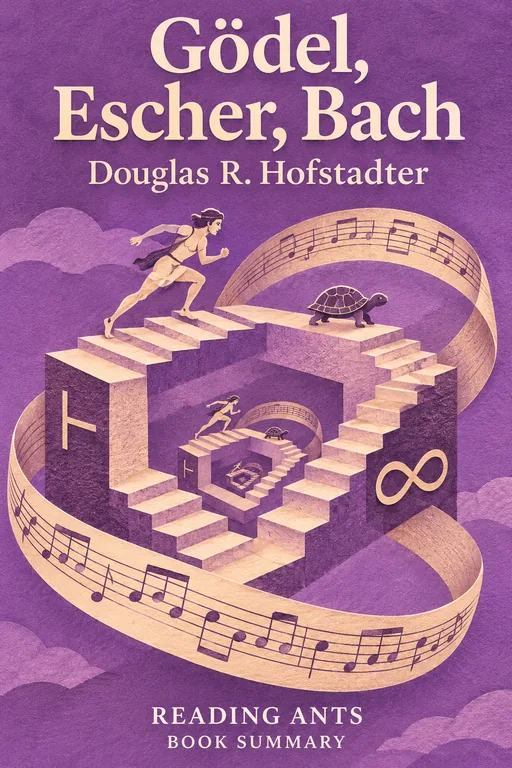
Douglas Hofstadter weaves together the logician Kurt Gödel, the artist M. C. Escher and the composer J. S. Bach to explore how meaning and a sense of self can arise from systems of symbols that refer back to themselves, which he calls strange loops.
Overview
Gödel, Escher, Bach: An Eternal Golden Braid was published in 1979 by Douglas Hofstadter, who was then a young computer scientist at Indiana University. It won the Pulitzer Prize and became a cult classic. It is a very unusual book: twenty chapters in two parts, each paired with a playful dialogue, many of them starring Achilles and the Tortoise, whom Hofstadter took from Zeno of Elea and from Lewis Carroll. Each dialogue is modeled on a piece of music by Bach and illustrates the ideas in the chapters around it. The central question is how a mind, a self, can arise from matter, and what is common to mathematics, art and music. The book is long, dense and full of puzzles.
Full Summary
1. Formal systems and puzzles
The idea: Hofstadter begins with simple formal systems, sets of symbols with rules for changing them. He introduces a puzzle called the MU puzzle: starting from the string MI and using a few rules for changing strings, can you produce MU? Hofstadter urges the reader to try, and does not give the answer until much later in the book, where a simple counting argument made from outside the system shows that MU can never be reached. The puzzle shows the difference between working inside a system and thinking about it. Later chapters build more formal systems, including one for number theory that he calls Typographical Number Theory, or TNT. All of this sets the stage for the main themes of the book.
In real life: In a game, you can follow the rules without knowing whether a given goal is reachable.
2. Gödel’s incompleteness theorem
The idea: The core mathematical idea is Gödel’s theorem, proved in 1931. In Hofstadter’s plain-English version, it shows that any consistent formal system for number theory contains statements that the system can neither prove nor refute, so that some true statements lie beyond its proofs. Gödel did this by making a statement that, in effect, says “this statement cannot be proved,” using a coding trick, now called Gödel numbering, in which numbers stand for symbols and statements, so that statements about numbers can also be read as statements about statements. Hofstadter explains the idea at length, including how the argument works for TNT, and shows how self-reference creates the effect.
In real life: A sentence that says “I am false” creates a puzzle, and Gödel found a precise version in mathematics.
3. Strange loops in art and music
The idea: Hofstadter connects the idea of self-reference to the drawings of Escher, such as a pair of hands that draw each other, and a staircase that goes up and yet returns to the start, and to the music of Bach, such as a canon from the Musical Offering that modulates upward through several keys and, after six steps, arrives back at its starting key, only an octave higher. He calls this phenomenon a strange loop: moving upward or downward through the levels of a hierarchical system, you unexpectedly find yourself back where you started. A system in which a strange loop occurs he calls a tangled hierarchy, and the strange loop shows up again and again in his discussion of self-reference.
In real life: In Escher’s Drawing Hands, each hand draws the other, so neither can be called the starting point.
4. Minds, brains and meaning
The idea: Hofstadter turns to the question of how a brain made of neurons can have thoughts. He proposes that meaning arises from patterns at a higher level than the physical, and that symbols in the brain can represent the world and the self. In the dialogue Ant Fugue, he compares a brain to an ant colony, Aunt Hillary, in which every ant is simple but the colony as a whole can hold a conversation, just as no single neuron needs to be intelligent for a person to think. The mind, he suggests, is something that emerges at the level of the pattern, not of the parts.
In real life: In the Ant Fugue, none of the ants can converse, yet the colony they form can.
5. Artificial intelligence and the possibility of machine thought
The idea: The book discusses whether machines can think. Hofstadter reviews the early history of artificial intelligence, including the Turing test, which he defends, and efforts to make computers play games, prove theorems and use language. He notes that some goals, such as strong computer chess, proved much harder than early estimates suggested, and he analyzes and rejects the argument that Gödel’s theorem shows human thought cannot be mechanical. He is open to the idea that a program of the right kind could one day think, and he gives special attention to how concepts and analogies work, which he sees as central to intelligence.
In real life: Hofstadter guessed that a program able to beat everyone at chess would have to be a general intelligence, not just a chess player, a guess that later chess programs did not bear out.
6. The self as a strange loop
The idea: In the later parts, Hofstadter suggests that the sense of “I” comes from a self-symbol, a large constellation of symbols in the brain that keeps track of the brain’s own activity, a pattern that models itself. He develops the idea of the self as a strange loop more fully in a later book. On this view the self is not a soul separate from the body but an abstract pattern of symbols and their relations. In the final chapter he turns to the snarl of humans thinking about their own minds and asks whether Gödel’s theorem, taken only as a metaphor, hints that we cannot fully understand ourselves. The closing dialogue, a retelling of the story of Bach’s Musical Offering with which the book began, loops back to the opening and makes the book itself one big self-referential loop.
In real life: Thinking about your own thinking is a loop you can try right now.
Why It Matters
Gödel, Escher, Bach is a landmark of popular science and philosophy. It introduced a wide audience to Gödel’s theorem, to the ideas of computation, and to the problem of consciousness, and influenced generations of students of computer science, mathematics and cognitive science. Its playful style and inventive structure make it a rare work in which the form reflects the content. Hofstadter later returned to its central ideas in I Am a Strange Loop. It has an enthusiastic following, and is still read as a challenge and a delight, often passed from one curious student to another with the warning that it will take a long time.
Key Takeaways
- Self-reference creates depth. Systems that refer to themselves produce surprises.
- Systems have limits. Gödel showed that truth outruns proof.
- Art, music and math share patterns. Strange loops appear in all three.
- Minds emerge from patterns. Meaning arises at a higher level than neurons.
- The self is a loop. Consciousness may be a pattern that models itself.
What We Can Learn
You can use the book to play with puzzles and patterns, and to see connections between different fields. Notice self-reference in everyday life, such as in a sentence about itself, or a mirror facing a mirror. Practice stepping outside of a problem to ask whether you are working in the right system. Be patient with difficult ideas, since the book rewards slow reading. And enjoy the dialogues, which can be read for fun even if the math is hard. Discuss it with friends to make it more fun.
Criticism and Counterpoints
Critics say that the book is overlong and indulgent, and that its playful structure can obscure the arguments. Some critics say that using Gödel’s theorem as a guide to the mind is a stretch, since the theorem does not directly say anything about consciousness. Hofstadter himself says that any such use must be treated as metaphor, not as a literal translation of the theorem. Others argue that the view that the mind is a pattern of symbols underestimates the role of the body and of experience, and that artificial intelligence has developed in ways that the book did not predict, such as with neural networks. Hofstadter himself has voiced concerns about modern AI.
Who Should Read It
This book is for curious, patient readers who enjoy puzzles, ideas and wordplay, and who do not mind a challenge. It is very long and demanding. Those who want only the main ideas can read Hofstadter’s shorter I Am a Strange Loop.
Want the whole book?
A summary is a taste, not the meal. Here is where to find the full book.
You reached the end 🎉
Nicely done. Mark this one as read, and we will suggest what to read next.
Read this next
Algorithms to Live By
Brian Christian and Tom Griffiths
Writer Brian Christian and cognitive scientist Tom Griffiths show how ideas from computer science, such as optimal stopping, sorting, caching and scheduling, offer practical guidance for everyday decisions about time, space, choices and other people.
💡 Technology
The Language Instinct
Steven Pinker
Psychologist Steven Pinker argues that language is an instinct, a specialized ability of the human brain that children acquire naturally, and not a cultural invention that is learned like other skills.
🔬 Science
Life 3.0
Max Tegmark
Physicist Max Tegmark explores what happens when artificial intelligence matches and then surpasses human intelligence, lays out a range of possible futures, and argues that we should think carefully, now, about which one we want.
🔬 Science
The Brain That Changes Itself
Norman Doidge
Psychiatrist Norman Doidge tells stories of patients and scientists who show that the adult brain is not fixed but can reorganize itself, a property called neuroplasticity, and what this means for healing and learning.
🧩 Mind & Psychology
Fermat's Last Theorem
Simon Singh
Simon Singh tells the story of a simple-looking mathematical puzzle posed by Pierre de Fermat in the seventeenth century, which defeated the best minds for more than three hundred years until Andrew Wiles solved it in the 1990s.
🔬 Science
A Brief History of Time
Stephen Hawking
One of the world's greatest physicists explains, with almost no math, what we know about the origin, structure and fate of the universe, from the Big Bang to black holes and the nature of time itself.
🔬 ScienceWant something different?
Pick another topic and we will show you three books to start with.