Fermat's Last Theorem
Simon Singh tells the story of a simple-looking mathematical puzzle posed by Pierre de Fermat in the seventeenth century, which defeated the best minds for more than three hundred years until Andrew Wiles solved it in the 1990s.
Overview
Fermat’s Last Theorem: The Story of a Riddle That Confounded the World’s Greatest Minds for 358 Years was published in 1997 by Simon Singh, a science writer and television producer who made a documentary on the subject for the BBC. The theorem says that there are no whole numbers that satisfy a certain equation when the power is greater than two. It is easy to state, but extremely hard to prove. Singh does not require advanced mathematics from the reader. He tells the story through people, from the ancient Greeks to modern mathematicians, and focuses on Wiles’s years of secret work.
Full Summary
1. A note in a margin
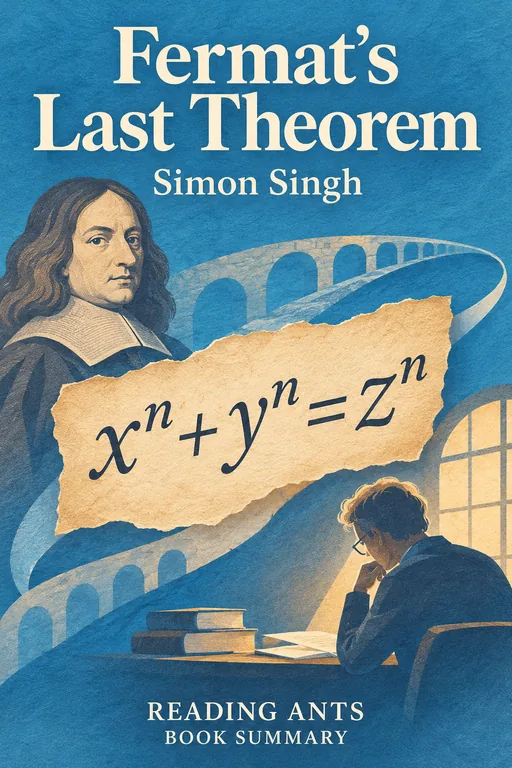
The idea: Singh begins with Pierre de Fermat, a French lawyer and amateur mathematician of the 1600s, who wrote in the margin of a book that he had found a marvelous proof that a certain equation has no solutions, but that the margin was too small to contain it. He never wrote it down. The statement, that there are no positive whole numbers x, y and z such that x to the power n plus y to the power n equals z to the power n, when n is larger than two, became known as his Last Theorem.
In real life: A note saying that a solution exists, without the work, can puzzle people for centuries.
2. Pythagoras and the roots of the problem
The idea: The author traces the puzzle back to Pythagoras, whose theorem about right triangles gives many whole-number solutions to the equation with the power two, such as three, four and five. Fermat asked what happens with higher powers, and said that there are no solutions. Singh also tells of the Greek mathematician Diophantus, whose book of problems Fermat was reading, and of the beauty of number theory, in which simple questions can hide deep answers.
In real life: A triangle with sides three, four and five is a simple example of a whole-number solution.
3. A parade of failures and partial victories
The idea: Over the centuries, many mathematicians tried to prove the theorem. Euler proved the case for the power three, Sophie Germain, who corresponded with leading mathematicians under a male pseudonym, made a major advance that covered a whole class of cases, and others extended the proof to more cases, one power at a time. But, since there are infinitely many powers, this could never complete the proof. Singh describes the frustration, and the prize that the German industrialist and amateur mathematician Paul Wolfskehl left in his will, announced in 1908, which attracted many amateurs with faulty proofs.
In real life: Solving one case at a time does not solve a problem that has infinitely many cases.
4. Modern mathematics and an unexpected connection
The idea: In the twentieth century, a different idea emerged. Two Japanese mathematicians, Yutaka Taniyama and Goro Shimura, proposed a conjecture that links two seemingly unrelated areas, elliptic curves and modular forms. Later, Gerhard Frey suggested, and Ken Ribet proved in 1986, that if the Taniyama-Shimura conjecture were true, then Fermat’s Last Theorem would follow. So, to prove the old puzzle, one had to prove a new, major conjecture, and a path appeared.
In real life: Sometimes the way to solve a puzzle is to connect it with another, seemingly unrelated field.
5. Wiles’s secret quest
The idea: Andrew Wiles, an English mathematician at Princeton who had been fascinated by the problem since he was ten, decided to take on the Taniyama-Shimura conjecture, at least for the part needed. He worked in near-total secrecy for about seven years, confiding in almost nobody except his wife. He used advanced methods from many areas of mathematics. In June 1993, he presented his proof at a conference in Cambridge, England, to astonishment and acclaim, and the news reached the world press.
In real life: Working on one big problem for years takes patience, and often privacy.
6. The gap and the repair
The idea: During the review process, a flaw was found in the proof. Wiles was dismayed, and for almost a year he worked to fix it, with the help of his former student Richard Taylor. Finally, in September 1994, they found a way, by using an approach that Wiles had earlier abandoned. The corrected proof was published in 1995, and in 1997, Wiles received the Wolfskehl prize. Singh ends with a reflection on the human drama and the power of persistence.
In real life: Finding a mistake in your work is painful, but fixing it can lead to a better result.
Why It Matters
Fermat’s Last Theorem was a bestseller, and a model of how to write about mathematics for general readers. It showed that mathematics has stories, characters and drama, and not only formulas. The proof by Wiles was a landmark in number theory, and the methods that he developed are still used. Singh’s book also helped to make Wiles a public figure, and encouraged students to pursue mathematics. It grew out of Singh’s 1996 BBC documentary on the subject, and was followed by his books on cryptography and cosmology. The book remains a favorite introduction to the beauty and difficulty of pure mathematics.
Key Takeaways
- Simple questions can be very hard. Fermat’s puzzle took centuries to solve.
- Persistence pays. Wiles worked in secret for about seven years.
- Mathematics connects. The proof linked distant branches of the subject.
- Mistakes can be fixed. The gap in the first proof was repaired.
- People drive discovery. The story is one of passion and rivalry.
What We Can Learn
You can try some of the simple number puzzles in the book, such as finding whole-number solutions for triangles. Notice how mathematicians build on earlier work, and how a single idea can unlock a problem. When you are stuck, try looking at the problem from a different angle, as the modern mathematicians did. Persist, and be willing to revise your work. And enjoy the idea that there is beauty in questions that have no obvious use, which is a good reason to study mathematics for its own sake.
Criticism and Counterpoints
Some mathematicians say that Singh simplifies the mathematics, and that the explanation of the key ideas, such as modular forms and elliptic curves, is superficial, which is inevitable in a book for the general public. Others note that the book focuses on a few heroes and glosses over the contributions of many others, and that the account of the drama of the gap is compressed. Some argue that Fermat himself likely did not have a valid proof. Still, specialists generally respect the book as a faithful and engaging account.
Who Should Read It
This book is for readers who like stories of discovery, and who are curious about mathematics, even if they have little training. It is clear and gripping. Those who want technical details of the proof will need to turn to specialized texts.
Want the whole book?
A summary is a taste, not the meal. Here is where to find the full book.
You reached the end 🎉
Nicely done. Mark this one as read, and we will suggest what to read next.
Read this next
Gödel, Escher, Bach
Douglas R. Hofstadter
Douglas Hofstadter weaves together the logician Kurt Gödel, the artist M. C. Escher and the composer J. S. Bach to explore how meaning and a sense of self can arise from systems of symbols that refer back to themselves, which he calls strange loops.
🔬 Science
The Double Helix
James D. Watson
James Watson gives a personal, frank and controversial account of how he and Francis Crick worked out the double-helix structure of DNA in 1953, and of the rivalry, luck and ambition that went with it.
🔬 Science
Longitude
Dava Sobel
Dava Sobel tells how a self-taught English clockmaker, John Harrison, spent decades building clocks that solved the problem of finding longitude at sea, and fought for recognition from the scientific establishment.
🏛️ History
A Mind for Numbers
Barbara Oakley
Barbara Oakley, who changed from a language student and soldier to an engineering professor, explains how the brain learns difficult subjects like math and science, and gives practical techniques for studying more effectively.
🔬 Science
Chaos: Making a New Science
James Gleick
Science writer James Gleick tells the story of a group of scientists who, in the 1960s and 1970s, discovered that simple systems can behave in unpredictable ways, giving birth to chaos theory and a new way of seeing complexity in nature.
🔬 Science
A Brief History of Time
Stephen Hawking
One of the world's greatest physicists explains, with almost no math, what we know about the origin, structure and fate of the universe, from the Big Bang to black holes and the nature of time itself.
🔬 ScienceWant something different?
Pick another topic and we will show you three books to start with.