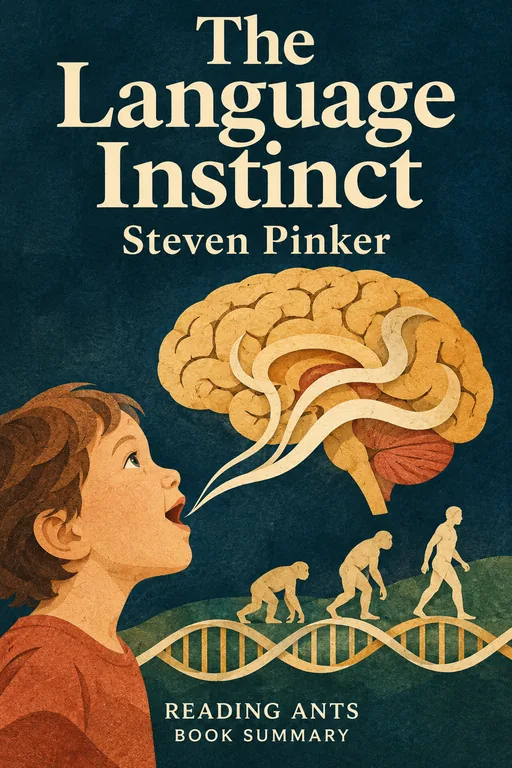
Psychologist Steven Pinker argues that language is an instinct, a specialized ability of the human brain that children acquire naturally, and not a cultural invention that is learned like other skills.
Overview
The Language Instinct: How the Mind Creates Language was published in 1994 by Steven Pinker, a cognitive scientist who taught at MIT and later at Harvard. He draws on the work of the linguist Noam Chomsky, and on research in psychology, neuroscience and evolutionary biology. The book is written for general readers, with humor and examples ranging from newspaper headlines to jokes and the speech of children. It explains what language is, how it is learned, how it works in the brain and how it evolved, and challenges popular beliefs about grammar and language.
Full Summary
1. Language as an instinct
The idea: Pinker begins by saying that language is not a cultural artifact, like the ability to tell time or to understand how a government works, but a distinct piece of the biology of the human brain, in the way that spiders know how to spin webs. Children, without formal teaching or conscious effort, acquire the complex rules of their native language in early childhood, in all cultures. He points out that there are Stone Age societies but no Stone Age languages, and that the speech of working-class people and of non-industrial peoples is as grammatically sophisticated as anyone’s. He uses the word instinct much as Darwin did, for an instinctive tendency to acquire an art, which of course still requires hearing a language. Language is unique to our species, but Pinker stresses that a unique ability is not unusual in nature, as the sonar of bats shows.
In real life: A small child picks up the rules of grammar without anyone explaining them.
2. The infinite creativity of grammar
The idea: The author explains that language is built on a system of rules for combining a finite number of words into an infinite number of sentences. We can understand and create sentences that we have never heard before, because our minds use grammar, not a memory of phrases. He shows that this cannot work as a simple chain in which each word triggers the next, because sentences contain long-distance dependencies, such as an either that must later be matched by an or. Instead, words are grouped into phrases and phrases into bigger phrases, like a tree, and the same kind of phrase can be plugged into many positions. This also explains why Chomsky’s famous sentence about colorless green ideas is grammatical and yet meaningless.
In real life: You can understand a sentence that has never been spoken before, because you know the rules.
3. How children learn language
The idea: Pinker reviews how children learn, and why it is difficult to explain without an innate predisposition. Children make systematic errors, such as putting a regular past-tense ending on an irregular verb or adding an ending that no adult around them uses, which show that they have learned a rule and apply it, and not just copied. Parents do not give grammar lessons, and in many cultures adults hardly talk to babies at all, yet the children learn. Pinker also shows how children can create structure: when speakers of different languages are thrown together, as on plantations, they develop a makeshift pidgin, and the next generation of children turns it into a full language called a creole. He describes the deaf children of Nicaragua who, after the first schools for the deaf opened in 1979, invented a signing system together, and whose younger schoolmates turned it into a more fluent and consistent language, showing that children spontaneously generate grammar.
In real life: A child who says “I goed” is using a rule that makes sense, even if it is wrong; no adult talks that way, so the child cannot be copying.
4. Universal grammar and the brain
The idea: Following Chomsky, Pinker argues that all languages share a common underlying design, a universal grammar, while differing in details. He discusses evidence from the brain, such as Broca’s aphasia, in which a stroke leaves a person alert and intelligent but unable to handle grammar, and a hereditary language impairment that runs through one British family. He also describes deaf people who learned sign language only as adults and never became as fluent as those who learned it in childhood, which points to a critical window in childhood for learning it. The idea is that the brain has a specialized system for language, distinct from general reasoning ability.
In real life: Some people with severe intellectual disabilities, such as children with Williams syndrome, speak fluently and with good grammar, which suggests that language is a separate skill.
5. Myths about language: grammar rules and dialects
The idea: Pinker criticizes the “language mavens,” self-appointed guardians of correct English, and rejects the popular belief that people’s grammar is in decline. He argues that the way people speak in non-standard dialects follows consistent grammar. He discusses Black English Vernacular, studied by the linguist William Labov, whose rules for things like negation and the dropping of the verb to be are as systematic as those of standard English. Labov also found that the great majority of sentences in everyday speech, in all social classes, are grammatical. Pinker says that every dialect is a system, and agrees with the saying that the difference between a language and a dialect depends on political and military power, not on grammar.
In real life: A double negative such as “ain’t no” follows its own rules, is normal in many languages such as French, and is not a sign of stupidity.
6. Evolution of language and the mind
The idea: The author also considers how language evolved. He argues that it is a product of natural selection, like the eye, an adaptation whose parts are designed for the important job of communicating who did what to whom, and he notes that Chomsky was skeptical about this. He also challenges the notion that language shapes thought. He examines the Sapir-Whorf idea that a person’s language determines how they think, and finds little support for it: Whorf’s claims about the Hopi were contradicted by later research on their language, and the belief that the Eskimos have a huge number of words for snow is a myth. Babies, monkeys and deaf adults who have no language show that thinking does not need words. Pinker says that people think in a language-like code that is not any particular language, which he calls mentalese, and that English sentences are too ambiguous and too vague to serve as thoughts, as newspaper headlines with two meanings show.
In real life: You can have an idea and then struggle to find the words, which suggests that thought and words differ.
Why It Matters
The Language Instinct became a bestseller, and one of the most influential popular science books on linguistics. It introduced a wide audience to the ideas of Chomsky, and the debate about nature and nurture in language. Pinker’s clear and funny explanations made the study of grammar interesting to many readers, and the novelist Ian McEwan counted it among the finest celebrations of language in science writing. It also challenged prescriptive attitudes, and encouraged greater respect for different dialects. Though some of its claims are disputed, it helped to shape cognitive science in the 1990s, and was followed by other works by Pinker.
Key Takeaways
- Language is an instinct. Children acquire it without formal instruction.
- Grammar is creative. Rules allow infinite new sentences.
- Children discover rules. Their errors reveal patterns.
- Dialects are rule-governed. No dialect is inherently inferior.
- Language evolved. Pinker argues that it is a product of natural selection, like other organs.
What We Can Learn
You can listen to the way small children speak, and notice the rules they invent. Be curious about dialects, and avoid judging people by the way they talk. Notice how you understand ambiguous sentences, and enjoy language games. Learn a second language, since children in particular pick up languages easily. And be cautious about claims that language is dying, or that texting is ruining it, since language changes in all times. Try keeping a list of new words or phrases that you hear from younger or older people, and notice how speech shifts across generations.
Criticism and Counterpoints
Many linguists and psychologists disagree with parts of Pinker’s account. Critics of Chomsky’s theory argue that there is no proof of a universal grammar, and that children may learn language by general learning mechanisms and by statistical patterns in what they hear, as shown in more recent research. Others say that the evolutionary story is speculative, and some doubt his speculations about other specialized mental modules. Pinker’s position remains influential but contested.
Who Should Read It
This book is for readers interested in language, the mind and science, and for those who enjoy wit. It is long, but very readable. Those who want a balanced view of the debate should read critics of the nativist theory as well.
Want the whole book?
A summary is a taste, not the meal. Here is where to find the full book.
You reached the end 🎉
Nicely done. Mark this one as read, and we will suggest what to read next.
Read this next
The Better Angels of Our Nature
Steven Pinker
Steven Pinker argues, with a mass of data, that violence has declined over the long course of history, and that this is one of the most important and least appreciated developments, explained by changes in institutions, culture and our better impulses.
🔬 Science
Behave
Robert M. Sapolsky
Neuroscientist Robert Sapolsky asks why humans do the best and worst things they do, and answers by working backward in time, from the second before an act to the seconds, hours, years and millennia that shaped it.
🧩 Mind & Psychology
The Brain That Changes Itself
Norman Doidge
Psychiatrist Norman Doidge tells stories of patients and scientists who show that the adult brain is not fixed but can reorganize itself, a property called neuroplasticity, and what this means for healing and learning.
🧩 Mind & Psychology
Thinking, Fast and Slow
Daniel Kahneman
Our minds run on two systems, a fast, intuitive one and a slow, careful one, and understanding how the fast system fools us can help us make better decisions about money, risk, work and happiness.
🧩 Mind & Psychology
A Brief History of Time
Stephen Hawking
One of the world's greatest physicists explains, with almost no math, what we know about the origin, structure and fate of the universe, from the Big Bang to black holes and the nature of time itself.
🔬 Science
On the Origin of Species
Charles Darwin
All living things are related and have slowly changed over immense periods of time, shaped by natural selection, the process by which individuals better suited to their environment survive and pass on their traits.
🔬 ScienceWant something different?
Pick another topic and we will show you three books to start with.