 Reading Ants
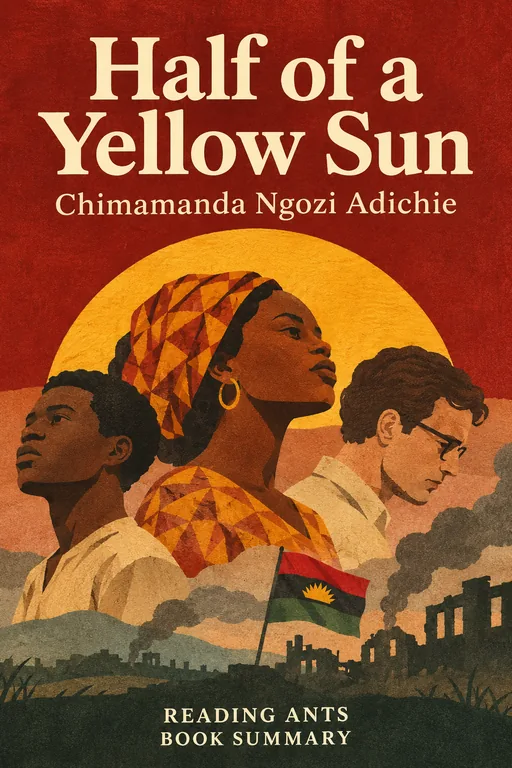
Half of a Yellow Sun
Through the intertwined lives of three people, a houseboy, a professor's lover and an English writer, the novel tells the story of Nigeria's civil war and the short-lived nation of Biafra.
Overview
Half of a Yellow Sun, by the Nigerian writer Chimamanda Ngozi Adichie, was published in 2006 and won the Orange Prize for Fiction. The title comes from the flag of Biafra, a breakaway state in southeastern Nigeria that existed from 1967 to 1970. The novel follows the lives of three main characters in the years before and during the Nigerian-Biafran War: Ugwu, a young houseboy; Olanna, a beautiful, educated woman from a wealthy family; and Richard, a shy English writer who falls in love with Olanna’s twin sister, Kainene. Their stories show how war changes love, loyalty and survival. Adichie, who was born after the war, wrote the book to honor the memory of her grandfathers, who died in it.
Main Characters
- Ugwu: a teenage boy from a poor village who becomes a houseboy and a witness to history.
- Olanna: a thoughtful woman who leaves a comfortable life in Lagos to live with her lover.
- Odenigbo: a charismatic, passionate university professor, Olanna’s lover.
- Kainene: Olanna’s tough, sarcastic twin sister, a businesswoman.
- Richard Churchill: an English writer in love with Kainene.
- Aunty Ifeka: Olanna’s aunt, who lives in the northern city of Kano.
- Mama: Odenigbo’s domineering mother.
Full Summary
The Professor’s House
In the early 1960s, shortly after Nigeria gained independence from British rule, thirteen-year-old Ugwu leaves his village to work as a houseboy for Odenigbo, a university lecturer at Nsukka. The professor’s house is alive with debate, politics and ideas. Ugwu is amazed by his employer’s books and conversations, and Odenigbo encourages him to study. Olanna, who moves in with Odenigbo and becomes his partner, treats Ugwu kindly.
Olanna comes from a rich Lagos family, and her parents expect her to marry well. Her twin sister, Kainene, who runs her father’s businesses, disapproves of Olanna’s leftist ideas but loves her. Kainene falls in love with Richard, an English writer drawn to Igbo art.
Cracks
When Odenigbo has a brief affair with a village woman, Amala, and she becomes pregnant, Olanna is furious and spends the night with Kainene’s partner, Richard, a betrayal that ends the sisters’ closeness. Eventually, Olanna forgives Odenigbo, accepts the baby, and the two are reconciled. Ugwu, who now attends school thanks to Odenigbo’s encouragement, quietly observes the mess.
Violence
In 1966, a military coup leads to ethnic violence in northern Nigeria. Igbo people living in the north are massacred. Olanna witnesses the aftermath firsthand, when she visits her uncle and aunt in the north, and she is deeply traumatized by what she sees. In the south and east, Igbo people flee home. In 1967, the Igbo-dominated Eastern Region declares independence as the Republic of Biafra.
Biafra
Olanna, Odenigbo, Ugwu and their baby move through Biafra as the Nigerian army advances, forcing them to move from town to town. Food runs out, and starvation begins, especially among the children, whose swollen bellies become the war’s most famous image. Olanna volunteers at a refugee camp, teaching children and distributing scarce supplies, while Odenigbo, who once had so much faith in ideas, struggles to find a role. Ugwu is forcibly conscripted into the Biafran army. During his service, he takes part in the gang rape of a girl, under pressure from the other soldiers, and the crime haunts him afterward. Richard, who is British and a “stranger,” stays in Biafra and writes about the war for foreign newspapers, but is told his story is not wanted.
Loss and Survival
Odenigbo becomes broken by the war, drinking heavily and losing his old confidence. Olanna’s loss grows heavier: she never forgets her aunt, uncle and cousin killed in the northern massacre, but she holds on to her baby daughter. The war leaves Olanna and Odenigbo struggling to hold onto hope, and Kainene, who runs a refugee camp, goes missing on the day she crosses into the enemy lines to buy food. Olanna searches for her in vain. Ugwu returns from the front.
After the War
When Biafra surrenders in 1970, the survivors return to what is left of their lives. Olanna still searches for Kainene, refusing to believe her dead. Richard, alone, begins to write the story of the war but gives up, deciding that this history is not his to tell. Ugwu, who has become a writer, takes it on; the novel ends with Ugwu’s own book, titled “The World Was Silent When We Died,” a bitter echo of the world’s indifference. It is left open whether Kainene will return.
Why It Matters
Half of a Yellow Sun won the 2007 Orange Prize for Fiction and was later named the “Best of the Best” of the Orange Prize’s first twenty years, in 2015. It was adapted into a 2013 film. For many readers, especially outside Nigeria, it was the first time they learned about the Biafran War, in which an estimated one to three million people, many of them children, died, mostly of starvation.
Adichie’s book restored a painful history that many Nigerian authors and officials had avoided. Her own writing, together with her widely viewed TED talks and essays, has made her one of Africa’s most influential voices. The novel is praised for putting human faces on political events.
Key Takeaways
- War destroys ordinary lives. The characters lose family, love and dignity.
- History has many sides. The conflict is told through different people’s eyes.
- Ethnic hatred is deadly. The violence of 1966 leads to the civil war.
- The world can be indifferent. International powers largely ignore Biafra’s suffering.
- Storytelling preserves memory. Ugwu’s writing ensures the dead are not forgotten.
What We Can Learn
The novel shows how quickly political division can lead to suffering, and why it is important to resist hatred based on ethnicity or religion. Learning about these wars helps us understand modern conflicts.
It also encourages us to listen to people who survived terrible events. Their stories remind us that history is not only about leaders but about families, hunger and courage.
Finally, it invites us to think about how global attention is directed. Some crises receive worldwide concern, while others, like Biafra, are overlooked. Paying attention to distant struggles is part of being a responsible global citizen.
Criticism and Counterpoints
Some critics have found the structure confusing, since the book jumps between the early and late 1960s and between viewpoints. Others have noted that the English character, Richard, is given a lot of space in a novel about Nigeria. Adichie has said she included him to show an outsider’s perspective.
The novel’s graphic scenes of violence and sexual assault are disturbing for many readers. Some have questioned whether the story simplifies the political causes of the war, favoring the Igbo viewpoint. Nonetheless, most readers regard it as an essential, powerful historical novel.
Who Should Read It
This novel suits mature teens and adults. It is long and emotionally demanding, and it contains violence and war crimes. Readers interested in African history, war and love will find it gripping and unforgettable.
Want the whole book?
A summary is a taste, not the meal. Here is where to find the full book.
You reached the end 🎉
Nicely done. Mark this one as read, and we will suggest what to read next.
Read this next
Things Fall Apart
Chinua Achebe
Okonkwo, a proud and fearsome leader in an Igbo village in Nigeria, struggles against his own fears and against the arrival of British missionaries and colonial rulers, who change his world forever.
🌍 World Literature
Americanah
Chimamanda Ngozi Adichie
Ifemelu and Obinze, young lovers in Lagos, are separated when she goes to study in America and he struggles in London, and the novel follows their years apart and their return to Nigeria, looking at race, identity and love.
✨ Modern Fiction
Purple Hibiscus
Chimamanda Ngozi Adichie
In Nigeria in the early 1990s, fifteen-year-old Kambili lives under the strict, violent religious rule of her father, until a visit to her aunt's lively home in Nsukka teaches her to laugh, to question and to speak.
✨ Modern Fiction
A Thousand Splendid Suns
Khaled Hosseini
Two Afghan women from different backgrounds, forced into the same abusive marriage, become unlikely allies, and find the strength to resist through friendship and love as their country is torn apart by war.
✨ Modern Fiction
Homegoing
Yaa Gyasi
Starting with two half-sisters in eighteenth-century Ghana who never meet, one married to a British slaver and one sold into slavery, this novel follows seven generations of each branch of their family, in Africa and America.
✨ Modern Fiction
The Kite Runner
Khaled Hosseini
A wealthy boy in Kabul betrays his loyal best friend on the day of a kite tournament, and decades later, after fleeing to America, he returns to a Taliban-ruled Afghanistan to try to make things right.
✨ Modern FictionWant something different?
Pick another topic and we will show you three books to start with.