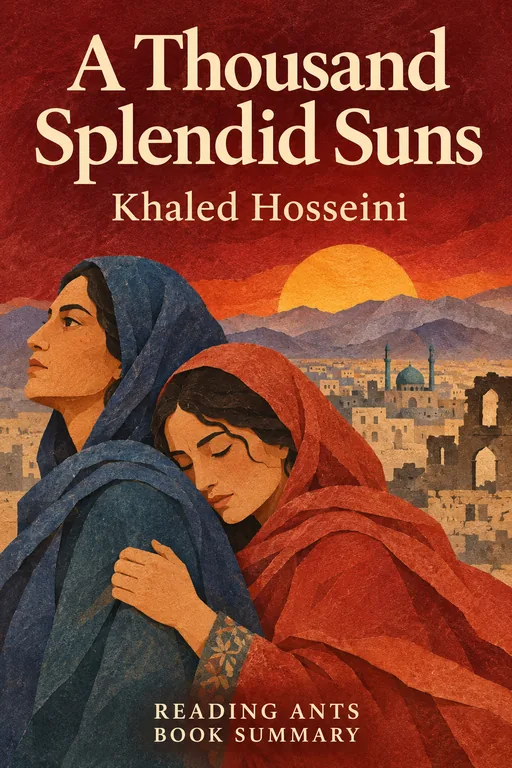
A Thousand Splendid Suns
Two Afghan women from different backgrounds, forced into the same abusive marriage, become unlikely allies, and find the strength to resist through friendship and love as their country is torn apart by war.
Overview
A Thousand Splendid Suns, Khaled Hosseini’s second novel, was published in 2007. Like his first, The Kite Runner, it is set in Afghanistan, but it focuses on the lives of women. The story follows Mariam, an illegitimate child born in a village near Herat in the 1950s, and Laila, a young woman from Kabul born in the 1970s. Over thirty years, as Afghanistan goes through the Soviet invasion, the civil war and the Taliban’s rule, their lives intertwine. The title comes from a poem about Kabul, a city of a thousand splendid suns. It is a powerful story of suffering and resilience.
Main Characters
- Mariam: a quiet, patient woman, born a “harami,” an illegitimate child.
- Laila: a clever, bold young woman from Kabul, who loves her friend Tariq.
- Rasheed: Mariam’s cruel, controlling husband, a shoemaker.
- Tariq: Laila’s childhood friend and love.
- Jalil: Mariam’s wealthy, weak father.
- Nana: Mariam’s embittered mother.
- Babi and Mammy: Laila’s gentle father and her grieving mother.
- Aziza and Zalmai: Laila’s children.
Full Summary
Mariam
Mariam grows up in a small hut near the village of Gul Daman with her mother, Nana, who was once a servant in the house of Jalil, a wealthy businessman in Herat. Jalil, who has other wives and children, visits Mariam on Thursdays and brings her gifts, but he refuses to bring her into his home. Nana warns her that the world is cruel to women, that a woman must endure like a stone, and that her father is ashamed of her.
On her fifteenth birthday, Mariam goes to Herat to see her father, who has promised to take her to the cinema. He doesn’t come. She sleeps outside his gate and, in the morning, is turned away by his servants. When she returns home, she finds that her mother has hanged herself. Jalil’s wives quickly marry Mariam off to Rasheed, a shoemaker in Kabul, thirty years older.
Marriage
At first, Rasheed seems polite. But after Mariam suffers several miscarriages, he turns cruel, forcing her to wear a burqa, beating her and treating her as a servant. Mariam endures in silence, as her mother taught her.
Meanwhile, in a nearby house, Laila grows up, the daughter of a kind teacher, Babi, who believes in education for girls. She is friends with Tariq, a boy who lost a leg to a landmine, and they fall in love. After the communist government falls, civil war breaks out in Kabul between rival warlords. Laila’s two older brothers had already been killed fighting the Soviets, leaving her mother almost paralyzed with grief.
Laila in Rasheed’s House
When Tariq’s family decides to flee to Pakistan, Laila and Tariq spend one night together. Soon after, a rocket hits her home and kills her parents, and Laila is badly injured. Rasheed and Mariam take her in. Rasheed, who does not know that she is pregnant, arranges for a man to tell her that Tariq has died, and then proposes that she marry him. Laila, who is carrying Tariq’s child and believes that he is dead, agrees, to protect her unborn baby, and lets Rasheed believe that the child is his.
At first, Mariam is hostile to the younger woman and jealous. But when Laila gives birth to a girl, Aziza, Mariam melts. Over time, Mariam and Laila become friends, then like mother and daughter. Rasheed beats both women and treats them with growing cruelty. Once the two women try to run away, but they are caught and brought back, and Rasheed punishes them harshly. When Laila has a son, Zalmai, Rasheed is overjoyed and favors the boy.
The Taliban
In 1996, the Taliban take Kabul. Women are forbidden to work, leave the house without a male relative or show their faces. Rasheed’s business fails, and he is unable to feed the family. He sends Aziza to an orphanage, where she is safe but unhappy. Laila and Mariam visit her, even though women can be beaten for traveling alone.
After years of drought and famine, Tariq, who is still alive, returns; the report of his death, it turns out, was part of Rasheed’s deception. Rasheed discovers him and, in a rage, tries to strangle Laila.
Mariam’s Choice
Mariam, seeing Rasheed about to kill Laila, takes a shovel and strikes him on the head, killing him. She hides the body, helps Laila and Tariq escape to Pakistan and decides that she must stay behind and take the blame. When she is arrested, tried by the Taliban and sentenced to death, Mariam accepts her fate with peace, saying that she has no regrets. She is executed in the football stadium, feeling that, in the end, she has done something worthy of love.
A New Day
After the Taliban fall in 2001, Laila and Tariq return to Kabul, where Laila becomes a teacher in the orphanage that once held Aziza. She is expecting another child. If it is a girl, she will name her Mariam. The novel ends with a note of hope, as Laila looks to the future with her family, in a city beginning to heal.
Why It Matters
A Thousand Splendid Suns was a massive bestseller, selling many millions of copies worldwide and translated into over forty languages. It stayed on the New York Times bestseller list for weeks and was widely read by book clubs. For many readers in the West, it provided a human face for the stories of Afghan women’s lives, especially during the Taliban’s rule.
The book has been praised for its emotional force and for highlighting issues such as forced marriage, domestic abuse and the lack of education for girls. It has also been criticized and challenged in some school systems because of its violence. Hosseini, who left Afghanistan as a child, later founded a foundation to help Afghan refugees.
Key Takeaways
- Friendship gives strength. Mariam and Laila’s bond helps them survive.
- Women’s rights matter. The novel exposes how women suffer under oppression.
- Sacrifice can be redemptive. Mariam finds worth in giving her life for Laila.
- War destroys families. Decades of conflict devastate ordinary people.
- Hope can survive. The ending shows resilience.
What We Can Learn
The novel reminds us of the value of education and the freedom to choose. Laila’s father insists that girls must learn, and it saves her life.
It also shows the importance of speaking up for people who are being abused, and of supporting survivors. The women are saved by one another.
Finally, it encourages us to learn about the lives of people in other countries. Understanding their struggles builds empathy and helps us support those who are in need, whether through donations, volunteering or simply learning more.
Criticism and Counterpoints
Some readers and critics have said the novel’s characters are too stark in their goodness or evil, with Rasheed as a pure villain and the women as saintly victims. Others have found the story melodramatic, with many coincidences.
Some Afghan readers and scholars have worried that Western readers may see it as the whole truth about Afghan men or society. Hosseini has acknowledged that his books do not represent all Afghans. The violence, particularly against women, may be too disturbing for some readers.
Who Should Read It
This novel suits mature teens and adults who can handle heavy themes. It is moving, emotional and hopeful. Readers who loved The Kite Runner will find it equally powerful, and book clubs often find it sparks long, important conversations.
Want the whole book?
A summary is a taste, not the meal. Here is where to find the full book.
You reached the end 🎉
Nicely done. Mark this one as read, and we will suggest what to read next.
Read this next
The Kite Runner
Khaled Hosseini
A wealthy boy in Kabul betrays his loyal best friend on the day of a kite tournament, and decades later, after fleeing to America, he returns to a Taliban-ruled Afghanistan to try to make things right.
✨ Modern Fiction
Half of a Yellow Sun
Chimamanda Ngozi Adichie
Through the intertwined lives of three people, a houseboy, a professor's lover and an English writer, the novel tells the story of Nigeria's civil war and the short-lived nation of Biafra.
✨ Modern Fiction
I Know Why the Caged Bird Sings
Maya Angelou
Maya Angelou tells of her childhood and youth in the segregated South and in California, a story of pain, silence and discovery in which words and books help her find her voice.
👤 Real Lives
The Color Purple
Alice Walker
Told in letters, the story follows Celie, a poor Black woman in rural Georgia who survives abuse and loss, and through the love of other women finds her voice, her independence and joy.
✨ Modern Fiction
Persepolis
Marjane Satrapi
In black-and-white comics, Marjane Satrapi tells of growing up in Iran during the Islamic Revolution and the Iran-Iraq war, then living alone in Europe and returning home, searching for where she belongs.
👤 Real Lives
The Bluest Eye
Toni Morrison
In 1940s Ohio, a poor Black girl named Pecola Breedlove, who believes that she is ugly, prays for blue eyes, and the community's failure to protect her leads to tragedy.
✨ Modern FictionWant something different?
Pick another topic and we will show you three books to start with.