 Reading Ants
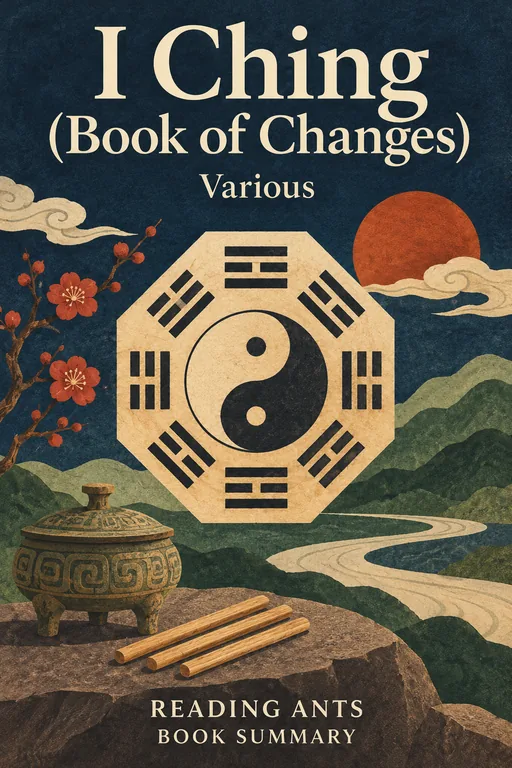
I Ching (Book of Changes)
Original title: 易经
An ancient Chinese book of sixty-four symbols, made of broken and unbroken lines, that was used to ask for guidance in times of uncertainty, and that grew into a work of wisdom about change, balance and timing.
Overview
The I Ching, also spelled Yijing, and known in English as the Book of Changes, is one of the oldest Chinese classics. Its earliest layer, a set of short texts attached to sixty-four figures called hexagrams, dates from the Western Zhou period, roughly 1000 to 750 BCE, though scholars debate when the text reached its present form. Later, a group of commentaries, known as the Ten Wings and traditionally linked to Confucius, added philosophical interpretations. No single author wrote it. For many centuries, it was used both as a manual for divination and as a source of moral and philosophical thinking, and it influenced Confucian, Daoist and later thought.
Full Summary
1. Yin and yang, broken and unbroken lines
The idea: The basis of the I Ching is a simple pair: an unbroken line, which stands for the active, firm and light principle called yang, and a broken line, which stands for the receptive, yielding and dark principle called yin. These are not good and evil, but complementary forces that depend on each other and constantly change into one another. The world, in this view, is a field of interplay between them, and wisdom lies in understanding how they shift.
In real life: Day turns into night and night into day, and neither could exist without the other.
2. Trigrams and hexagrams
The idea: Combining three lines, in every possible way, gives eight figures called trigrams, which are linked with images of nature such as heaven, earth, thunder, water, mountain, wind, fire and lake. Pairing two trigrams, one above the other, gives sixty-four hexagrams of six lines. Each hexagram stands for a kind of situation, and has a name, such as Creative, Receptive, Difficulty at the Beginning, Waiting, Conflict or Peace.
In real life: A set of sixty-four situations offers a rough map of the kinds of circumstances that we encounter.
3. Consulting the book
The idea: In traditional use, a person with a question would generate a hexagram by a random process, originally with yarrow stalks, and later with three coins tossed six times. Each toss gave a line, and some lines were marked as “changing,” which meant that they would turn into their opposite, forming a second hexagram. In one common reading, the first hexagram describes the present situation, and the second shows where things are moving. Methods differ about how to read the moving lines and the second hexagram. The reader then looks up the text for the hexagram and the changing lines.
In real life: It is a little like drawing a card at random and then reflecting on how it applies to your question.
4. The texts: images and judgments
The idea: Each hexagram has a short judgment, and each line a brief comment, written in a poetic and cryptic language, full of images such as a dragon in the sky or a person crossing a great river. The commentaries explain the images and give moral advice, such as to act with sincerity, to wait when it is not time, or to be modest in success. The advice is often conditional: it depends on the moment and on the character of the person.
In real life: Advice like “do not rush” can be right at one time, and wrong at another.
5. The philosophy of change
The idea: The Ten Wings turn the book into a philosophy. They teach that change is the basic fact of the universe, that all things are in transition, and that the wise person adapts, by understanding the patterns of change and acting at the right moment. Extremes tend to turn into their opposites, so growth is followed by decline, and difficulty by relief. The aim is harmony with the flow, and with one’s own character.
In real life: A time of great success may be a time to be careful, and a time of difficulty may be the beginning of a turn.
6. A guide for the gentleman
The idea: In the Confucian tradition, the I Ching was read as a book of moral cultivation. Each hexagram was taken to offer a lesson about how a person of integrity should behave in a given situation, whether in leadership, friendship or adversity. Its moral message, in this tradition, is that good conduct leads to good fortune, which is an ethical teaching and not a prediction.
In real life: The idea that how you act shapes what happens to you is common to many traditions.
Why It Matters
The I Ching is one of the foundational texts of Chinese civilization, and has been studied and used for nearly three thousand years. It influenced Chinese philosophy, medicine, art and politics, and was carried to Korea and Japan. In the West, it became known through translations, including Richard Wilhelm’s German translation of the 1920s and the English version by Cary F. Baynes, published in 1950 with a foreword by the psychologist Carl Jung, who saw it as an example of what he called synchronicity, meaningful coincidence. The philosopher Leibniz noted a resemblance between the hexagrams and the binary numbers. Today, it is read for its wisdom, its poetry and its picture of a world in constant change.
Key Takeaways
- Change is constant. Everything is in transition.
- Opposites complement. Yin and yang depend on each other.
- Timing matters. The right action depends on the moment.
- Extremes reverse. Growth leads to decline, and decline to renewal.
- Character shapes fortune. The book urges sincerity, modesty and balance in every situation.
What We Can Learn
Whether or not you use it for divination, you can take from the book the habit of reflecting on your situation and asking what is changing, and what action suits the moment. When things are going well, be modest and prepare for change, and when they are difficult, remember that situations shift. Pay attention to timing: sometimes patience is the best course, and sometimes boldness. Use the images as prompts for your own thinking, and decide for yourself. Remember that important life decisions should be made with real information and the advice of people you trust.
Criticism and Counterpoints
Skeptics say that divination with the I Ching has no scientific basis, and that its ambiguous language can be read to fit any situation. Scholars note that the book’s meaning has been transformed over time, and that the earliest layer was a divination manual, with later commentaries adding moral philosophy, so different versions and interpretations exist. Translations vary widely. Some traditional teachers consider it a serious spiritual tool, while others see it mainly as a literary and philosophical text. Readers should approach it according to their own judgment, and avoid relying on it for major decisions.
Who Should Read It
This book is for readers interested in Chinese culture, philosophy and symbolism, and for those who like reflective texts. It is not a continuous narrative, and is best read with a good translation and commentary. Those who prefer practical or scientific books may find it strange, but many value it as a meditation on change.
Want the whole book?
A summary is a taste, not the meal. Here is where to find the full book.
You reached the end 🎉
Nicely done. Mark this one as read, and we will suggest what to read next.
Read this next
Tao Te Ching
Laozi
The deepest wisdom is to live in harmony with the Tao, the natural way of the universe, by being humble, gentle and simple, and by acting without force.
🕊️ Philosophy & Religion
Zhuangzi
Zhuangzi
A witty collection of stories, jokes and arguments from ancient China that invites readers to loosen their fixed ideas, to follow the natural way of things and to find freedom in changing with the world.
🕊️ Philosophy & Religion
The Analects
Confucius
A good life and a good society are built on personal virtue: being kind, respectful and honest, learning constantly, honoring family, and leading others by example rather than by force.
🕊️ Philosophy & Religion
The Book of Five Rings
Miyamoto Musashi
Miyamoto Musashi, a famous Japanese swordsman, writes at the end of his life a guide to the way of strategy, in which he explains how to win in single combat and in battle, and how to master any art through discipline and awareness.
🕊️ Philosophy & Religion
The Art of War
Sun Tzu
The greatest victory is the one won without fighting, achieved through careful planning, knowing both yourself and your opponent, and using deception, flexibility and timing.
🕊️ Philosophy & Religion
Meditations
Marcus Aurelius
The private notebook of a Roman emperor, reminding himself daily to accept what he cannot control, to act with justice and kindness, and to remember that life is short.
🕊️ Philosophy & ReligionWant something different?
Pick another topic and we will show you three books to start with.