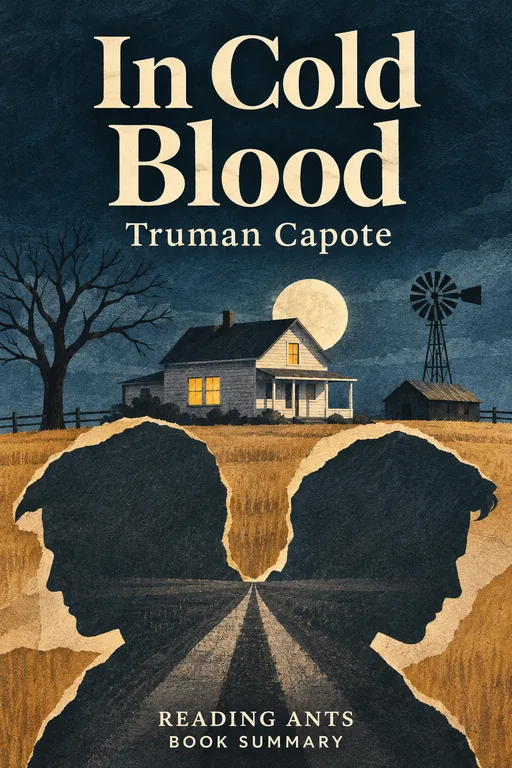
In Cold Blood
Truman Capote reconstructs the real 1959 murder of a Kansas family and the lives of the two killers, creating a landmark work that reads like a novel but is based on interviews and records.
Overview
In Cold Blood was written by the American author Truman Capote and published in 1966, after appearing in The New Yorker in installments. It tells the story of the murder of the Clutter family, who lived on a farm near Holcomb, Kansas, in November 1959, and of the two men who committed the crime, Richard Hickock and Perry Smith. Capote spent years researching the case, interviewing the investigators, townspeople and the killers themselves, with the help of his childhood friend, the writer Harper Lee. He called the book a “nonfiction novel,” a new form that applied the techniques of fiction to true events. It became a bestseller and a landmark of true-crime writing.
Full Summary
1. The Clutters and a quiet town
The idea: The book opens in Holcomb, a small farming community, and describes the Clutter family: Herbert, a respected and prosperous farmer; his wife Bonnie, who suffers from depression; and their teenage children Nancy and Kenyon. The Clutters are portrayed as a decent, hardworking family, well liked in the town. Capote lingers over their ordinary final day, building the contrast between the calm life of the town and the violence about to arrive. On the morning of November 15, 1959, the family is found dead.
In real life: The shock of the crime came partly from its being so unexpected in a place where people often left their doors unlocked.
2. The killers
The idea: In alternating sections, Capote introduces Dick Hickock and Perry Smith, two men who met in prison. Hickock heard from a former cellmate that Herbert Clutter kept a large amount of money in a safe at his home, and he persuaded Smith to join him in a robbery. In truth, there was no such safe, and the men found little to steal. Capote gives each a detailed background: Hickock as a charming but unscrupulous man, and Smith as a sensitive, damaged person with a hard childhood.
In real life: The crime was driven by a false rumor, a sad reminder that a few words of gossip can lead to a tragedy.
3. The investigation
The idea: The Kansas Bureau of Investigation, led by agent Alvin Dewey, pursues the case with few clues. The detectives search for motives and suspects, and the town grows fearful, with neighbors suspecting each other. Meanwhile, Hickock and Smith flee to Mexico and then drift across the United States, writing bad checks and living on the run. The same former cellmate who had told Hickock about the supposed safe eventually contacts the authorities, which gives the investigators their first real lead.
In real life: Many real-life cases are solved not by brilliant guesses but by persistence, tips and checking records.
4. Capture and confession
The idea: After weeks of travel, Hickock and Smith are arrested in Las Vegas at the end of December 1959. They are questioned and confess, and Smith describes the crime in detail, saying that he killed the family members. Capote shows their different reactions: Hickock tries to appear unconcerned, while Smith shows remorse and complexity. The book prompts readers to think about how people capable of such an act can also seem ordinary or even sympathetic.
In real life: The case shows how difficult it can be to understand why a person commits terrible acts.
5. Trial and years on death row
The idea: The two men are tried in Garden City, Kansas, in 1960 and found guilty. The defense argues that they were mentally unstable, but under the legal standard of the time, this was not enough, and they are sentenced to death. The final part of the book follows their years in prison on death row, with appeals that fail. Capote developed close relationships with both men, especially Smith, and these years give the book a reflective tone about justice and punishment.
In real life: The long gap between sentence and execution is part of the continuing debate about the death penalty.
6. The execution
The idea: Hickock and Smith are hanged in April 1965 at the Kansas State Penitentiary. Capote describes their last hours and the reactions of those present. The book ends with a quiet scene in the cemetery in Holcomb, where Dewey meets a friend of Nancy Clutter and reflects on the lives lost. The ending leaves readers to wrestle with questions about justice, revenge and the meaning of the case.
In real life: Whatever one’s view about capital punishment, the finality of an execution raises serious moral questions.
Why It Matters
In Cold Blood helped establish the modern true-crime genre and is a founding example of narrative or “creative” nonfiction, where real events are told with the style of a novel. It was a huge commercial and critical success and was adapted into a film in 1967. It also influenced later writers and journalists and sparked a lasting debate about how closely nonfiction should follow the facts.
The book’s focus on the killers as human beings, and not just as monsters, also changed how many people thought about crime, mental illness and punishment.
Key Takeaways
- Fact can read like fiction. Capote helped create narrative nonfiction.
- Crime has human faces. Both victims and killers are shown in detail.
- Rumors can have deadly effects. A false tip led to a tragedy.
- Justice raises hard questions. The book makes readers think about punishment.
- Research takes patience. Capote spent years on the story.
What We Can Learn
The book shows that understanding a crime means looking at the people involved, including the victims and the community, without excusing anything. Seeing the case from several sides helps us think about how violence affects everyone it touches.
It also illustrates the power and responsibility of storytelling. When writers tell true stories, the way they arrange details shapes how readers feel, so readers should stay alert to how a story is told.
Finally, it invites us to think about justice: how a society responds to terrible acts, what role mental health should play and whether punishment achieves its goals.
Criticism and Counterpoints
Critics have questioned how accurate the book is. Capote claimed that everything in it was true, but later investigations and the notes of people involved suggest that he invented or rearranged some scenes and dialogues, including parts of the ending. Some people in Holcomb and investigators involved in the case felt that he portrayed events inaccurately.
There is also criticism of Capote’s closeness to the killers and the idea that he benefited from the case, and a debate over whether he could have done more to help them. The graphic nature of the murders disturbs many readers. Even so, the book is still widely respected as a masterpiece of style and an influential work.
Who Should Read It
This book suits mature teenagers and adults who can handle disturbing subject matter. It is a gripping read, but the crime scenes are upsetting. Readers should be aware that some details were shaped by the author’s imagination.
Want the whole book?
A summary is a taste, not the meal. Here is where to find the full book.
You reached the end 🎉
Nicely done. Mark this one as read, and we will suggest what to read next.
Read this next
To Kill a Mockingbird
Harper Lee
In a small Alabama town in the 1930s, young Scout Finch watches her father, a lawyer, defend a Black man falsely accused of a crime, and learns hard lessons about prejudice, courage and seeing the world through other people's eyes.
📜 Classics
Sapiens: A Brief History of Humankind
Yuval Noah Harari
Humans came to rule the planet not because we are the strongest animals but because we can believe in shared stories (gods, nations, money, companies) that let millions of strangers cooperate.
🏛️ History
Guns, Germs, and Steel
Jared Diamond
Some societies came to conquer others not because their people were smarter or better, but because geography gave them a head start in farming, animals, germs and technology.
🏛️ History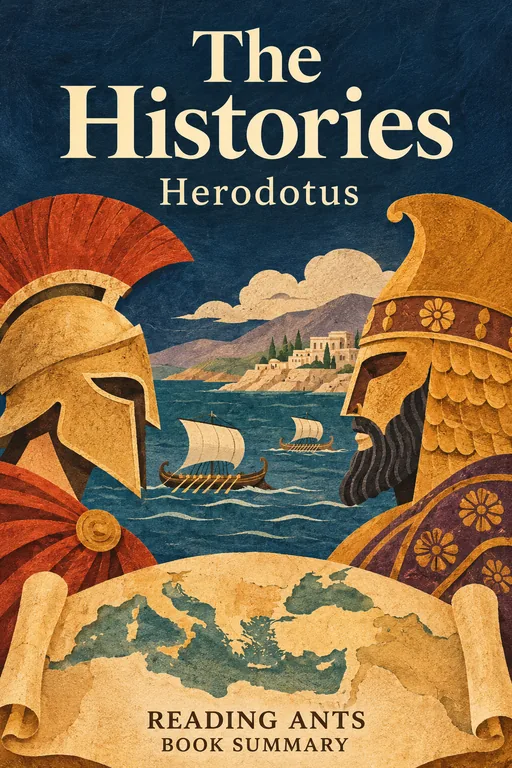
The Histories
Herodotus
Herodotus, often called the father of history, tells how the Greeks and the Persians came into conflict and fought the great wars of the early fifth century BCE, with long, colorful detours into the lands, customs and legends of the known world.
🏛️ History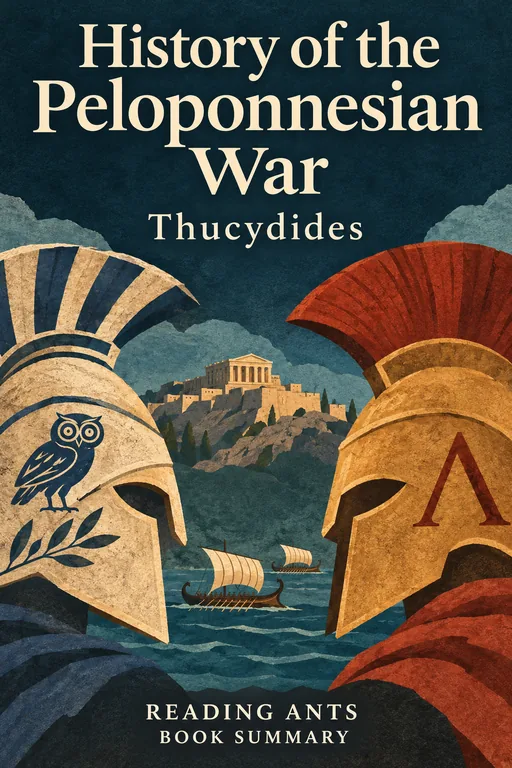
History of the Peloponnesian War
Thucydides
Thucydides, an Athenian general turned historian, records the long war between Athens and Sparta in the fifth century BCE and uses it to study power, fear, politics and how human nature behaves in crisis.
🏛️ History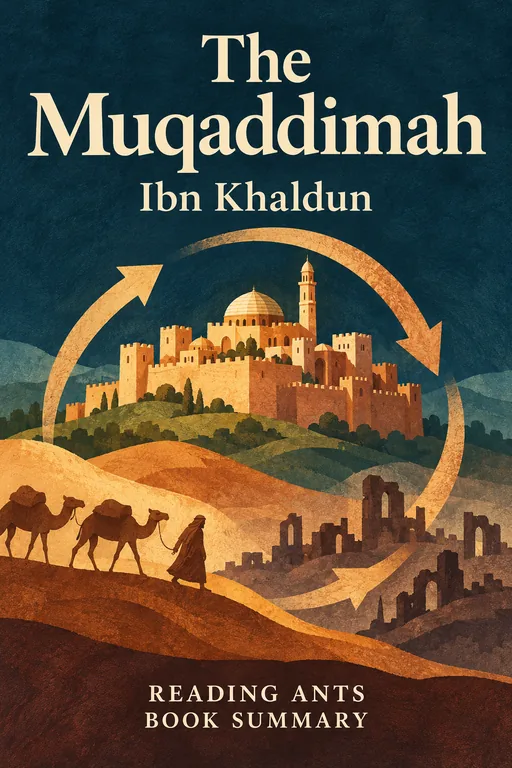
The Muqaddimah
Ibn Khaldun
Ibn Khaldun, a North African scholar of the fourteenth century, sets out a pioneering theory of how societies are organized, how states rise and fall, and how economies work, as an introduction to a larger history of the world.
🏛️ HistoryWant something different?
Pick another topic and we will show you three books to start with.