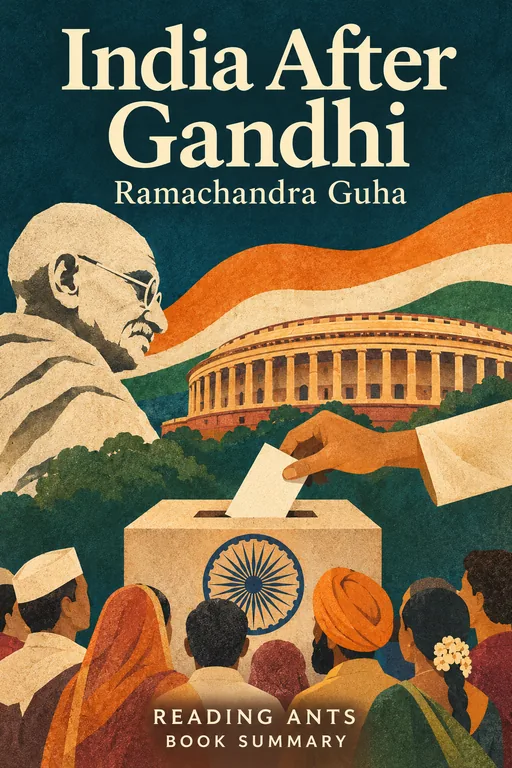
India After Gandhi
Historian Ramachandra Guha tells the story of independent India from 1947 to the early twenty-first century, and explains how such a huge, diverse and poor country has remained a democracy against many predictions.
Overview
India After Gandhi: The History of the World’s Largest Democracy was published in 2007 by Ramachandra Guha, an Indian historian and writer. It begins with the independence and partition of India in 1947, and follows the nation through its wars, crises, elections and economic changes. Guha calls India an “unnatural” nation (the title of his prologue), because many observers in 1947 believed that a country with so many languages, religions and castes, and with so few people who could read, could not stay united or democratic. He draws on the private papers of important Indian figures, newspaper records and other archives.
Full Summary
1. Independence and partition
The idea: In August 1947, British rule ended, and the subcontinent was divided into two states, India and Pakistan, mostly on religious lines. The partition caused huge violence between communities, in which hundreds of thousands were killed, and millions of people fled across new borders. Guha describes the grief and chaos, and the leadership of figures such as Jawaharlal Nehru and Vallabhbhai Patel. Mahatma Gandhi was assassinated in January 1948, by a Hindu extremist, which shocked the new country.
In real life: A sudden breakup of a community into two parts leaves families split and wounds that last for generations.
2. Making a union and a constitution
The idea: The new government had to bring more than five hundred princely states into the Indian union, which Vallabhbhai Patel and his adviser V. P. Menon did mainly through negotiation and pressure. A constituent assembly, in which B. R. Ambedkar, a leader from a community that had been treated as untouchable, played a key role, wrote a constitution that guaranteed equal rights, universal adult voting and many freedoms. Guha shows how remarkable it was to give the vote to millions of poor and illiterate citizens.
In real life: Giving every person a voice, even those who were never asked before, is an act of trust in people.
3. The Nehru years and the first tests
The idea: The first general election of 1951 and 1952 was a huge task, organized across rivers and villages. Nehru, as prime minister, promoted a mixed economy with heavy industry, secular politics and a non-aligned foreign policy. Guha also describes the dispute over Kashmir, the struggles over languages, which led to the redrawing of state boundaries to reflect them, and the defeat in a war with China in 1962, which shook Nehru’s reputation.
In real life: A new institution faces its hardest tests early, and how it handles them shapes its future.
4. Indira Gandhi and the Emergency
The idea: After Nehru died in 1964, and his successor Lal Bahadur Shastri died two years later, his daughter Indira Gandhi became a powerful prime minister. She won a war with Pakistan in 1971, which led to the creation of Bangladesh, but later faced protests and a legal ruling against her election. In 1975, she declared a state of Emergency, in which civil liberties were suspended, critics were jailed and the press was censored. In elections in 1977, voters rejected her. Guha treats the Emergency as a serious rupture, and the 1977 vote as a sign that Indian democracy could recover.
In real life: When power is abused, a community with the right to vote can still correct it.
5. Caste, religion and regional politics
The idea: In later decades, Guha traces the rise of regional parties, movements of lower castes demanding a share of power and jobs, and the growth of Hindu nationalism. The destruction of a mosque at Ayodhya in 1992 led to riots and tension. He also discusses violent insurgencies in the northeast, in Punjab and Kashmir, and the radical Maoist movement. He shows how Indian politics became more diverse and sometimes more divided.
In real life: A country that holds many different groups together has to keep negotiating how power and respect are shared.
6. Liberalizing the economy and the rise of a new India
The idea: In 1991, after an economic crisis, the government of P. V. Narasimha Rao, with Manmohan Singh as finance minister, loosened controls on business and trade, and the economy began to grow faster. Guha describes how cities, technology and the middle class expanded, while many still lived in poverty. He ends with a mixed picture: a country that has held together as a democracy and has made progress, but still faces problems of inequality, corruption and conflict.
In real life: Growth can raise many people’s lives, but it does not reach everyone equally unless there is attention to who is left out.
Why It Matters
India After Gandhi is a major history of modern India, and it has been widely praised for its detail and its readability. It gives the story of the country not just through leaders but through ordinary people, social movements and regional conflicts. For readers outside India, it explains a large part of the world that is often poorly understood. For Indian readers, it offers a way of seeing the nation’s journey with its triumphs and failures. The book also addresses a global question: how can democracy survive in a poor and diverse society? Guha’s account, which credits a constitution that made room for India’s diversity and the resilience of its institutions and people, remains relevant.
Key Takeaways
- India’s democracy was unlikely. Many predicted failure, yet it endured.
- Institutions matter. Elections, courts and a free press helped to correct abuses.
- Diversity creates tension and richness. Language, caste and religion shape politics.
- Leaders can strengthen or damage democracy. The Emergency showed both the danger and the resilience.
- Development is uneven. Economic growth has brought progress and left gaps.
What We Can Learn
Reading this history can help us to see that democracy is not automatic, and requires continual care by citizens. It shows how difficult it is to unite many communities, and why respect for minorities is important. You can learn about the history of another country as a way to understand your own. Notice how the news about a country fits into a longer story. And ask how institutions in your own community, such as elections and local councils, are kept strong by ordinary people.
Criticism and Counterpoints
Some critics say that Guha, a liberal and secular thinker, gives a view that favors the Nehruvian tradition, and that he is harshest on the decline that followed it. One reviewer argues that he explains failures too often as a lack of political will, when powerful interests and structures also played a part, and that he looks at religion mainly through law and political parties. The sheer size of the work means that many topics are covered quickly. Readers should treat it as a thorough guide, with the usual caution about the author’s perspective.
Who Should Read It
This book is for readers interested in Indian history, politics and democracy. It is long, but divided into clear sections and written in an accessible style. Those who want a short introduction might choose a brief history of India, and those who want a specific view of a region or event should add specialized books.
Want the whole book?
A summary is a taste, not the meal. Here is where to find the full book.
You reached the end 🎉
Nicely done. Mark this one as read, and we will suggest what to read next.
Read this next
The Discovery of India
Jawaharlal Nehru
Written in prison by Jawaharlal Nehru, later India's first prime minister, this book is a sweeping and personal exploration of India's long history, culture and character, and of what it means to be an Indian.
🏛️ History
Long Walk to Freedom
Nelson Mandela
Nelson Mandela tells his own story, from a village childhood to twenty-seven years in prison to becoming South Africa's first democratically elected president, and shows how patience, courage and forgiveness helped end apartheid.
👤 Real Lives
The God of Small Things
Arundhati Roy
In Kerala, India, a pair of twins grows up in a divided family where a forbidden love across caste lines leads to a tragedy that haunts them for the rest of their lives.
✨ Modern Fiction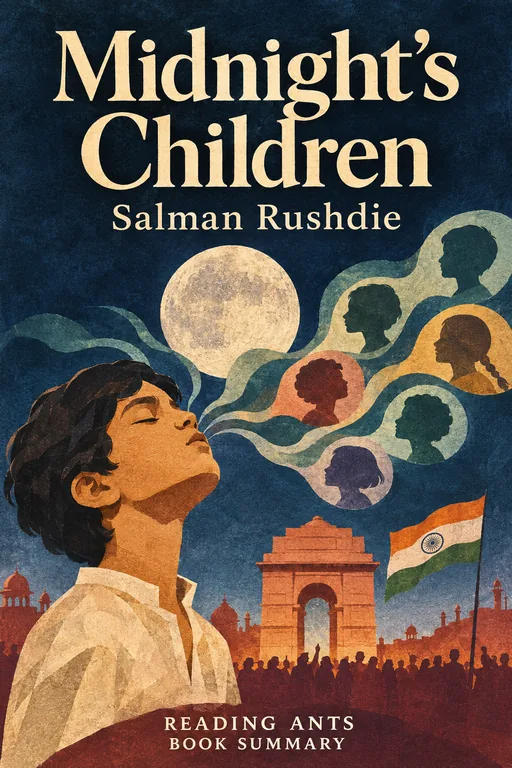
Midnight's Children
Salman Rushdie
Born at the exact moment India became independent, a boy named Saleem Sinai discovers that his life is mysteriously linked to the nation's history, and tells his story as a wild mix of family saga, politics and magic.
✨ Modern Fiction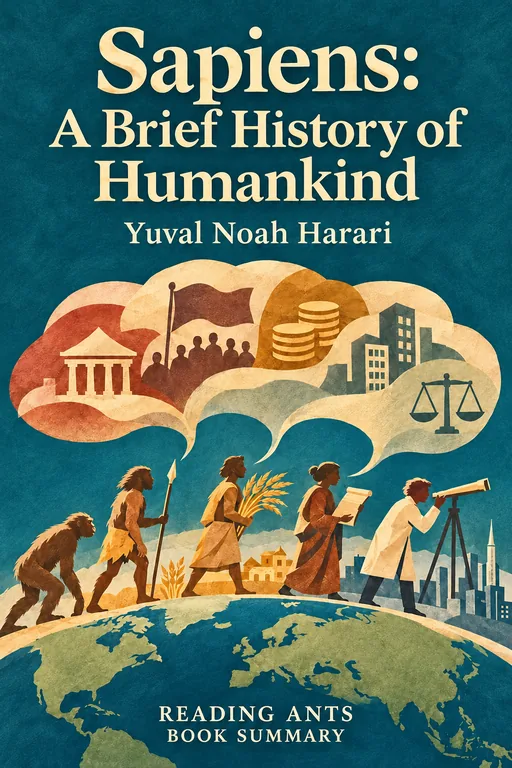
Sapiens: A Brief History of Humankind
Yuval Noah Harari
Humans came to rule the planet not because we are the strongest animals but because we can believe in shared stories (gods, nations, money, companies) that let millions of strangers cooperate.
🏛️ History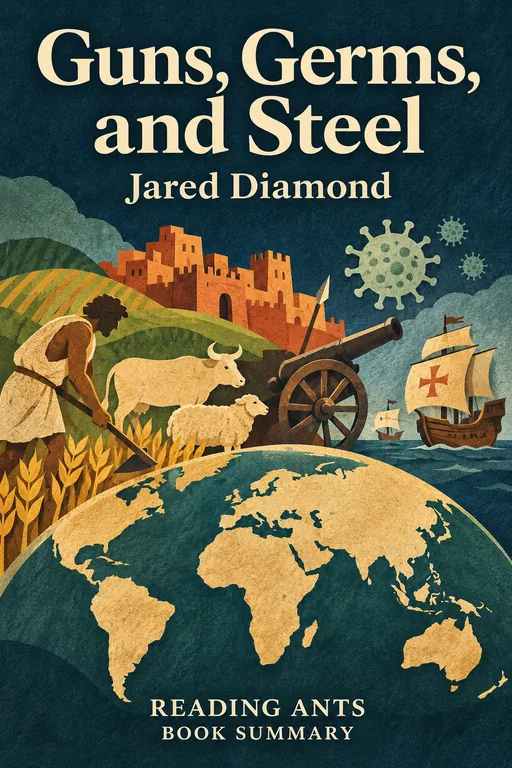
Guns, Germs, and Steel
Jared Diamond
Some societies came to conquer others not because their people were smarter or better, but because geography gave them a head start in farming, animals, germs and technology.
🏛️ HistoryWant something different?
Pick another topic and we will show you three books to start with.