 Reading Ants
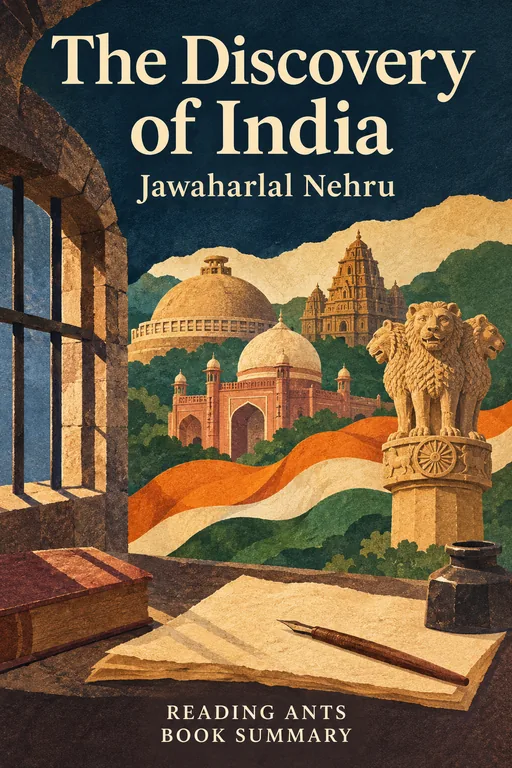
The Discovery of India
Written in prison by Jawaharlal Nehru, later India's first prime minister, this book is a sweeping and personal exploration of India's long history, culture and character, and of what it means to be an Indian.
Overview
The Discovery of India was written while Nehru was imprisoned by the British at Ahmednagar Fort, a period that ran from August 1942 to March 1945, after the Indian National Congress launched the Quit India movement. He wrote the book by hand in about five months, from April to September 1944, helped by long talks with his fellow prisoners, who included scholars such as Maulana Abul Kalam Azad. The book was published in 1946, a year before India became independent. It mixes history, philosophy and autobiography. Nehru wanted to understand the country he was fighting for, and to explain it to himself and to others. He also reflected on the choices that India faced.
Full Summary
1. A search for a country
The idea: Nehru opens in Ahmednagar Fort, writing about life in prison, the war and the terrible famine in Bengal, and about how a prisoner can feel cut off from the present and surrounded by the past. He then asks himself what India really is, what gave it strength in the past, and how it fits into the modern world. He says that India is difficult to define, with its enormous variety of peoples, languages and beliefs, and yet it has a strong sense of continuity. He compares India to an ancient manuscript on which layer upon layer of thoughts has been written, none of which has fully hidden the ones below.
In real life: A town has many layers: old buildings, new shops, customs of the past, and each tells part of the story.
2. The ancient roots
The idea: Nehru traces the story back to the earliest cities of the Indus Valley, the writings of the Vedas and the epics, such as the Mahabharata and the Ramayana, which still live in the minds of people. He writes with admiration for the philosophy of the Upanishads, and the teaching of the Buddha, and for the ruler Ashoka, who, after a bloody war, turned toward peace and tolerance. He says that these formed a base of values, such as respect for different paths and the value of reason.
In real life: Old stories and teachings may still guide the way that people think about right and wrong.
3. Unity in diversity
The idea: A central idea of the book is that, despite great differences, India has a deep cultural unity. Nehru argues that over the centuries, various peoples came, from the Greeks and Central Asians to Arabs and Persians, and that they were absorbed into a shared civilization. He is particularly interested in the periods of cultural mixing, such as the Mughal era, with rulers like Akbar, whom he pictures in debate with the learned of all faiths, and the new arts and languages that resulted.
In real life: A school with students from many backgrounds may become richer in its music, food and ideas.
4. Decline and foreign rule
The idea: Nehru discusses how India, once rich and creative, fell under foreign control. He says that the arrival of the British East India Company and then the British government brought about a long period of exploitation, in which Indian industry, such as textiles, was damaged and wealth was moved abroad. He writes with anger about poverty and famine, and he argues that India’s loss of freedom led to a loss of confidence and creativity.
In real life: A group that has its voice taken away may find it hard to use its talents.
5. The freedom struggle and Gandhi
The idea: The book describes the growth of the national movement, with the Indian National Congress and, above all, Mahatma Gandhi, whom Nehru admires, though he does not always agree with him. He writes about the idea of nonviolent resistance, which he says gave ordinary Indians a way to take part. He reflects on the tensions with religious communities, and the hope that a free India could find a way to bring them together.
In real life: A peaceful protest that many people join can show a strength that force cannot.
6. Science, modernity and the future
The idea: Nehru stresses the need for India to combine its own heritage with the best of modern science and technology. He believes that scientific thinking, planning and industry are necessary to remove poverty, and that superstition and rigid customs should give way to reason. At the same time, he does not want India to lose its soul. In the last chapters, he looks to a future in which a free India would work with other nations for peace.
In real life: A family may keep its traditions and also learn new skills that help it in the present.
Why It Matters
The Discovery of India is one of the classic texts of Indian nationalism and of modern Indian thought. It offers a view of the nation’s past from the eyes of the man who would become its first prime minister, and it influenced how generations of Indians understood their history and identity. The book’s ideas of unity in diversity, secularism and scientific temper became part of the vocabulary of the new republic. It was also adapted into a television series. Scholars still use the book to understand Nehru’s thought and the intellectual background of independence, and it continues to be read by those who want to see how a leader thought about his country.
Key Takeaways
- India is layered. Many cultures have contributed to its civilization.
- Unity can come from diversity. Shared life has blended different traditions.
- Colonial rule did harm. Nehru stresses its economic and spiritual costs.
- Reason and science are needed. Modernization must tackle poverty and superstition.
- Look to the future. A new nation must combine its roots with new ideas.
What We Can Learn
The book invites us to try the same exercise: to ask what has shaped our own country or community, and what we value in it. We can learn to respect different traditions, and to look for what holds people together. Nehru’s willingness to question and to think while in prison also shows that time of hardship can be used for reflection. At the same time, we can read critically, understanding that the picture of a nation drawn by a leader is shaped by his hopes and his time.
Criticism and Counterpoints
Historians point out that Nehru wrote the book in about five months in prison, relying largely on his reading, memory and conversation, and that his portrait of the past is sometimes romantic and selective. His emphasis on unity and on a single Indian civilization has been questioned by those who say that it downplays conflict, caste inequality and regional differences. Critics from several viewpoints have also said that his picture of India did not fully reflect the experience of every community. Nevertheless, the book is valued as a document of its time.
Who Should Read It
This book is for readers interested in Indian history, politics and thought, and for those who like reflective writing by a statesman. It is long and sometimes dense. Readers who want an up-to-date history should combine it with modern scholarship, and may like to read selected chapters.
Want the whole book?
A summary is a taste, not the meal. Here is where to find the full book.
You reached the end 🎉
Nicely done. Mark this one as read, and we will suggest what to read next.
Read this next
India After Gandhi
Ramachandra Guha
Historian Ramachandra Guha tells the story of independent India from 1947 to the early twenty-first century, and explains how such a huge, diverse and poor country has remained a democracy against many predictions.
🏛️ History
Long Walk to Freedom
Nelson Mandela
Nelson Mandela tells his own story, from a village childhood to twenty-seven years in prison to becoming South Africa's first democratically elected president, and shows how patience, courage and forgiveness helped end apartheid.
👤 Real Lives
Midnight's Children
Salman Rushdie
Born at the exact moment India became independent, a boy named Saleem Sinai discovers that his life is mysteriously linked to the nation's history, and tells his story as a wild mix of family saga, politics and magic.
✨ Modern Fiction
The God of Small Things
Arundhati Roy
In Kerala, India, a pair of twins grows up in a divided family where a forbidden love across caste lines leads to a tragedy that haunts them for the rest of their lives.
✨ Modern Fiction
Sapiens: A Brief History of Humankind
Yuval Noah Harari
Humans came to rule the planet not because we are the strongest animals but because we can believe in shared stories (gods, nations, money, companies) that let millions of strangers cooperate.
🏛️ History
Guns, Germs, and Steel
Jared Diamond
Some societies came to conquer others not because their people were smarter or better, but because geography gave them a head start in farming, animals, germs and technology.
🏛️ HistoryWant something different?
Pick another topic and we will show you three books to start with.