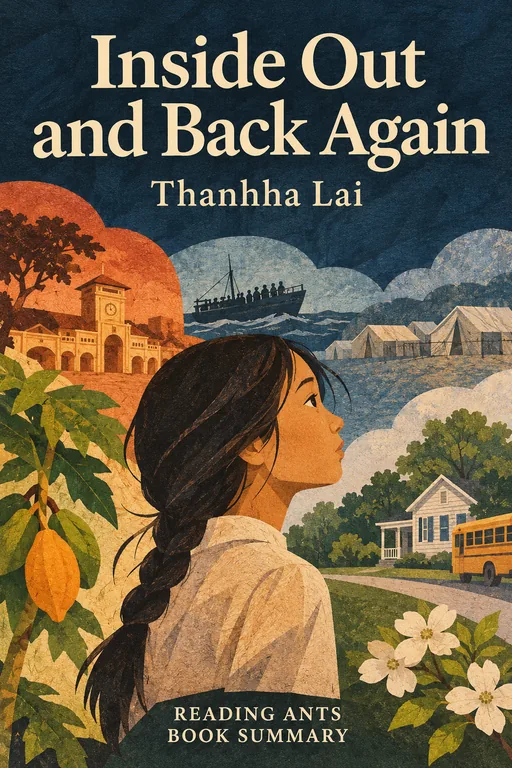
Inside Out and Back Again
In short poems, a ten-year-old Vietnamese girl named Hà describes fleeing Saigon in 1975, living in a refugee camp and starting a new life in Alabama, where she learns a strange new language and a new way of life.
Overview
Inside Out & Back Again is a novel written in free verse by Thanhha Lai, published in 2011. It won the National Book Award for Young People’s Literature and was a Newbery Honor book. The story is based on Lai’s own childhood: she was born in Vietnam and left with her family in 1975, at the end of the Vietnam War, when she was ten, and settled in Alabama. The book follows a year in the life of Hà, a girl who loves her papaya tree and her home, as she moves from Saigon to a boat, then a camp, and finally to a small American town. The short poems give a vivid, honest and often funny picture of what it feels like to be a newcomer.
Main Characters
- Hà: the narrator, a spirited, observant ten-year-old girl who is full of questions.
- Mother: a strong, loving woman who works hard to keep the family together.
- Khôi, Vũ and Quang: Hà’s brothers, who protect and tease her.
- Father: a naval officer who was missing in action and is not with them.
- Miss Washington: a kind, patient retired teacher who lives nearby and helps Hà learn English.
- Cowboy: the Alabama man, nicknamed for his hat, who sponsors the family and lets them settle near his home.
- Pink Boy and other bullies: classmates who tease Hà.
Full Summary
Saigon Before the Fall
Hà lives in Saigon with her mother and three older brothers. Her father, who was in the navy, has been missing for years, and the family waits for news. Hà loves her papaya tree, which she watches grow, and the sweet taste of fruit, and she loves Tết, the Vietnamese New Year. But the war is coming closer to the city. As the news grows worse, the family feels danger. Mother faces a decision: they cannot wait any longer, and must leave.
Leaving
The family sets off in a rush, carrying only a few belongings. Hà has to leave her beloved tree and her friends behind, and says goodbye to her home. They board a crowded ship, and as they move away, they see their city fade. On the ship, the family is cramped and short of food. Hà struggles with fear and uncertainty about what will happen to them, but she holds onto the memories of home. She tries to remain brave for her mother, but she is only a child.
The Camp
After a long, hard trip, the family is taken to a refugee camp on Guam, and later flown to Florida. There are many people waiting for a place to go, and Hà sees the sadness of people who have lost everything. They must find sponsors who will take them in. Mother finds that to leave the camp, they must be sponsored by a person in the United States. Hà dreams of a place where her family can be safe.
Alabama
A man in Alabama, whom the children nickname Cowboy for his hat, agrees to sponsor them. Hà finds herself in a small town, where everything is unfamiliar: the houses, the food and the weather. She discovers that people are curious, but some are not kind. At school, Hà cannot understand English, and a boy teases her cruelly, calling her names and bullying her. She finds the language very hard, with its odd rules and strange sounds, and has to fight to learn it. The poems show her frustration and her sharp humor.
Learning and Belonging
A kind older neighbor, Miss Washington, a retired teacher, is patient with Hà, and helps her to learn English, and she gives her comfort. Hà makes slow progress and learns to defend herself. Her brothers help, too, each in his own way, including Quang, who is clever with machines. At home, the family clings to their traditions, and the mother works to keep the household together. Hà begins to see that she can belong to two worlds.
A New Year
By the end of the story, a year has passed, and the family celebrates Tết in their new country, with a few simple treats. Hà reflects that she no longer feels like a stranger in her own life. The family holds a ceremony to mourn her father, who is presumed dead, and her old home is gone, but she and her family have survived and begun to build something new. Hà finds hope, and the book closes on a gentle note of acceptance and strength.
Why It Matters
Inside Out & Back Again gave young readers a first-person view of the experience of refugees, in a form that is easy to read and moving. It was praised by critics and widely used in classrooms to discuss immigration and empathy. Thanhha Lai’s own story as a Vietnamese refugee who became a writer adds to its value.
The book helped bring attention to the Vietnamese American experience in children’s literature, and it showed that a novel in verse can be both short and powerful. It is often paired with other refugee stories.
Key Takeaways
- Starting over is hard. Hà has to learn everything again.
- Language can be a barrier and a bridge. Learning English opens doors.
- Family keeps people strong. Hà and her brothers rely on each other.
- Kindness matters. A kind teacher and neighbors help.
- Home is carried inside. Memories and traditions stay with us.
What We Can Learn
The book helps us imagine what it is like to leave a home and arrive in a place where everything is different. It can make us kinder to newcomers in our schools and neighborhoods.
It also shows how important small acts of welcome are. A patient teacher or a friendly neighbor can make a big difference to someone who is struggling.
Finally, it reminds us that courage can be quiet. Hà does not fight a war, but she shows bravery every day by trying again.
Criticism and Counterpoints
Some readers find the verse format sparse, and wish for more detail about the war and its causes, or about Vietnamese culture. Others point out that the book presents a single family’s experience, which cannot represent all refugees, and that the American characters sometimes appear in simple ways, either very cruel or very kind.
A few critics say the humor can make the hard parts seem lighter, and that the ending is quick. Because the book is brief, it leaves many questions unanswered. Still, it is considered an authentic and touching story.
Who Should Read It
This book suits children from about age eight, and also adults. The poems are short and easy to read, and the subject can open conversations about war and immigration. Some scenes of bullying and loss may be upsetting.
Want the whole book?
A summary is a taste, not the meal. Here is where to find the full book.
You reached the end 🎉
Nicely done. Mark this one as read, and we will suggest what to read next.
Read this next
Refugee
Alan Gratz
Three children, in three different times and places, flee danger by sea, and their stories show the courage and the cost of being a refugee.
🎒 Young Adult
A Long Walk to Water
Linda Sue Park
Two young people in Sudan, twenty-three years apart, are linked by their search for water, in a story inspired by the real life of Salva Dut.
🎒 Young Adult
Number the Stars
Lois Lowry
In 1943, a ten-year-old Danish girl named Annemarie helps her Jewish best friend Ellen escape from Nazi-occupied Copenhagen by pretending that Ellen is her sister and by helping with a daring rescue.
🧸 Children's Books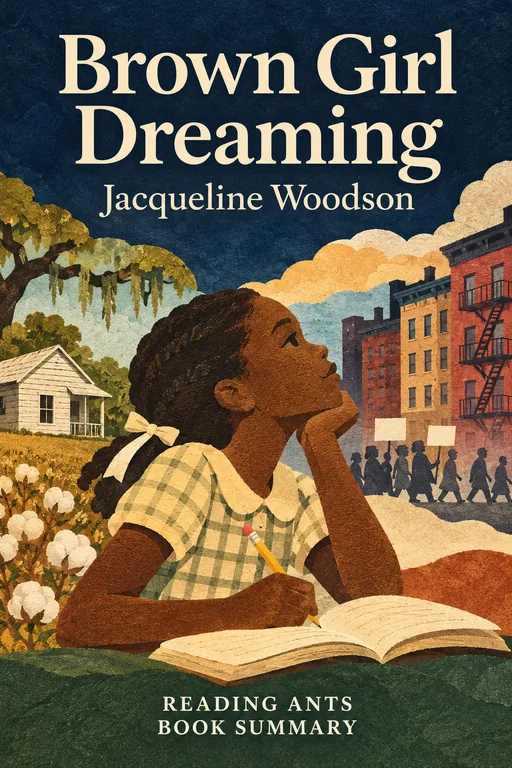
Brown Girl Dreaming
Jacqueline Woodson
A poet tells the story of her childhood in the 1960s and 1970s, moving between South Carolina and New York, and discovering her love of words.
🎒 Young Adult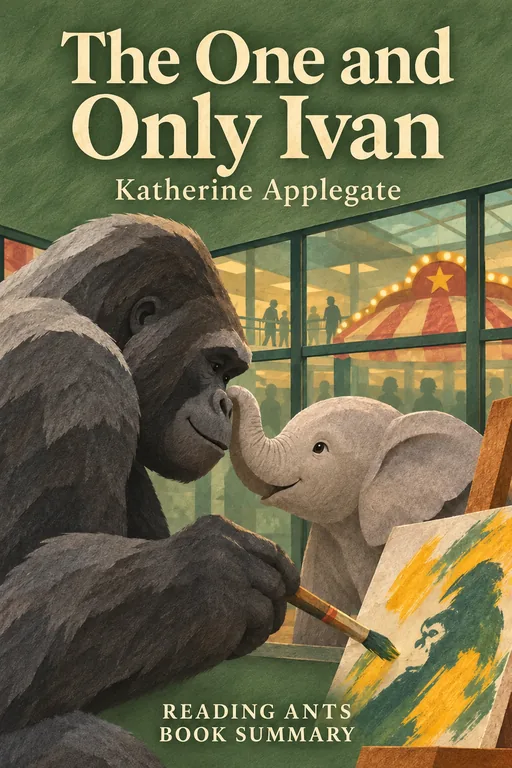
The One and Only Ivan
Katherine Applegate
A gorilla named Ivan, who lives in a small cage in a shopping mall, promises to rescue a baby elephant named Ruby and finds his voice through painting.
🧸 Children's Books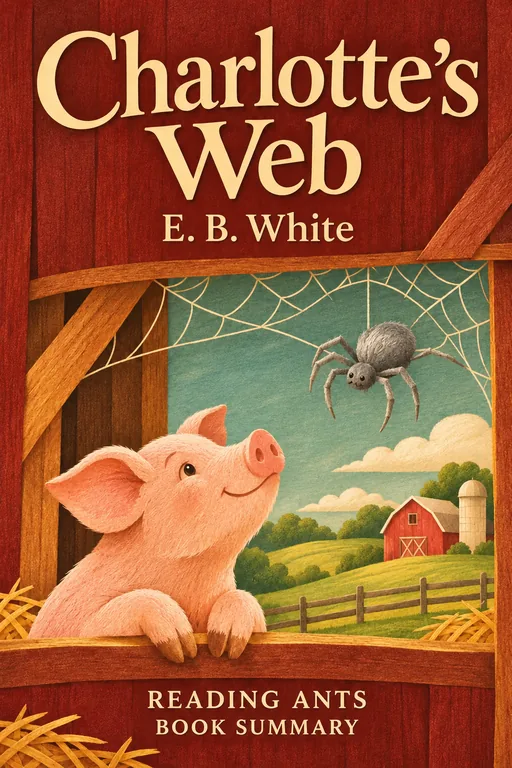
Charlotte's Web
E. B. White
A lonely pig named Wilbur learns he is going to be killed, and his clever friend Charlotte, a spider, comes up with an amazing plan to save his life.
🧸 Children's BooksWant something different?
Pick another topic and we will show you three books to start with.