 Reading Ants
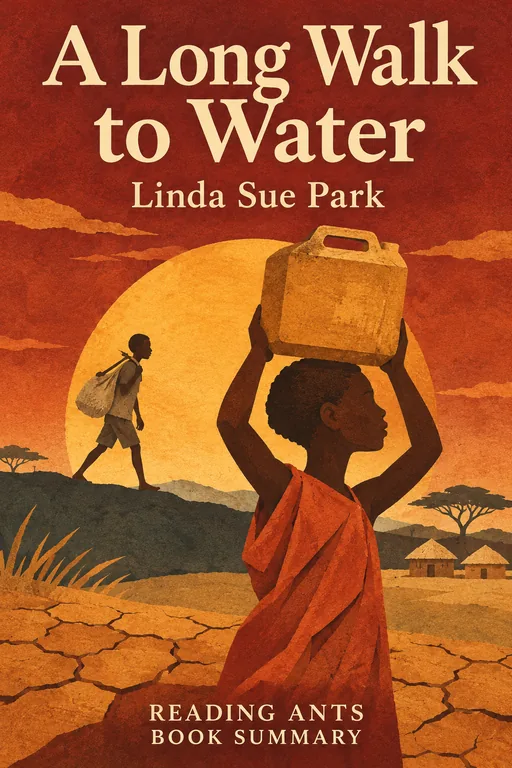
A Long Walk to Water
Two young people in Sudan, twenty-three years apart, are linked by their search for water, in a story inspired by the real life of Salva Dut.
Overview
A Long Walk to Water is a short novel by Linda Sue Park, published in 2010. It is based on the true story of Salva Dut, one of the “Lost Boys of Sudan,” who fled from the civil war as a child. The book alternates between two stories: Salva’s in 1985, when he is eleven, and Nya’s twenty-three years later, in 2008, when she is eleven and lives in a village that has no clean water. They live in different times, but they are bound by the same land and the same need. The chapters are short and simple, and the book is widely read in schools.
Main Characters
- Salva: an eleven-year-old boy from the Dinka tribe, who is separated from his family by war.
- Nya: a girl in the same region, more than twenty years later, who walks hours each day to fetch water.
- Uncle Jewiir: Salva’s uncle, a former soldier, who joins the group Salva is traveling with and becomes its leader.
- Marial: a boy of Salva’s age, who becomes his friend on the walk to Ethiopia.
- The other boys: children who lose their families and walk with Salva.
- Nya’s family: her parents, her younger sister Akeer and her brother.
- The man leading the drilling team: a stranger who brings a well to Nya’s village, and who turns out to be Salva.
Full Summary
Salva Runs
In 1985, Salva is at school when gunfire erupts outside. When it stops, his teacher tells the boys to run into the bush and not go back to their villages, because it is not safe. Salva runs away from his home and family and joins a group of other people who are fleeing the fighting. But after a couple of nights the group leaves without him, because a child would slow them down.
An old woman whom he calls Auntie lets him stay with her for a while. When she must leave, she arranges for him to join another small group. A few weeks later, his Uncle Jewiir joins the group, and Salva is overjoyed to see a relative. Jewiir has been a soldier, and he soon becomes the group’s leader.
Nya Walks
In 2008, Nya, who is eleven, lives in a village in southern Sudan where water is far away. For seven months of the year, she makes two long walks every day to a pond to collect water, which she carries home in a heavy container. In the dry season, her family moves to a camp by a lake, where she digs in the clay and waits for hours for a little muddy water. The water is dirty, and it makes people sick. Her younger sister, Akeer, falls ill, and a nurse says the cause is contaminated water.
Nya does not go to school, because her task is to fetch water. She is strong and determined, but it is a hard life.
Dangers on the Road
Jewiir decides to lead the group to a refugee camp in Ethiopia. They must cross a desert, and Salva starts to lose hope and falls behind. Jewiir keeps him moving by teaching him to aim only for the next bush, then the next rock, one small goal at a time. Salva also makes a friend his own age, a boy named Marial, but one night lions attack the group and take Marial.
Just before the group reaches Ethiopia, armed men ambush them and kill Jewiir. Salva is alone again, and he is deeply sad. Yet he feels that the strength of Jewiir and Marial is with him, and he keeps walking.
Boys Without Parents
Salva spends about six years in the refugee camp at Itang, in Ethiopia. Then soldiers arrive and order everyone out, driving the people toward a river. Many are shot or swept away, and Salva barely survives the crossing back into Sudan.
On the far bank he finds other boys who have lost their families, and soon he is the leader of more than a thousand of them. Using the lesson he learned from Jewiir in the desert, he guides them step by step across southern Sudan. The long journey takes more than a year, and it ends in Kenya.
The Camp
Salva lives in refugee camps in Kenya for about five years. He grows from a boy into a young man, and an Irish aid worker named Michael teaches him English. Eventually, he hears that some of the boys will be sent to the United States, and his name is on the list.
He flies to Rochester, New York, where he is welcomed into a new family, with parents named Chris and Louise and their children.
A New Life
In America, Salva learns English better, goes to school, and later to college. One day he gets word that his father is alive and in a clinic in southern Sudan. With the help of his American family, he plans a long trip, and after many years apart, he finds his father. They have an emotional reunion, and he learns that much of his family has survived.
On the flight home, Salva has an idea: to drill wells and bring clean water to remote villages in Sudan. He makes it the work of his life, and he founds an organization for this purpose, which is now called Water for South Sudan.
The Well
In Nya’s village, two strangers arrive and talk with her uncle, who is the village chief. Soon a crew comes and begins to drill a well. Nya doubts that water can come out of the ground, but at last it gushes out, and the whole village celebrates. Her father says that a school will be built, and since she no longer has to walk for water, she will be able to learn to read and write.
Nya waits in line to fill her container with cool, clean water. Then she thanks the man who led the drilling crew, and he tells her that his name is Salva. The two stories join, and the book ends there. The two also come from rival groups, since Salva is Dinka and Nya’s family is Nuer.
Why It Matters
A Long Walk to Water is widely read in schools, especially by middle school students. It introduces young readers to the history of Sudan and to the work of Salva Dut, who founded the organization Water for South Sudan. The book shows how access to clean water can change lives, and gives an inspiring example of a refugee who turns his suffering into service. Nya’s story is fictional, but the author based it on interviews with travelers who had seen wells being drilled in villages like hers. The book also does what good school texts do: it makes a faraway place and a real event feel close, and it leaves readers wanting to find out more, and often to take action by raising money for wells.
Key Takeaways
- Water is life. Clean water changes health, school and hope.
- Perseverance can save us. Salva keeps going, one step at a time.
- Refugees carry stories. Their experience has lessons for the world.
- Kindness can come from pain. Salva helps others because of what he suffered.
- Small groups can make a difference. A single organization can bring wells to villages.
What We Can Learn
The story helps us to be thankful for what we have, such as clean water, school and safety, and to recognize that many people do not have them. It encourages us to think about how we can help, whether by giving, volunteering or learning.
It also shows that the worst moments can lead to good outcomes, if a person has the will to help others. Finally, it reminds us of the importance of listening to the stories of refugees and treating them with respect.
Criticism and Counterpoints
Some readers find the writing very simple, and the characters not deeply developed. The alternating structure makes the connection between the two stories clear only at the end. Others point out that the book simplifies a complex civil war, and that Nya’s story is made up, so that it should not be read as a true account. A few have also said that the story’s focus on one man’s success may overlook the larger problems of aid and development.
Who Should Read It
This book is for readers from about ten years old, and is often used in school. It is a short and easy read. Younger readers may need help with the scenes of loss and danger, and parents may want to talk with them about the real history behind the story.
Want the whole book?
A summary is a taste, not the meal. Here is where to find the full book.
You reached the end 🎉
Nicely done. Mark this one as read, and we will suggest what to read next.
Read this next
Refugee
Alan Gratz
Three children, in three different times and places, flee danger by sea, and their stories show the courage and the cost of being a refugee.
🎒 Young Adult
Inside Out and Back Again
Thanhha Lai
In short poems, a ten-year-old Vietnamese girl named Hà describes fleeing Saigon in 1975, living in a refugee camp and starting a new life in Alabama, where she learns a strange new language and a new way of life.
🧸 Children's Books
Hatchet
Gary Paulsen
After a plane crash leaves him alone in the Canadian wilderness with only a hatchet, a thirteen-year-old boy must learn to survive, and grows from a frightened city kid into a patient, resourceful young man.
🧸 Children's Books
I Am Malala
Malala Yousafzai with Christina Lamb
Malala Yousafzai tells how a girl who loved school stood up for girls' education in Pakistan's Swat Valley, was shot by the Taliban at age fifteen, survived, and became a global voice for children's right to learn.
👤 Real Lives
The Giver
Lois Lowry
In a perfectly controlled community with no pain, choice or color, a boy about to turn twelve is chosen to hold the memories of the past, and discovers the terrible price his people pay for their safety.
🎒 Young Adult
The Outsiders
S. E. Hinton
After a deadly clash between rival social groups, teenager Ponyboy Curtis learns that loyalty can sustain people without making violence noble or erasing their shared humanity.
🎒 Young AdultWant something different?
Pick another topic and we will show you three books to start with.