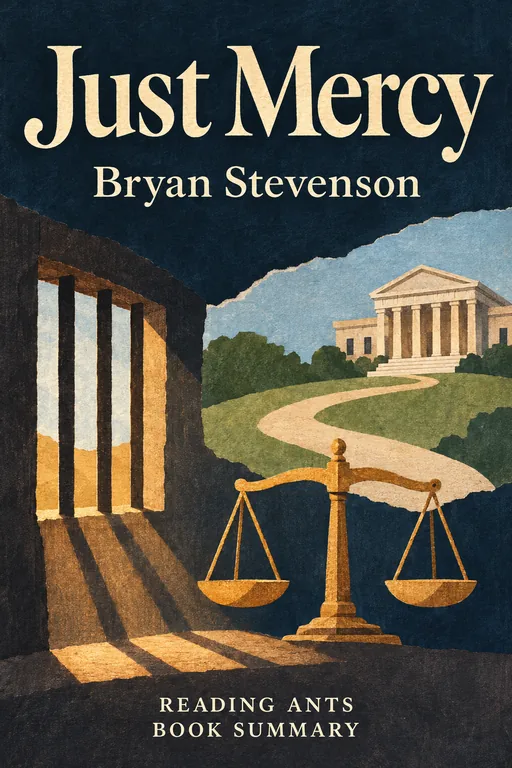
Just Mercy
Lawyer Bryan Stevenson tells how he defended people condemned or imprisoned unfairly, especially a Black man named Walter McMillian who was sentenced to death for a crime he did not commit, and argues that mercy and justice must go together.
Overview
Just Mercy: A Story of Justice and Redemption is a memoir by Bryan Stevenson, a lawyer and professor who founded the Equal Justice Initiative (EJI) in Montgomery, Alabama, to provide legal help to prisoners who had been unfairly treated. The book was published in 2014. It follows Stevenson from his time as a young lawyer, fresh out of Harvard Law School, to his work with people on death row, and interweaves several stories, with the case of Walter McMillian at the center. It became a bestseller and was adapted into a 2019 film. Stevenson argues that the system often punishes the poor and minorities more harshly, and that every person is more than the worst thing they have done.
Full Summary
1. A young lawyer finds his calling
The idea: Stevenson, who grew up in a poor, rural, mostly Black community in Delaware, goes to Harvard Law School. During an internship, he visits a death row prisoner in Georgia and is deeply affected by the man’s despair and the lack of legal help. He realizes that many people on death row have no lawyer to fight for them. After graduating, he moves to Alabama to defend the condemned, and later starts the Equal Justice Initiative with very little money.
In real life: One moving experience can set a person on a path of service for life.
2. Walter McMillian’s case
The idea: McMillian, a Black pulpwood worker in Monroeville, Alabama, is found guilty of the 1986 murder of Ronda Morrison, an eighteen-year-old white store clerk, and sent to death row, even though many witnesses say he was at a fish fry at his home when the crime happened. The prosecution relied mainly on a man named Ralph Myers, who had been pressured by police to accuse McMillian. Stevenson begins to investigate and finds that the evidence is flimsy and that officials ignored facts. The community, in a town best known as the home of Harper Lee, the author of To Kill a Mockingbird, is largely hostile.
In real life: A conviction based on one unreliable witness can lead to a terrible mistake if no one checks the evidence.
3. Uncovering the truth
The idea: Stevenson and his team work for years to prove McMillian’s innocence. They find that key witnesses were lying or coerced, that the prosecution held back evidence and that racial prejudice shaped the case. Stevenson faces threats and obstacles, including a bomb threat to his office. Eventually, Myers admits that he lied, and the state’s case collapses. The book shows the slow, frustrating process of challenging the courts and the personal strain on McMillian and his family.
In real life: Sometimes justice depends on people who are willing to keep searching for facts despite pressure to quit.
4. Other clients and hard cases
The idea: Alongside the main story, Stevenson describes other clients. These include children sentenced to die in prison, a woman convicted after a stillbirth, a mentally ill veteran who was executed and a man who had been abused as a child and then ended on death row. He argues that the system often punishes people who are poor, mentally ill or from minority groups and that many are never given the help they needed. He also describes the pain of losing cases and seeing clients executed.
In real life: People with mental illness or a history of trauma often receive punishment instead of treatment.
5. Exoneration and its cost
The idea: In 1993, after about six years on death row, McMillian is released, and the book describes the emotional moment. Yet his freedom does not make him whole. He struggles with the trauma of confinement, with illness and with the lack of a real apology; he later received a financial settlement, but it could not give back his lost years. Stevenson uses the case to show that wrongly convicted people may suffer for the rest of their lives, and that even freedom is not a complete remedy.
In real life: People who are released after wrongful convictions often need counseling, housing and support to rebuild their lives.
6. Mercy and justice
The idea: In the closing chapters, Stevenson reflects on what he has learned. He argues that all of us are more than our worst acts and that a just society must find ways to show mercy. He says that proximity to those who suffer changes us and that we need to get close to those who are excluded. He talks about the importance of hope, and says that a country should be judged not by how it treats the rich and powerful, but by how it treats the poor and condemned.
In real life: Spending time with people in a different situation, as a volunteer or a listener, can change how we think about justice.
Why It Matters
Just Mercy spent years on bestseller lists and was widely read in schools, churches and community groups. It put the problems of the American criminal justice system, including racial bias, harsh sentences and the death penalty, in front of a very large audience. The 2019 film, starring Michael B. Jordan and Jamie Foxx, extended its reach.
The EJI’s work, including a memorial in Montgomery to victims of lynching, grew in prominence, and Stevenson became a leading voice in the debate on criminal justice reform. Stevenson’s and the EJI’s litigation, which predates the book, contributed to changes in some sentencing laws for juveniles.
Key Takeaways
- Everyone deserves a fair trial. Poverty and race should not decide justice.
- Innocent people can be convicted. Careful investigation matters.
- We are more than our worst acts. People can change and deserve mercy.
- Being near suffering changes us. Getting close helps us understand.
- Hope is a choice. Persistence can lead to change.
What We Can Learn
The book teaches us to look carefully at how fairly our justice system treats people. If outcomes differ by race or wealth, we should ask why, and what can be done.
It also shows the power of persistence. Stevenson worked for years on a single case, and many other lawyers and volunteers did similar work, reminding us that big change often comes from steady effort.
Finally, it encourages compassion. Whether or not we agree with every opinion Stevenson holds, his view that people have the capacity to change and deserve a chance is one we can practice in daily life.
Criticism and Counterpoints
Some critics say that the book focuses on dramatic cases of innocence or extreme sentences, and that it may not represent typical cases. Others feel that its portrayal of prosecutors and police is one-sided, and that the legal system includes many people who work to be fair. Supporters of the death penalty argue that it is a just punishment for terrible crimes and that the book gives too little attention to victims’ families.
Some readers have also noted that the book is told from Stevenson’s viewpoint and omits some complexity, and that the film simplified parts of the story. Still, many praise its moral clarity and humane tone.
Who Should Read It
This book suits teenagers and adults. It describes executions, violence and injustice, and may be upsetting. It is a strong choice for classes, book clubs and families who want to discuss fairness and the law.
Want the whole book?
A summary is a taste, not the meal. Here is where to find the full book.
You reached the end 🎉
Nicely done. Mark this one as read, and we will suggest what to read next.
Read this next
Between the World and Me
Ta-Nehisi Coates
In a letter to his teenage son, Ta-Nehisi Coates describes what it means to live in a Black body in America, and reflects on fear, history and the struggle to be free.
⚖️ Politics & Society
In Cold Blood
Truman Capote
Truman Capote reconstructs the real 1959 murder of a Kansas family and the lives of the two killers, creating a landmark work that reads like a novel but is based on interviews and records.
🏛️ History
The New Jim Crow
Michelle Alexander
Civil rights lawyer Michelle Alexander argues that the American criminal justice system, especially the War on Drugs, has functioned as a system of racial control that labels many Black men as criminals and strips them of rights, much as Jim Crow laws once did.
⚖️ Politics & Society
To Kill a Mockingbird
Harper Lee
In a small Alabama town in the 1930s, young Scout Finch watches her father, a lawyer, defend a Black man falsely accused of a crime, and learns hard lessons about prejudice, courage and seeing the world through other people's eyes.
📜 Classics
The Fire Next Time
James Baldwin
Through a letter to his nephew and a longer essay about religion and race, James Baldwin tells white and Black Americans the truth about racism and urges them to face it with love and courage before it destroys the country.
⚖️ Politics & Society
The Prince
Niccolo Machiavelli
A Renaissance diplomat advises rulers to judge their actions by results rather than morality, arguing that a successful leader must sometimes be cunning and ruthless to win and keep power.
⚖️ Politics & SocietyWant something different?
Pick another topic and we will show you three books to start with.