 Reading Ants
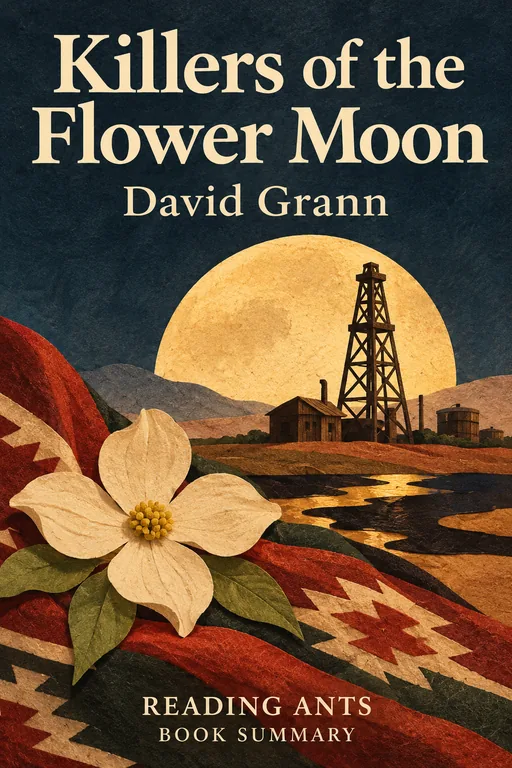
Killers of the Flower Moon
David Grann tells how, in the 1920s, members of the Osage Nation, who had become rich from oil, were murdered one by one, and how a young FBI and a Native investigator uncovered a conspiracy that was larger and darker than anyone had known.
Overview
Killers of the Flower Moon: The Osage Murders and the Birth of the FBI was published in 2017 by David Grann, a journalist. The Osage people had bought their land in Oklahoma, a rocky area that turned out to have oil underneath, and they had kept the mineral rights as a shared tribal asset. Shares in those rights, called headrights, could be inherited or passed on through marriage, which became the key to the crime. Because the tribe held the rights to the minerals, its members received large payments and became some of the richest people per head in the world. This wealth attracted greedy outsiders. The book follows a series of murders, the investigation and the author’s own discovery that the story was not over. The title comes from the Osage name for May, the Flower-Killing Moon, when taller plants overshadow and kill smaller flowers. Grann takes it from a poem by the Osage poet Elise Paschen.
Full Summary
1. A rich nation and a disappearance
The idea: Grann begins with the Osage Nation of the early twentieth century, whose members received money from oil leases, and who lived in fine houses and drove expensive cars. Many white neighbors resented this, and the federal government required many Osage to have guardians, usually white men, to control their money. In 1921, a woman named Mollie Burkhart sees her sister Anna go missing, and Anna is later found dead. This is the first of a series of deaths in her family.
In real life: When someone else controls your money, you are not free, however rich you are.
2. A family hit by death
The idea: More members of Mollie’s family die, from mysterious illnesses and from an explosion that destroys a house. Other Osage are also found dead. Local authorities do little, or are corrupt, and the town of Fairfax seems to be afraid. Mollie, who is ill herself, suspects that she and her family are being targeted. Grann shows the fear in the community and the sense that justice would not come.
In real life: When those who should protect you do nothing, it is harder to hope.
3. The Bureau steps in
The idea: The Osage appeal to the federal government, and the young Bureau of Investigation, later called the FBI, sends in agents under the direction of J. Edgar Hoover. An agent named Tom White, who grew up in Texas around his father’s county jail, takes charge, and builds a team that includes undercover agents who pose as ordinary people in the area. One of them, John Wren, is the Native American investigator whom Grann highlights. The team has to overcome fear and silence in the community, as well as obstruction. Grann describes their slow work.
In real life: Solving a hard problem may depend on patient work and trust, not just on one clever idea.
4. The king of the Osage Hills
The idea: The investigation leads to William Hale, a wealthy rancher who is known as a friend of the Osage, and who has a hold on the community. The agents find that he has planned many of the killings, so that his family could inherit oil money, and that his nephew Ernest Burkhart, Mollie’s husband, was involved. Grann shows how the betrayal was personal and complicated: Ernest appears to love Mollie, but follows his uncle’s orders.
In real life: Harm can come from someone who seems to care for you, and it is painful to learn this.
5. Trials and a limited justice
The idea: Hale and some accomplices are put on trial. Ernest first confesses, then recants, and finally pleads guilty and is sentenced to life in prison. Hale and another man, John Ramsey, are convicted at a second federal trial for the murder of one victim, Henry Roan, and are sentenced to life. However, many other deaths are never solved. Grann notes that the Bureau’s success was celebrated, and helped to build the reputation of the new agency, but that justice for the Osage was only partial.
In real life: Some wrongs cannot be fully put right, even when someone is punished.
6. The author’s search for the rest
The idea: In the last part of the book, Grann turns to his own research. He visits Oklahoma, reads records and speaks with descendants of victims. He finds that there were many more deaths than the Bureau had examined, and that other people, such as doctors and officials, may have been involved. The book ends with the realization that the full story of the killings will probably never be known, and that the Osage still carry the memory.
In real life: Talking with people who remember a history can reveal things that records miss.
Why It Matters
Killers of the Flower Moon was a bestseller and was named one of the best books of 2017. It brought national attention to a crime that had been largely forgotten outside Oklahoma, and to the broader pattern of the exploitation of Native Americans. A feature film adaptation followed in 2023. The book is also a reminder of the origins of the FBI and of how institutions begin, and it raises questions about who gets protection under the law. For the Osage Nation, the story is part of their history, and the book has helped to keep it alive. It also shows the importance of persistence in research, and of listening to descendants.
Key Takeaways
- Wealth attracted predators. The Osage’s oil money made them targets.
- Guardianship took away control. The system limited Osage freedom.
- Silence and corruption allowed crimes. Local power protected the guilty.
- Justice was incomplete. Many murders were never solved.
- History lives in memory. Descendants help to keep the truth alive.
What We Can Learn
The book encourages us to ask who benefits when a law or system treats one group differently, and to notice when those who are supposed to protect people fail. It also shows the value of persistence and of listening to survivors and their families. Learn about the history of the Native peoples of your area, and support organizations led by Native people. And be careful when you read true crime, remembering that the victims were real people, and that their dignity matters.
Criticism and Counterpoints
Some critics say that the book and its film adaptation give the Osage victims, including Mollie, less inner life than the white men around them, and that the story could have been told more fully from the Osage perspective. Some historians note that the number of killings and the extent of the conspiracy are uncertain, and that Grann relies on available records that are incomplete. The 2023 film made different choices, and some Native viewers had mixed views about it.
Who Should Read It
This book is for readers who like true crime and history, and who are interested in Native American history and the origins of the FBI. It reads like a thriller but is based on research. It contains accounts of murder and betrayal, so it is for mature readers, and those who want an Osage perspective should also read works by Osage writers.
Want the whole book?
A summary is a taste, not the meal. Here is where to find the full book.
You reached the end 🎉
Nicely done. Mark this one as read, and we will suggest what to read next.
Read this next
Bury My Heart at Wounded Knee
Dee Brown
Dee Brown tells the history of the American West from 1860 to 1890 as seen by the Native peoples who lost their lands, showing the broken treaties, the wars and the massacres that ended their independence.
🏛️ History
The Devil in the White City
Erik Larson
Erik Larson interweaves two true stories from Chicago in 1893: the architects who built the dazzling World's Fair against great odds, and the charming killer who preyed on young women in a hotel nearby.
🏛️ History
In Cold Blood
Truman Capote
Truman Capote reconstructs the real 1959 murder of a Kansas family and the lives of the two killers, creating a landmark work that reads like a novel but is based on interviews and records.
🏛️ History
The Warmth of Other Suns
Isabel Wilkerson
Isabel Wilkerson tells the story of the Great Migration, in which about six million Black Americans left the South for cities in the North and West, through the lives of three people who made the journey.
🏛️ History
1491: New Revelations of the Americas Before Columbus
Charles C. Mann
Charles Mann gathers recent research to argue that the Americas before Columbus held more people, older cities and more skillful land managers than most of us were taught, and that the picture of a pristine, empty wilderness is wrong.
🏛️ History
Sapiens: A Brief History of Humankind
Yuval Noah Harari
Humans came to rule the planet not because we are the strongest animals but because we can believe in shared stories (gods, nations, money, companies) that let millions of strangers cooperate.
🏛️ HistoryWant something different?
Pick another topic and we will show you three books to start with.