 Reading Ants
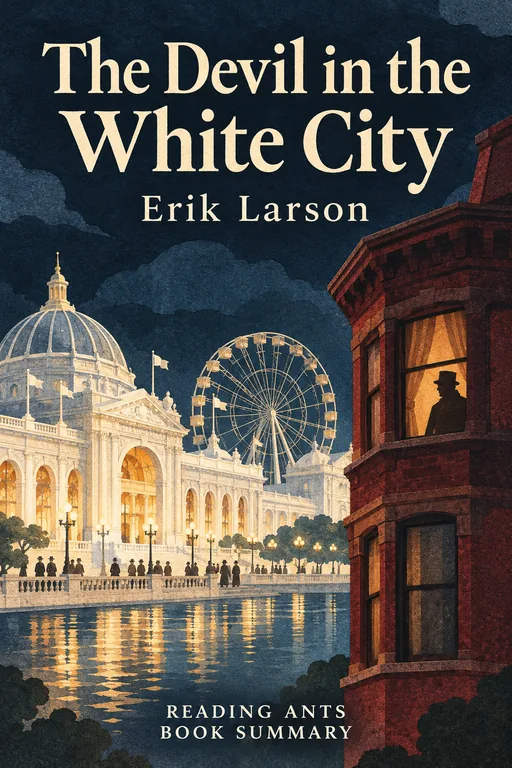
The Devil in the White City
Erik Larson interweaves two true stories from Chicago in 1893: the architects who built the dazzling World's Fair against great odds, and the charming killer who preyed on young women in a hotel nearby.
Overview
The Devil in the White City: Murder, Magic, and Madness at the Fair That Changed America was published in 2003 by Erik Larson, who writes narrative history that reads like a novel. The book follows two men in the same city at the same time. One is Daniel Burnham, the architect in charge of the World’s Columbian Exposition, held in Chicago in 1893 to celebrate the four hundredth anniversary of Columbus’s voyage. The other is Dr. H. H. Holmes, a con man and murderer. The fair was called the White City because of its gleaming white buildings.
Full Summary
1. A city that wants to win
The idea: After Paris had amazed the world with the Eiffel Tower in 1889, American leaders wanted their own fair that would top it. Chicago, which had been rebuilt after a great fire, competed against New York and won the right to host. Burnham and a group of leading architects, with the landscape designer Frederick Law Olmsted, were given the task of building a vast exhibition on a marshy lakefront site, against a tight deadline. Larson shows the pressure, the egos and the doubts.
In real life: A project with a tight deadline and a very high goal tests the skills of every person involved.
2. Building the White City
The idea: The team faced obstacles: the swampy ground, bad weather, labor strikes, disagreements over designs and a nationwide financial panic. Yet they transformed the site into a grand collection of buildings, lagoons and gardens, lit with electric light. The need for something to rival the Eiffel Tower led an engineer, George Ferris, to propose a giant wheel that carried passengers in cars high above the ground. Larson describes the creation of the wheel as a triumph of will.
In real life: A bold idea often looks impossible until someone figures out how to build it.
3. The charming doctor
The idea: In another part of the city, a handsome and persuasive man who called himself Dr. Henry Holmes opened a large building with shops on the ground floor and rooms above, which he later called a hotel. He was a swindler who cheated suppliers and investors, and a murderer who targeted young women who came to the city for work or for the fair. This summary leaves out graphic detail, though the book itself includes some grim material, and Larson shows how Holmes used charm and the anonymity of a big city to hide his crimes.
In real life: A friendly manner is not proof of good character, and caution is a form of wisdom.
4. The fair opens
The idea: The exposition opened in the spring of 1893 and was a great success, with millions of visitors who wandered its grounds and enjoyed exhibits from many countries, the Ferris wheel and displays of new inventions. The fair was admired for its beauty, and it influenced American architecture and city planning. Larson also shows the shadows, such as the strain on Burnham and the memory of the loss of his partner John Root, who had died of pneumonia in 1891, before the work was well under way.
In real life: A grand celebration can inspire people, even as some are left out of the picture.
5. Tragedy and the end of the fair
The idea: Near the end of the fair, the mayor of Chicago, Carter Harrison, who had been a supporter, was shot and killed at his home by a disappointed man, Patrick Prendergast, and the closing celebrations were canceled. A fire destroyed some of the buildings in the following months. The fair itself was soon demolished, though its impact lasted. Holmes, meanwhile, carried on with his schemes, and his crimes would not be uncovered until later.
In real life: Moments of great joy and great sorrow can happen in the same place and week.
6. The hunt for Holmes
The idea: After leaving Chicago, Holmes was arrested in Boston in 1894, at first on a swindling charge. He had also carried out an insurance fraud that ended in the murder of his associate Benjamin Pitezel, and three of Pitezel’s children had gone missing in his care. A detective, Frank Geyer, followed Holmes’s trail from city to city and found the bodies of the children in Toronto and Indianapolis. Chicago police also searched Holmes’s building, and its odd layout fed newspaper stories of a “murder castle,” though historians now doubt many of the sensational details. Holmes was tried in Philadelphia and sentenced to death. He was hanged in 1896. The true number of his victims is not certain.
In real life: Patient, careful work by an investigator can put the pieces together even when a criminal is clever.
Why It Matters
The Devil in the White City was a long-running bestseller and helped to popularize narrative history, in which real events are told with the pacing and detail of fiction. It brings alive a moment when Chicago and America were growing and changing, and it shows the dramatic difference between a dream of beauty and the darkness that can hide next to it. The book also had a lasting influence on how people picture the 1893 fair, which was remembered for its architecture, its Ferris wheel and its role in shaping the style of public spaces. It sparked interest in the history of Chicago and in other works by Larson.
Key Takeaways
- Big dreams take huge effort. The fair was built through will and teamwork.
- Light and shadow coexist. A glittering event can hide danger.
- Ingenuity meets competition. The Ferris wheel arose as a response to the Eiffel Tower.
- Cities create anonymity. Strangers could vanish unnoticed.
- Careful investigation matters. Persistent detective work solves mysteries.
What We Can Learn
The book teaches us to admire the energy that goes into great projects and to remember the people whose work is forgotten. It also encourages sensible caution about strangers who are too eager to please, and attention to signs that something is wrong. Think about how a big event, like a school fair or a festival, depends on dozens of people behind the scenes. And note that history is full of contrasts, which make it more interesting and more truthful than a simple story.
Criticism and Counterpoints
Some historians say that the popular picture of Holmes mixes proven facts with legend, since many claims about the number of victims and the secret features of the building came from sensational newspapers of the time. Reviewers have also noted that Larson says in his notes that parts of his account of the murders are conjecture built on a few facts. Others point out that the two narratives are only loosely connected, which can make the book feel like two stories sharing a cover. Historians also point out that Black Americans were largely shut out of planning the fair, a subject that is not central to this book. Despite this, readers admire the book’s vivid style and its energy.
Who Should Read It
This book is for readers who enjoy history that reads like a thriller, and who are interested in Chicago, architecture or true crime. It is easy to read, though it contains accounts of murder. Younger readers should have guidance, and those who want a strict academic history of the fair may prefer another source.
Want the whole book?
A summary is a taste, not the meal. Here is where to find the full book.
You reached the end 🎉
Nicely done. Mark this one as read, and we will suggest what to read next.
Read this next
Killers of the Flower Moon
David Grann
David Grann tells how, in the 1920s, members of the Osage Nation, who had become rich from oil, were murdered one by one, and how a young FBI and a Native investigator uncovered a conspiracy that was larger and darker than anyone had known.
🏛️ History
The Boys in the Boat
Daniel James Brown
Daniel James Brown tells how a group of working-class young men from the University of Washington learned to row as one and won the gold medal for the United States at the 1936 Berlin Olympics, with the story of Joe Rantz at its heart.
🏛️ History
The Warmth of Other Suns
Isabel Wilkerson
Isabel Wilkerson tells the story of the Great Migration, in which about six million Black Americans left the South for cities in the North and West, through the lives of three people who made the journey.
🏛️ History
In Cold Blood
Truman Capote
Truman Capote reconstructs the real 1959 murder of a Kansas family and the lives of the two killers, creating a landmark work that reads like a novel but is based on interviews and records.
🏛️ History
Sapiens: A Brief History of Humankind
Yuval Noah Harari
Humans came to rule the planet not because we are the strongest animals but because we can believe in shared stories (gods, nations, money, companies) that let millions of strangers cooperate.
🏛️ History
Guns, Germs, and Steel
Jared Diamond
Some societies came to conquer others not because their people were smarter or better, but because geography gave them a head start in farming, animals, germs and technology.
🏛️ HistoryWant something different?
Pick another topic and we will show you three books to start with.