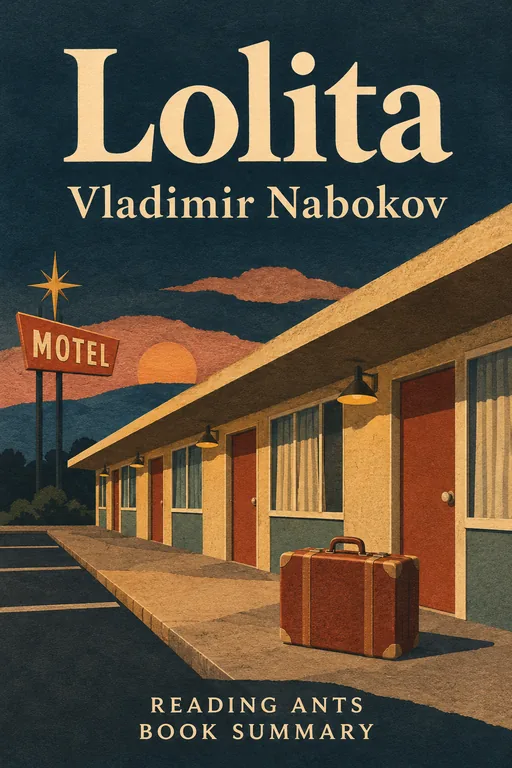
Lolita
Humbert Humbert, a cultured, self-justifying European scholar, tells how he abused and trapped a twelve-year-old girl, in a book that makes readers see how a charming voice can disguise a monster.
Overview
Lolita is a novel by Vladimir Nabokov, a Russian-born writer who wrote it in English. It was first published in Paris in 1955, after American publishers refused it, and appeared in the United States in 1958. It is presented as the confession of Humbert Humbert, who writes from prison, and who tells of his obsession with a girl he calls Lolita. His elegant, witty prose tries to make his crimes seem romantic, but the novel is designed to expose his self-deception, and the damage done to the girl, whose real name is Dolores Haze. It is a famous and controversial book that has been misread as a love story. It is, in fact, a story about abuse and the way that it is justified.
Main Characters
- Humbert Humbert: the narrator, an educated, self-obsessed European who abuses a child.
- Dolores “Dolly” Haze (Lolita): a twelve-year-old girl, who is the victim of Humbert’s abuse.
- Charlotte Haze: Dolores’s widowed mother, who marries Humbert.
- Clare Quilty: a playwright and rival who pursues Dolores.
- Dick Schiller: the man whom Dolores later marries.
Full Summary
Humbert’s Confession
Humbert Humbert begins his account by describing his childhood in Europe, where he lost a young love, Annabel Leigh, who died of typhus. He claims that this loss shaped his desires, and that he is drawn to certain young girls, whom he calls nymphets. He tells his story in a flowery, literary voice, and addresses an imagined jury, asking for sympathy. The reader soon sees that he is manipulative and cruel, and that his language is a mask.
The Hazes
In 1947, Humbert goes to a small New England town to live as a lodger with Charlotte Haze, a widow, and sees her twelve-year-old daughter, Dolores. He becomes fixated on her, though he does not care for the mother, who is vain and lonely. To stay close to the child, he marries Charlotte, writing in his diary about his plans, and even considers killing her. When Charlotte reads the diary and learns of his feelings, she rushes out in distress, and is struck and killed by a car.
The Road
After Charlotte’s death, Humbert collects Dolores from a summer camp and takes her on a long journey across America, staying at motels. He first tells her that her mother is ill in the hospital, and tells her of the death only the next day, and he begins to abuse her, and she is trapped, without any other family. The book shows, through hints Humbert cannot hide, that she is unhappy, cries at night and has no one to turn to. He controls her by threats of an orphanage, and by bribes. The trip through roadside America is both comic and horrifying.
Settling Down
Humbert settles in another town, Beardsley, where Dolores goes to school. He is jealous and controls her friendships. She takes part in the school play, written by a playwright, Clare Quilty, whose name appears in the story as a mysterious shadow. Dolores becomes more independent and tries to escape. Humbert, alarmed by her growing resistance, takes her on another long road trip.
Humbert watches her every move, forbids dating and uses money and fear to keep her close. The narration shows, in his own anxious details, that she is lonely, tired and increasingly desperate to get away from him, even as he describes himself as a devoted guardian.
The Escape
On the second trip, Humbert becomes convinced that he is being followed. Dolores falls ill and is taken to a hospital, from which she vanishes with a man. Humbert searches for her for years, driven by rage and desolation. He enters into a relationship with another woman, but he remains haunted.
Reunion and Murder
Years later, he receives a letter from Dolores, now seventeen, who is married to Dick Schiller, who is hard of hearing. She is expecting a baby and asks for money. He finds her poor, and she tells him that the man she left with was Quilty, who exploited her. Humbert gives her money, and begs her to go with him, but she refuses. He then tracks down Quilty and shoots him in his mansion. Humbert is arrested. He writes the book in prison, where he dies before the trial. The fictional editor, John Ray Jr., explains in a foreword that Dolores died in childbirth. In the closing lines of his own account, Humbert says that the only immortality he can offer Dolores is the book itself.
Why It Matters
Lolita is one of the most celebrated and most contested novels of the twentieth century. Its brilliance as a work of language and structure is admired by many critics, and it is widely taught in universities. It was adapted into films by Stanley Kubrick in 1962 and Adrian Lyne in 1997. The word “Lolita” has entered the language, though often in a distorted sense that makes a child seem a seductress, which is the opposite of what the book shows.
The novel is also an influential study of the unreliable narrator, and how rhetoric can disguise cruelty. In recent years, readers have increasingly emphasized Dolores’s victimhood, and later memoirs about grooming and abuse, such as Vanessa Springora’s Consent, are often discussed alongside it.
Key Takeaways
- Eloquence can disguise evil. Humbert’s beautiful language hides abuse.
- Victims are often silenced. Dolores’s pain is mostly seen through the cracks.
- Self-deception is powerful. Humbert convinces himself that he is a lover.
- Beware the narrator. Readers must question what they are told.
- Abuse destroys lives. The ending shows the cost to Dolores.
What We Can Learn
The novel teaches us to read critically. When someone tells a story in a persuasive voice, we should ask what they are leaving out, and whose perspective is missing.
It also teaches that abusers often present themselves as sympathetic, intellectual or romantic, and that it is important to recognize the signs and to listen to children who are in trouble.
Finally, it helps us see the difference between beautiful writing and moral truth, and to appreciate that art can portray evil without endorsing it.
Criticism and Counterpoints
Some readers feel that the novel’s beauty makes Humbert too attractive, and that it risks seducing the reader into sympathy, or that Dolores is silenced and denied a voice, though the novel can be read as showing exactly that. Others find that it should not be read at all, because of its subject. It has been banned in some countries and challenged in others.
Some critics also claim that the film versions and the popular use of the name have turned a story of abuse into a romance. Others discuss whether art that portrays abuse can be separated from its aesthetic pleasures. The debate continues.
Who Should Read It
This book is for adult readers only. It deals with the sexual abuse of a child, and although it is not graphic, it is disturbing. Readers should be prepared to read critically and to focus on Dolores’s suffering.
Want the whole book?
A summary is a taste, not the meal. Here is where to find the full book.
You reached the end 🎉
Nicely done. Mark this one as read, and we will suggest what to read next.
Read this next
Crime and Punishment
Fyodor Dostoevsky
A poor former student in St. Petersburg murders an old pawnbroker to prove he is an extraordinary man above ordinary morality, then is tormented by guilt until love and confession offer him a path to redemption.
🌍 World Literature
Notes from Underground
Fyodor Dostoevsky
A bitter, lonely former clerk who lives in a squalid underground existence writes an angry confession about his own spite, his contempt for the world and a humiliating episode from his past.
🌍 World Literature
The Great Gatsby
F. Scott Fitzgerald
A mysterious millionaire throws lavish parties on Long Island in the hope of winning back the woman he loved years ago, but his dream collides with the careless cruelty of the rich.
📜 Classics
The Bell Jar
Sylvia Plath
A talented young woman named Esther Greenwood, who seems to be on the path to success in 1950s America, sinks into depression and a suicide attempt, and slowly begins to recover.
📜 Classics
Pride and Prejudice
Jane Austen
Quick-witted Elizabeth Bennet and the proud, wealthy Mr. Darcy badly misjudge each other, and only by facing their own faults do they find their way to love.
📜 Classics
Nineteen Eighty-Four
George Orwell
In a future Britain ruled by an all-seeing Party, one man secretly rebels by keeping a diary and falling in love, and discovers just how completely a totalitarian state can crush the human mind.
📜 ClassicsWant something different?
Pick another topic and we will show you three books to start with.