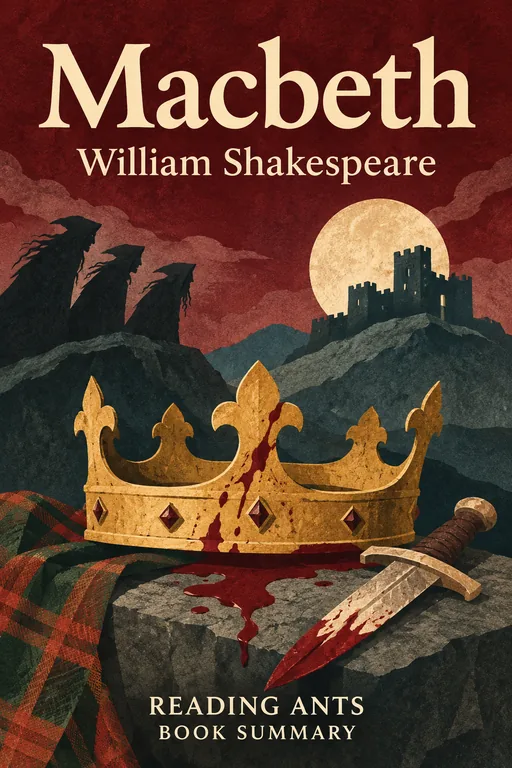
Macbeth
A brave Scottish general, spurred on by a witches' prophecy and his ambitious wife, murders the king to take the throne, and is driven by guilt and paranoia into more and more killing until he is destroyed.
Overview
Macbeth is one of William Shakespeare’s darkest and shortest tragedies, written around 1606 and first printed in 1623. It is set in medieval Scotland. Returning from victory in battle, the general Macbeth and his friend Banquo meet three mysterious witches, who predict that Macbeth will become king. Encouraged by his wife, Lady Macbeth, he murders King Duncan and seizes the crown. But one crime leads to another, and the couple are consumed by guilt, fear and madness. The play is a powerful study of ambition, conscience and how power corrupts. Because of a theatrical superstition, many actors refuse to say its title inside a theater, calling it “the Scottish play” instead.
Main Characters
- Macbeth: a brave general whose ambition leads him to murder.
- Lady Macbeth: his determined, ambitious wife.
- The three witches: mysterious prophets of fate.
- King Duncan: the kind, trusting king of Scotland.
- Banquo: Macbeth’s friend and fellow general.
- Fleance: Banquo’s son.
- Macduff: a Scottish nobleman who opposes Macbeth.
- Malcolm: Duncan’s elder son and heir.
- Lady Macduff: Macduff’s wife.
Full Summary
The Witches’ Prophecy
On a stormy heath, three witches wait for Macbeth. He and Banquo, returning from crushing a rebellion, meet them. The witches greet Macbeth with three titles: Thane of Glamis, which he already is; Thane of Cawdor; and future king. They tell Banquo that he will not be king, but his descendants will be. Moments later, messengers announce that King Duncan has made Macbeth Thane of Cawdor, as the previous one was a traitor. Macbeth is shaken: the first prophecy has come true, and he begins to imagine murdering the king.
The Murder of Duncan
Macbeth writes to his wife about the prophecy. Lady Macbeth fears he is too kind to seize the crown and calls on dark spirits to fill her with cruelty. When Duncan announces he will stay at their castle, she plans his murder. Macbeth hesitates, thinking of Duncan’s goodness and the consequences, but she mocks his courage and convinces him.
That night, Macbeth sees a vision of a dagger floating before him, leading him to Duncan’s room. He stabs the king in his sleep. Afterward, he is horrified, and imagines a voice crying that he has murdered sleep. Lady Macbeth smears the sleeping guards with blood to frame them. When the murder is discovered, Macbeth kills the guards, claiming fury. Duncan’s sons, Malcolm and Donalbain, fear for their lives and flee, which makes them look guilty. Macbeth is crowned king.
Banquo’s Ghost
Macbeth cannot feel safe. He remembers that the witches promised Banquo’s descendants would be kings. He hires murderers to kill Banquo and his son, Fleance. Banquo is killed, but Fleance escapes.
At a royal banquet, Macbeth sees Banquo’s bloody ghost sitting in his chair. Only Macbeth can see it, and he raves in terror before his guests. Lady Macbeth tries to cover for him, but the nobles grow suspicious.
New Prophecies
Macbeth visits the witches again. They show him three apparitions with new prophecies: beware Macduff; no man born of a woman can harm Macbeth; and he will never be defeated until Birnam Wood moves to Dunsinane Hill, where his castle stands. Macbeth feels invincible. But he also sees a vision of a line of kings descended from Banquo.
Learning that Macduff has fled to England to join Malcolm, Macbeth orders the murder of Macduff’s wife and children. When Macduff hears the news, he is shattered with grief, and he vows revenge.
Lady Macbeth’s Guilt
Lady Macbeth, once so strong, is now tormented by guilt. She sleepwalks through the castle at night, trying to wash imaginary bloodstains from her hands, and speaks of the murders while a doctor and servant watch in horror. Later, she dies, apparently by suicide. When Macbeth hears, he reflects bitterly that life is empty and meaningless, like a passing shadow or a madman’s noisy story.
Birnam Wood
Malcolm and Macduff lead an English army against Macbeth. To hide their numbers, the soldiers cut branches from the trees of Birnam Wood and carry them as they advance. To Macbeth’s horror, the forest seems to be moving toward Dunsinane.
Still, Macbeth fights fiercely, trusting that no man born of woman can harm him. Then he meets Macduff, who reveals that he was not born naturally but was delivered by being cut from his mother’s womb. Macbeth realizes the witches tricked him, but refuses to surrender. They fight, and Macduff kills him. Macduff brings Macbeth’s head to Malcolm, who is crowned the new king of Scotland.
Why It Matters
Macbeth is one of Shakespeare’s most frequently performed and studied plays. Its fast pace, supernatural elements and psychological depth make it gripping for modern audiences. It explores how ambition, unchecked by conscience, can destroy a person and a nation.
Lady Macbeth is one of the most famous female characters in literature, and her sleepwalking scene is iconic. Many lines from the play, about “double, double toil and trouble” and life being “full of sound and fury,” have entered everyday language and inspired other works, including William Faulkner’s novel The Sound and the Fury. The play has been adapted into countless films, including Akira Kurosawa’s Throne of Blood, set in Japan.
Key Takeaways
- Unchecked ambition destroys. Macbeth’s desire for power leads to ruin.
- Guilt cannot be washed away. Lady Macbeth is driven mad by her crimes.
- Prophecies can mislead. The witches’ words tempt Macbeth into his own destruction.
- One crime leads to another. Each murder makes the next seem necessary.
- Tyranny brings its own downfall. Macbeth’s cruelty turns everyone against him.
What We Can Learn
Macbeth warns us to think carefully before acting on ambition. Wanting success is natural, but pursuing it through cheating or harming others leads to fear and regret.
It also shows that our conscience matters. Macbeth and Lady Macbeth try to ignore their guilt, but it destroys them. Listening to our sense of right and wrong, and admitting our mistakes early, helps us avoid bigger problems.
Finally, the play teaches us to be careful who we listen to. The witches and Lady Macbeth push Macbeth toward evil. Choosing friends and advisers who encourage our best selves is important.
Criticism and Counterpoints
Some readers find Macbeth’s transformation from loyal hero to tyrant too rapid, and the witches’ role confusing: do they control fate, or simply reveal Macbeth’s hidden desires? Critics have also debated whether Lady Macbeth is a villain or a victim of her own ambition and of a society that gave women little power.
Historians note that the real Macbeth, an eleventh-century Scottish king, ruled for seventeen years and was not the tyrant Shakespeare portrayed. The play was likely written to please King James I, who believed in witchcraft and was said to be a descendant of Banquo. The language, as in all Shakespeare, can be challenging without notes or performance.
Who Should Read It
This short, gripping play suits teenagers and adults, and it is a favorite in schools. Its witches, ghosts and murders appeal to those who enjoy dark, dramatic stories. Watching a film or stage version helps bring its powerful language to life.
Want the whole book?
A summary is a taste, not the meal. Here is where to find the full book.
You reached the end 🎉
Nicely done. Mark this one as read, and we will suggest what to read next.
Read this next
Hamlet
William Shakespeare
A grieving prince of Denmark learns from his father's ghost that his uncle murdered the king to take the throne, and his struggle to decide whether and how to take revenge leads to madness and death.
🎭 Epics, Drama & Poetry
King Lear
William Shakespeare
An aging king divides his kingdom among his daughters based on how much they flatter him, banishes the one who truly loves him, and is driven to madness on a stormy heath as his family and kingdom collapse.
🎭 Epics, Drama & Poetry
Othello
William Shakespeare
A noble Black general in the Venetian army is manipulated by his trusted officer Iago into believing that his loving wife is unfaithful, and his jealousy leads him to destroy her and himself.
🎭 Epics, Drama & Poetry
Julius Caesar
William Shakespeare
A group of Roman senators, organized by Cassius and morally led by Brutus, kill Julius Caesar to save the republic from his ambition, but their act leads to civil war and ruin for the conspirators.
🎭 Epics, Drama & Poetry
The Prince
Niccolo Machiavelli
A Renaissance diplomat advises rulers to judge their actions by results rather than morality, arguing that a successful leader must sometimes be cunning and ruthless to win and keep power.
⚖️ Politics & Society
The Odyssey
Homer
After the Trojan War, the clever hero Odysseus struggles for ten years against monsters, gods and temptations to return home to his faithful wife and son, then must win back his house from the men trying to steal it.
🎭 Epics, Drama & PoetryWant something different?
Pick another topic and we will show you three books to start with.