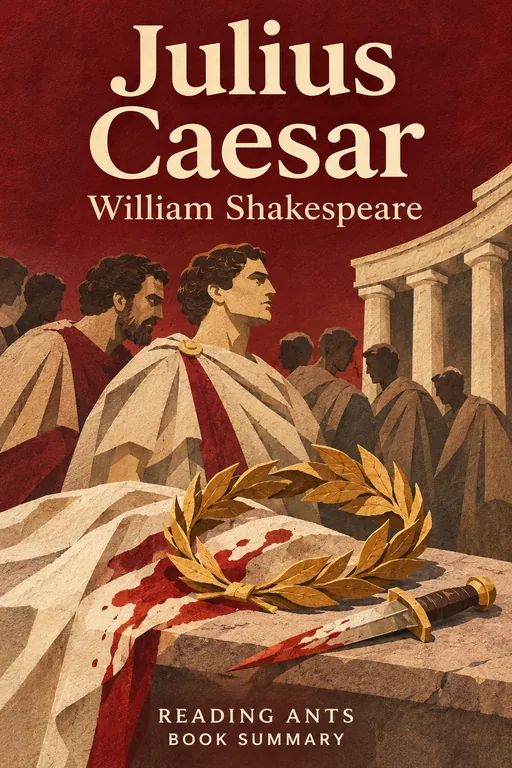
Julius Caesar
A group of Roman senators, organized by Cassius and morally led by Brutus, kill Julius Caesar to save the republic from his ambition, but their act leads to civil war and ruin for the conspirators.
Overview
Julius Caesar is a tragedy by William Shakespeare, first performed around 1599. It is based on the Roman history of Plutarch, and tells of the assassination of Julius Caesar in 44 BC and its aftermath. Although the play is named after Caesar, he dies in the middle of the play, and the central character is Brutus, a noble Roman who joins the plot out of principle. The play explores questions of political power, loyalty, public opinion and the ethics of violence, and has often been staged as a commentary on contemporary politics.
Main Characters
- Julius Caesar: the great Roman general and dictator, popular and ambitious.
- Marcus Brutus: a respected senator and friend of Caesar, who loves Rome and fears that Caesar’s ambition will destroy the republic.
- Cassius: a bitter, clever senator who organizes the conspiracy.
- Mark Antony: Caesar’s loyal friend and a skilled orator.
- Calpurnia: Caesar’s wife, who has bad dreams.
- Portia: Brutus’s wife.
- Casca, Cinna and the other conspirators.
- Octavius Caesar: Caesar’s heir.
Full Summary
The Fear of a King
The play opens in Rome, as the people celebrate Caesar’s victory over the sons of Pompey. A soothsayer warns Caesar to beware the Ides of March, but he ignores him. Cassius, who resents Caesar’s power, speaks to Brutus, whom he knows to be honorable, and tries to convince him that Caesar has become a danger to the republic. Brutus is troubled, because he loves Caesar, but he fears that Caesar will be crowned king, and that Roman liberty will be lost.
The Conspiracy
Cassius arranges for forged letters, supposedly from citizens, to be thrown through Brutus’s window, to persuade him that the people want Caesar stopped. Brutus joins the conspirators, who meet at night in his garden. He rejects Cassius’s suggestion to kill Antony too, saying that they must be sacrificers, not butchers. Portia, who sees that her husband is troubled, begs to know his secret.
The Ides of March
On the morning of March 15, Calpurnia, who has had terrible dreams, begs Caesar not to go to the Senate. He decides to stay, but one of the conspirators, Decius, convinces him by flattering him and by interpreting the dream as a good omen. On the way, Artemidorus, a teacher of rhetoric, tries to hand Caesar a paper warning him of the plot, but Caesar refuses to read it, saying that what concerns himself he serves last. At the Capitol, Metellus Cimber kneels with a petition, as a pretext, and the others crowd around him. The conspirators strike in turn, with Casca first, and Brutus last. When Caesar sees Brutus among them, he says, in Latin, “Et tu, Brute?” and falls dead. After the killing, they bathe their hands in his blood and declare that they have freed Rome.
Antony’s Speech
Brutus addresses the crowd and explains that he killed Caesar not because he loved Caesar less, but because he loved Rome more. The people cheer. Antony, who has been allowed to give a funeral speech, appears with the body. He speaks carefully, repeating that Brutus is an honorable man, while pointing out Caesar’s kindness to the poor, his refusal of the crown and his will, which leaves money to the people. The crowd turns, and in a fury, drives out the conspirators and burns the houses of their leaders.
War
Antony, Octavius and Lepidus form a triumvirate, and begin a purge of their enemies. Brutus and Cassius gather armies in the east, and in a tent they quarrel bitterly over money and honor. Cassius accuses Brutus of failing to support him, and Brutus accuses Cassius of taking bribes. Their anger gives way to tears, and they reconcile, and Brutus tells Cassius that his wife Portia has died. It is clear that the strain of what they have done is weighing on them. As night falls, Brutus reads, and Caesar’s ghost enters, telling him that they will meet again at Philippi. The two armies then meet in battle.
Philippi
In the battle, Cassius, thinking wrongly that his friend Titinius has been captured, orders his servant to kill him. Brutus mourns Cassius, and fights on, but his army is overwhelmed. He asks his friends to help him end his life, and finally runs on his sword. Antony, seeing his body, says that Brutus was the noblest Roman of them all, because he acted for the good of Rome. Octavius closes the play by ordering a proper burial for him.
Why It Matters
Julius Caesar is one of Shakespeare’s most frequently taught plays, in part because it is short and has a clear political theme. Its lines have become part of the language, including “Beware the Ides of March” and “Friends, Romans, countrymen.” The play has often been staged in modern dress to comment on events, such as Orson Welles’s 1937 production with fascist imagery.
It is also often studied for its treatment of rhetoric. The contrasting speeches of Brutus and Antony are a classic example of how language persuades a crowd.
Many politicians and speechwriters study Antony’s funeral speech for the way it uses repetition and irony to turn a crowd, and the play remains a frequent choice for school productions because its themes of power and persuasion are easy to relate to modern politics.
Key Takeaways
- Good intentions can have bad consequences. The conspirators’ act leads to more violence.
- Rhetoric moves crowds. Antony’s speech turns public opinion.
- Ambition worries free societies. The fear of tyranny drives the plot.
- Honor and judgment can conflict. Brutus is noble but misjudges.
- Violence leads to violence. The assassination starts a civil war.
What We Can Learn
The play warns that noble motives do not guarantee good results. Brutus acts for what he believes is the common good, but his naivety allows Antony to turn the people against him.
It also shows the power of words and the importance of thinking critically about speeches. Antony’s irony shows how a speaker can lead an audience by repeating a phrase.
Finally, it asks us to consider when, if ever, violent action against a ruler is justified, and what it might cost.
Criticism and Counterpoints
Some readers find Caesar to be a weak character in the play, who is vain and deaf, and the play’s title misleading since he is killed early. Others find Brutus naive and self-righteous. Critics have debated whether Shakespeare sympathizes with Caesar, Brutus or neither, and the play has been used by both supporters of republicanism and supporters of strong leaders.
The play also has few female roles, and those who do appear are mainly wives. Some readers find the language and Roman references difficult. Still, its drama and political insight remain strong.
Who Should Read It
This play suits teenagers and adults. It is shorter than many of Shakespeare’s tragedies and is commonly studied in school. A modern edition with notes, or a performance, will help readers follow the action.
Want the whole book?
A summary is a taste, not the meal. Here is where to find the full book.
You reached the end 🎉
Nicely done. Mark this one as read, and we will suggest what to read next.
Read this next

Hamlet
William Shakespeare
A grieving prince of Denmark learns from his father's ghost that his uncle murdered the king to take the throne, and his struggle to decide whether and how to take revenge leads to madness and death.
🎭 Epics, Drama & Poetry
Macbeth
William Shakespeare
A brave Scottish general, spurred on by a witches' prophecy and his ambitious wife, murders the king to take the throne, and is driven by guilt and paranoia into more and more killing until he is destroyed.
🎭 Epics, Drama & Poetry
The Odyssey
Homer
After the Trojan War, the clever hero Odysseus struggles for ten years against monsters, gods and temptations to return home to his faithful wife and son, then must win back his house from the men trying to steal it.
🎭 Epics, Drama & Poetry
The Epic of Gilgamesh
Anonymous
A proud, powerful king of ancient Mesopotamia gains a true friend, loses him to death, and journeys to the edge of the world in search of eternal life, only to learn that what lasts is the life and legacy we leave behind.
🎭 Epics, Drama & Poetry
The Iliad
Homer
During the final year of the Trojan War, the great Greek warrior Achilles withdraws from battle in anger, and only the death of his dearest friend drives him back to fight, leading to terrible loss and a moment of shared human grief with his enemy.
🎭 Epics, Drama & Poetry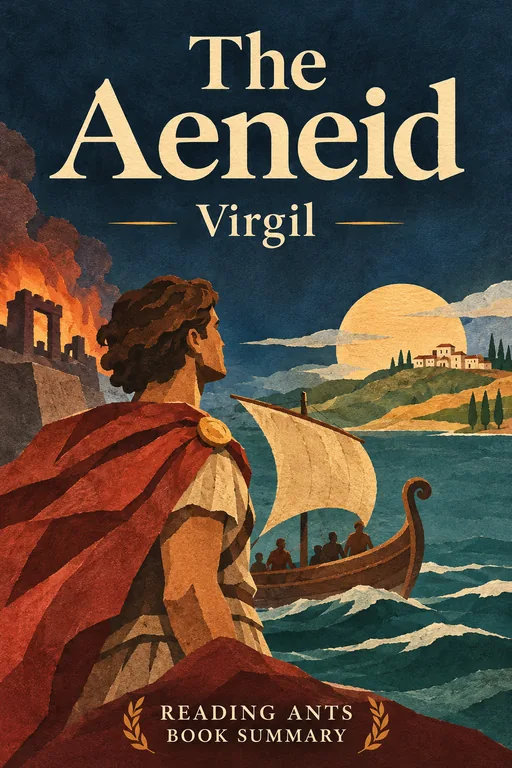
The Aeneid
Virgil
After the fall of Troy, the hero Aeneas leads a band of refugees across the sea to Italy, where he is fated to found the line that will build Rome, at great personal cost.
🎭 Epics, Drama & PoetryWant something different?
Pick another topic and we will show you three books to start with.