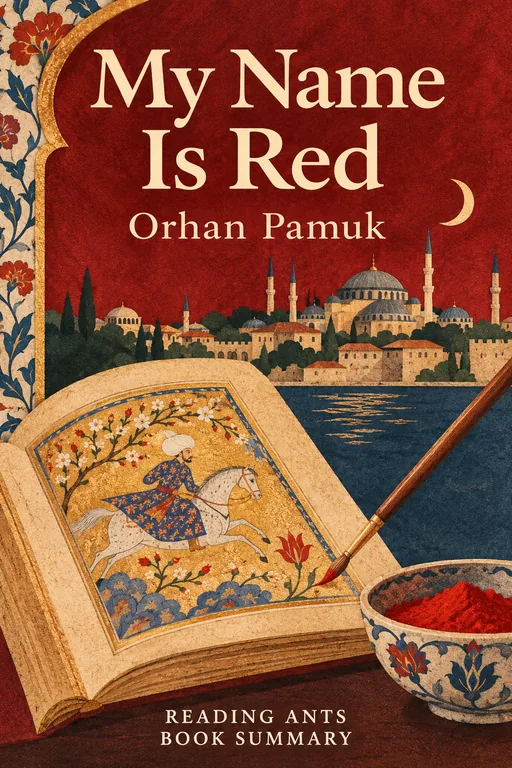
My Name Is Red
Original title: Benim Adım Kırmızı
In sixteenth-century Istanbul, a murder among the painters of the Sultan's secret book raises questions about art, faith and the cost of seeing the world in a new way.
Overview
My Name Is Red is a novel by the Turkish writer Orhan Pamuk, published in 1998. It is set in Istanbul in the 1590s, in the Ottoman Empire, in the time of Sultan Murad III. It is a murder mystery set in the world of miniature painters, who are working on a secret book. Each chapter is narrated by a different voice, including a corpse, a dog, a tree, a coin and the color red. The book asks what art is, who has the right to define it, and what happens when two cultures, the Islamic East and the Christian West, meet.
Main Characters
- Black (Kara): a man who returns to Istanbul after twelve years away, and who loves Shekure.
- Shekure: his cousin, a clever, strong-willed woman, whose husband has gone missing.
- Enishte Effendi: Shekure’s father, who is supervising the secret book.
- Master Osman: the head of the Sultan’s workshop, a traditional artist.
- Elegant, Olive, Butterfly and Stork: four gifted artists of the workshop. Elegant, a master gilder, is the first murder victim, and the other three are suspects.
- The murderer: someone among the painters, whose identity is hidden from the reader.
Full Summary
A Body in a Well
The novel begins with the voice of a dead man, Elegant Effendi, a master gilder who has been killed and thrown into a well. He does not know who killed him, and begs the living to find the murderer, warning that his death hides a plot against the faith and the way of life of the city. He addresses the reader from beyond the grave.
The Sultan has commissioned a book to be painted in the new, European style, with portraits of people, which breaks with the Islamic tradition. The work is being done in secret, by a group of painters, under the direction of Enishte Effendi.
Black Returns
Black, who left Istanbul twelve years ago after his love for Shekure was rejected and he was forced to leave her father’s house, returns to the city. He still loves Shekure, who has two sons and whose husband is missing in battle. Enishte asks Black to help finish the book, and to find out who killed Elegant.
Shekure, who is practical, is under pressure from her brother-in-law, who wants to marry her. She sees Black as an option, but she is also cautious.
The Painters
Black learns that the Sultan’s workshop is a world of its own, with its own pride, its own rivalries and its own jealousies. The painters have trained for years, some from boyhood, and they believe that real mastery comes only after a lifetime of work. Each of the artists has his own style, and a distinct view of art and faith. Master Osman believes in the old way of painting, in which each picture shows the world as God sees it, and the artist’s own style is not important. Others, such as Elegant before his death, become deeply uneasy about the new European method, which values individual faces and a single viewpoint, and fear that it is sinful.
The artists are afraid that the secret book is blasphemy, and the religious zealots of the city are hostile to it. Rumors spread, and the workshop is full of tension.
A Second Murder
Enishte is murdered. Before he dies, he has been working on a mysterious final picture. Black and Shekure, now married, must find the killer, in a city where people are suspicious and religious tension is high.
The Sultan gives Black and Master Osman three days to find the killer, or the painters will be tortured, Black first. The three possible suspects, Olive, Butterfly and Stork, are questioned. Each is a talented painter, and each has a motive. Black is forced to compare the miniatures of each, in search of hidden signs in their style, such as the way each of them draws the nostrils of a horse, for no artist can fully hide his own hand. During the search in the Sultan’s Treasury, Master Osman, who feels that the old art is being betrayed, blinds himself with a needle said to have been used by the master Bihzad, in the way of the old masters, who preferred blindness to painting in a new style.
The Unmasking
Black discovers the identity of the murderer: it is Olive, who killed Elegant, a childhood companion who threatened to expose the painters to the zealots, and then Enishte. Olive is confronted in a dervish lodge by Black and two of the other painters, and in the struggle he is wounded in the eyes, as the painters panic and turn on him. He then wounds Black with a dagger and flees toward a ship bound for India, but he is beheaded outside the workshop by Hasan, Shekure’s brother-in-law.
Master Osman, who lives on blind for two more years, is replaced as Head Illuminator by Stork.
Love and Legacy
Black survives, though he is left crippled, and he and Shekure, who have found a measure of peace, live together with her sons for many years, until his death. The secret book is never completed, and the age of the old miniaturists passes, as a later Sultan turns away from painting. The story ends with Shekure, in old age, telling her son Orhan her story, and the thought that a story is the only way to keep the past alive.
Why It Matters
My Name Is Red was Pamuk’s breakthrough novel, which made him an international star. He won the Nobel Prize in Literature in 2006. It is celebrated for its originality of form, in which many voices tell the story, and for its vivid picture of Ottoman life. It is also a book about the meeting of East and West, and has been widely studied for what it says about art, identity and cultural change. Readers have found it both a gripping thriller and a deep meditation on beauty. It has also been praised for its wit, since many of the narrators, such as the dog, the coin or the tree, speak with humor about the human world, and for bringing the history of Istanbul to life in a way that few novels have done.
Key Takeaways
- Art reflects belief. The way we paint shows how we see the world.
- Cultures meet and clash. The Ottoman painters must face European ideas.
- Style is a fingerprint. Even a hidden artist can be identified by his hand.
- Change brings loss. The old way of painting is fading.
- Many voices make a truth. The novel shows that no single viewpoint is complete.
What We Can Learn
The novel invites us to think about how we see the world, and how much of our vision comes from our culture. It also encourages us to respect traditions, while recognizing that change is a part of life.
It shows the pain that can arise when people feel their way of life is threatened, and the importance of dialogue between cultures. Finally, it reminds us that every creator leaves a personal mark, and that the search for a unique voice is a lifelong task.
Criticism and Counterpoints
Some readers find the book long and slow, with a lot of discussion of art theory that interrupts the plot. The shifting voices can be confusing at first, and the mystery plot is not always tight. Others note that the female characters are less developed than the male ones. In Turkey, the book also drew some criticism for its treatment of religious topics, though it was widely read. The humor and playfulness are not to everyone’s taste.
Who Should Read It
This book is for readers who enjoy intellectual mysteries and historical fiction, and who are interested in art. It is long and dense, but it rewards patient readers. Those who are looking for a quick thriller may be disappointed.
Want the whole book?
A summary is a taste, not the meal. Here is where to find the full book.
You reached the end 🎉
Nicely done. Mark this one as read, and we will suggest what to read next.
Read this next
The Name of the Rose
Umberto Eco
A Franciscan friar investigates deaths in a medieval abbey, where the struggle to control books and laughter proves more dangerous than any supernatural curse.
🌍 World Literature
The Tale of Genji
Murasaki Shikibu
A gifted prince's loves, losses and descendants reveal the beauty and cruelty of court life, where every relationship is shaped by rank, time and impermanence.
🌍 World Literature
The Shadow of the Wind
Carlos Ruiz Zafon
A Barcelona boy's devotion to a forgotten novel draws him into the tragic history of its author and a struggle over whether stories and people can escape the past.
🌍 World Literature
Cloud Atlas
David Mitchell
Six nested stories, set from the nineteenth century to a far future, each discovered by the next narrator, show how the strong prey on the weak and how small acts of courage can echo through time.
✨ Modern Fiction
The Thousand and One Nights
Anonymous
A storyteller postpones her execution night after night with unfinished tales whose wonders, dangers and nested voices gradually challenge a king's murderous view of human nature.
🌍 World Literature
The Little Prince
Antoine de Saint-Exupery
A pilot stranded in the desert meets a small boy from a tiny planet, who teaches him that the most important things in life, like love and friendship, can only be seen with the heart.
🌍 World LiteratureWant something different?
Pick another topic and we will show you three books to start with.