 Reading Ants
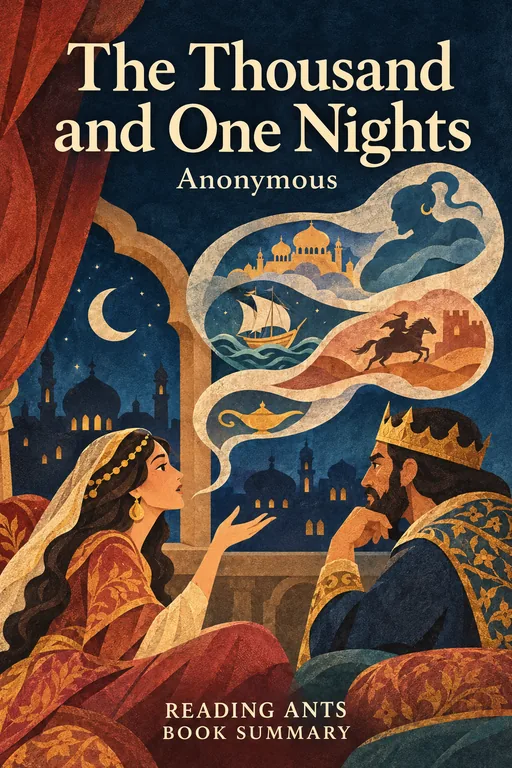
The Thousand and One Nights
Original title: ألف ليلة وليلة
A storyteller postpones her execution night after night with unfinished tales whose wonders, dangers and nested voices gradually challenge a king's murderous view of human nature.
Overview
The Thousand and One Nights, also called The Arabian Nights, is not a single fixed novel but a collection that developed across centuries from Middle Eastern, Persian, Indian and other storytelling traditions. Its frame concerns Shahrazad, who marries King Shahriyar after he has begun executing a new bride each morning. She tells a story at night and stops at a suspenseful point, giving him a reason to spare her until the next evening. Within this frame, merchants, sailors, rulers, spirits, thieves and clever outsiders tell further stories. Magic and adventure sit beside comedy, moral argument and observations about money, justice and chance. Because surviving manuscripts and modern editions differ, no short summary can represent every version.
Main Characters
- Shahrazad: the learned storyteller who uses courage and narrative skill to confront the king’s violence.
- King Shahriyar: a betrayed ruler whose revenge against women becomes systematic murder.
- Dunyazad: Shahrazad’s sister, who helps prompt the nightly storytelling.
- Sinbad: a merchant whose seven voyages bring fortune, disaster and wonder in many editions.
- Harun al-Rashid: a caliph who appears in numerous Baghdad tales, often traveling in disguise.
- The many narrators: Merchants, women, servants, rulers and supernatural beings whose voices form the collection.
Full Summary
The King’s Cruel Vow
King Shahriyar discovers his wife’s betrayal and concludes that no woman can be trusted. He orders her death, then marries a virgin each night and has her executed the next morning. Families live in terror as the vizier is forced to supply brides. His daughter Shahrazad, educated in history, poetry and stories, volunteers to marry the king despite her father’s pleas.
Shahrazad arranges for Dunyazad to ask for one last story. Near dawn, she stops before the ending. Shahriyar postpones the execution because he wants to hear what happens. Shahrazad completes one tale the following night but begins another, creating a chain in which curiosity repeatedly interrupts violence.
Stories Inside Stories
Many early tales concern travelers whose ordinary decisions bring them before supernatural powers. A merchant accidentally causes a death and faces a vengeful spirit, but other men offer remarkable stories in exchange for portions of his pardon. Elsewhere, fishermen discover sealed vessels, animals speak, and people are transformed by magic.
The nested structure matters as much as any adventure. A character in Shahrazad’s story may tell a second story, whose character tells a third. Each narrator tries to gain time, justice, mercy or understanding. Listening becomes an ethical act because a judgment made too quickly may be reversed when another person’s history is known.
Baghdad by Night
A group of tales follows Caliph Harun al-Rashid and his companions as they move through Baghdad, sometimes in disguise. They encounter households governed by puzzling rules, lovers separated by mistakes, poor people with extraordinary experiences and officials whose conduct needs correction. The powerful ruler temporarily becomes a listener in streets he normally governs from above.
These stories can end in rewards and reunions, but justice is unpredictable. Clever speech may rescue the innocent, while rank, wealth and slavery shape whose testimony is heard. Comedy often exposes arrogant judges or jealous husbands. The city is both a real social world and a stage where identity can change overnight.
Sinbad’s Seven Voyages
In the popular Sinbad cycle, a wealthy merchant tells a poor porter how he gained his fortune. On seven voyages he repeatedly seeks trade or adventure, is shipwrecked, meets gigantic creatures or strange societies, escapes with difficulty and returns richer. Each homecoming seems final, yet restlessness sends him out again.
Sinbad’s resourcefulness is impressive, but survival also depends on luck and on wealth extracted from dangerous places. His tales offer wonder while raising questions about appetite: experience never permanently satisfies him. By telling them to the porter and sharing money, he turns private suffering into entertainment and a limited form of generosity.
Famous Later Tales
Many readers associate the collection with Aladdin, Ali Baba and the forty thieves, although these stories are not part of the oldest known Arabic core. Aladdin rises from poverty with the aid of a magical lamp and powerful spirits, while Ali Baba discovers a thieves’ treasure and survives largely through the intelligence of Morgiana. Their later inclusion shows that the Nights continued changing as storytellers, translators and publishers reshaped it.
Across versions, similar patterns recur: hidden identity, sudden reversals, dangerous curiosity and underestimated people using intelligence against strength. Women are sometimes confined by stereotypes, yet women such as Shahrazad and Morgiana are also among the collection’s most capable agents.
The Thousand and First Night
After many nights, Shahrazad’s storytelling brings the frame to an end. In widely known versions, she has borne children and asks Shahriyar to spare her for their sake. The king declares that he has changed and ends the executions. Her survival is not merely a reward for entertaining him: the stories have made him spend years considering varied motives, consequences and possibilities.
The conclusion cannot erase his victims or make Shahrazad’s danger romantic. Her victory occurs under coercion. Yet the frame imagines storytelling as a force that can delay violence long enough for reflection and empathy to grow. The collection remains open-ended in spirit because every tale suggests another voice waiting to be heard.
Why It Matters
The Nights preserves a vast, changing network of oral and written storytelling rather than the vision of one author. Its nested tales influenced world literature’s use of frames, cliffhangers and stories that comment on storytelling itself. Shahrazad became an enduring figure of intellectual courage: she works within extreme danger and uses the king’s desire to hear more as space for moral change.
The collection also shaped European ideas about the Middle East, sometimes through translations and adaptations that added exotic stereotypes or changed sexual and religious material. Recognizing its varied textual history helps readers avoid treating it as a transparent picture of one culture. Its richest legacy lies in plurality. Merchants, enslaved people, rulers, craftspeople and supernatural beings continually exchange positions, and certainty is repeatedly overturned by another tale.
Key Takeaways
- Stories can delay rash judgment. Shahrazad creates time in which curiosity competes with the king’s violent certainty.
- No single voice controls the collection. Nested narrators offer conflicting lessons about justice, fate, desire and power.
- Fortune changes quickly. Wealth and status disappear overnight, rewarding adaptability but also exposing social unfairness.
- Intelligence can resist force. Many physically vulnerable characters survive through planning, language and attention.
- Editions shape what readers call a classic. Famous tales may come from different periods and transmission routes.
What We Can Learn
Before deciding that we understand another person’s action, we can ask what story or context is missing. The collection does not guarantee that every narrator tells the truth, but it demonstrates why listening can complicate judgment. Shahrazad also models strategic courage: she understands her audience, creates manageable delays and works toward change without pretending she is safe.
For modern readers, comparing tables of contents and translators is part of reading responsibly. Differences are not defects to hide; they reveal how culture travels. Finally, the repeated reversals warn against assuming success proves virtue. Luck, inherited rank and unequal institutions matter alongside cleverness. Enjoying the wonders need not mean accepting every social value represented in them.
Criticism and Counterpoints
The collection includes misogyny, slavery, racial stereotypes, sexual coercion and severe punishments. These differ across versions but should not be softened into harmless fairy-tale decoration. Shahriyar’s reform does not restore the women he killed, and framing his violence as the result of betrayal risks shifting blame toward women.
European translations have sometimes altered the text to satisfy fantasies about an exotic East. Because there is no single definitive contents list, broad claims about what the book teaches require caution. Readers may need a well-annotated modern edition to understand textual history and offensive representations.
Who Should Read It
This collection is ideal for readers who enjoy framed tales, folklore, magic, adventure and the history of storytelling. Teens and adults should choose an edition suited to their interests. Younger readers need an adapted selection because unabridged versions may include sexual material, enslavement and brutal violence.
Want the whole book?
A summary is a taste, not the meal. Here is where to find the full book.
You reached the end 🎉
Nicely done. Mark this one as read, and we will suggest what to read next.
Read this next
The Odyssey
Homer
After the Trojan War, the clever hero Odysseus struggles for ten years against monsters, gods and temptations to return home to his faithful wife and son, then must win back his house from the men trying to steal it.
🎭 Epics, Drama & Poetry
The Decameron
Giovanni Boccaccio
While the Black Death ravages Florence in 1348, ten young people retreat to a country villa and pass the time by each telling a story a day, making a hundred tales of love, wit, trickery and fate.
🎭 Epics, Drama & Poetry
Aesop's Fables
Aesop
A collection of very short stories, mostly about talking animals, each teaching a simple lesson about life, such as slow and steady wins the race, and don't cry wolf.
🧸 Children's Books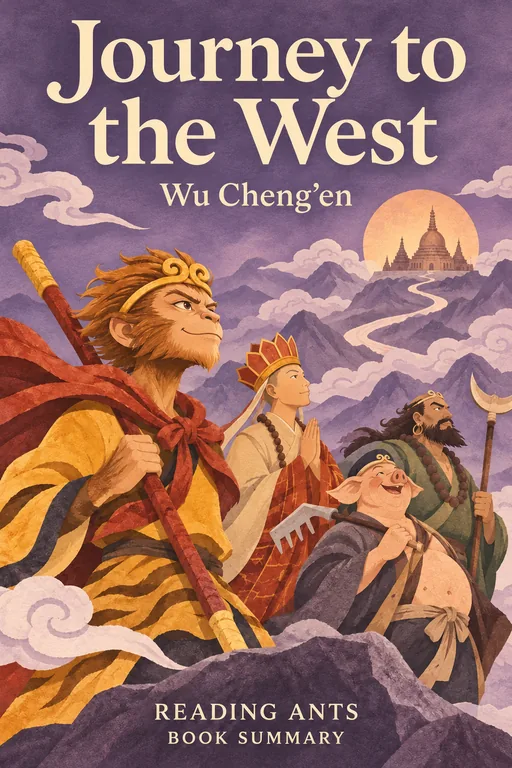
Journey to the West
Wu Cheng'en
A rebellious, magical Monkey King and two monstrous companions protect a gentle Buddhist monk on his long, demon-filled journey from China to India to bring back holy scriptures.
🌍 World Literature
The Little Prince
Antoine de Saint-Exupery
A pilot stranded in the desert meets a small boy from a tiny planet, who teaches him that the most important things in life, like love and friendship, can only be seen with the heart.
🌍 World Literature
Things Fall Apart
Chinua Achebe
Okonkwo, a proud and fearsome leader in an Igbo village in Nigeria, struggles against his own fears and against the arrival of British missionaries and colonial rulers, who change his world forever.
🌍 World LiteratureWant something different?
Pick another topic and we will show you three books to start with.