No Exit
Original title: Huis clos
Three dead people are locked together in a room that turns out to be hell, and discover that, with no torturer needed, they torment one another.
Overview
No Exit (in French, Huis clos) is a one-act play by the French philosopher and writer Jean-Paul Sartre, first performed in Paris in 1944, during the German occupation. It takes place in a single room, with three characters, who are condemned to spend eternity together. The play dramatizes ideas from Sartre’s existentialism, in particular his view that we are defined by our actions and by how others see us. It contains the famous line, which is often quoted, that hell is other people. The play is short and intense.
Main Characters
- Joseph Garcin: a journalist, who says that he was a pacifist, but who deserted his post and was shot.
- Inès Serrano: a clerk in the post office, who is sharp, honest and cruel.
- Estelle Rigault: a beautiful, vain young woman, who has committed a terrible act.
- The Valet: an attendant, who leads them into the room.
- The living world: seen only through hints, since the characters watch their earthly lives.
- The door: a symbol of the exit that they cannot or will not use.
- The bronze statue: the ornament in the room.
Full Summary
The arrival
A valet leads a man, Garcin, into a drawing room furnished in a bourgeois style of the Second Empire. There are three sofas, a bronze ornament and no mirrors or windows, and the lights cannot be turned off. Garcin had expected to find torture chambers and fire, and asks where the instruments are. The Valet says that there are none. He tells Garcin that he will stay forever. In the room there is no night and no sleep, and the Valet himself never blinks.
Inès and Estelle
Soon, two women arrive, one after the other. Inès is a post office clerk, who asks the Valet no questions, and who quickly decides that Garcin must be her torturer. Estelle is a young socialite, who is anxious and wants a mirror, to look at herself, and is distressed that she cannot see herself. The three try to be polite at first, and to pretend that they are in a normal situation. Garcin suggests that they should keep quiet, and each should keep to himself, and ignore the others, but this soon fails.
The truth begins to emerge
Soon, the three begin to reveal why they are there. Garcin says that he was a journalist, killed for his pacifism, but he had been shot after trying to flee the country, and he is troubled about whether he is a coward. Inès confesses that she caused her cousin’s death, and drove his wife to kill them both, because she had designs on the wife. Estelle admits that she had a lover, bore his child, and drowned the baby, after which her lover shot himself.
The triangle of torment
The three realize that their punishment is to be together, and that each is both the tormentor and the victim of the others. Inès, who loves women, desires Estelle, who is interested in Garcin, who wants Inès to believe that he is not a coward. Whenever one tries to find comfort, the third interferes. Estelle tries to seduce Garcin, but he cannot accept it, with Inès watching. Inès wants to break him, and make him admit his weakness, while Garcin needs her approval.
The door opens
At one point, Garcin demands that the door be opened, and it suddenly opens. But none of them leaves. Garcin says that he could go, but that, if he does, Inès will remain, thinking him a coward. Garcin does not leave, realizing that he cannot escape the judgment of others, and that he must stay and face them. He says that he now understands: there is no need for fire or a rack, since hell is other people. Estelle, furious, picks up a paper knife and stabs Inès, who points out that they are already dead. The three laugh at the absurdity.
The ending
They sit down, with no more illusions. Each of them knows that they will be locked in a cycle of desire, accusation and failure forever. The play ends with Garcin’s line that they should continue. No one leaves, and the lights stay on. There is no end to the torment, and no way to change what they have done.
Why It Matters
No Exit is one of the most famous and widely performed plays of the twentieth century, and an accessible introduction to Sartre’s ideas. It expresses his philosophy that we are responsible for what we do, and that our identity depends on how we act and how others see us, and that we may lie to ourselves to escape this. The line about hell has entered everyday speech, though often misunderstood. The play is compact, with a single set, and has been staged all over the world, and it is one of the best-known examples of existentialist drama.
Key Takeaways
- We are what we do. Actions define a person.
- Others’ judgment matters. We depend on how people see us.
- Self-deception is hard to keep. In the room, the lies fall away.
- Responsibility cannot be escaped. The characters cannot undo their deeds.
- Relationships can be hell. When we need others’ approval, they have power.
What We Can Learn
You can learn from this play to think about how much you depend on other people’s opinions, and whether you are honest with yourself about your actions. It also invites us to consider how we treat others, and whether we trap people by our expectations. If you read it with friends, you might discuss whether the line about hell is true, and what Sartre meant by it. It is a prompt for self-reflection and for developing better relationships, and a reminder to be kind in how we judge others, since our words can shape how they see themselves.
Criticism and Counterpoints
Some readers consider the play too philosophical, with characters who exist mainly to illustrate ideas, and a plot that is more a debate than a drama. Others feel that the line about hell, taken out of context, is misleading, since Sartre himself said that he meant that if our relations with others are twisted, then others can become hell, not that all relations are so. The critic Clive Barnes wrote in the 1960s that the play’s central idea is stated so plainly that the outcome becomes predictable, and that the play had come to feel dated. The setting also limits the play’s variety, but others find that this focus gives it strength.
Who Should Read It
This book is for readers from about fourteen who are interested in philosophy, drama and big questions. It is short and can be read in an hour. Readers who like it may go on to Sartre’s Existentialism Is a Humanism or Camus’s The Stranger.
Want the whole book?
A summary is a taste, not the meal. Here is where to find the full book.
You reached the end 🎉
Nicely done. Mark this one as read, and we will suggest what to read next.
Read this next
Existentialism Is a Humanism
Jean-Paul Sartre
In a lecture given in Paris in 1945, Jean-Paul Sartre explains and defends existentialism, arguing that humans have no fixed nature, that we create ourselves through our choices, and that this freedom brings full responsibility.
🕊️ Philosophy & Religion
The Stranger
Albert Camus
An emotionally detached office worker kills a man on an Algerian beach and discovers that society condemns him as much for refusing its expected feelings as for the murder itself.
🌍 World Literature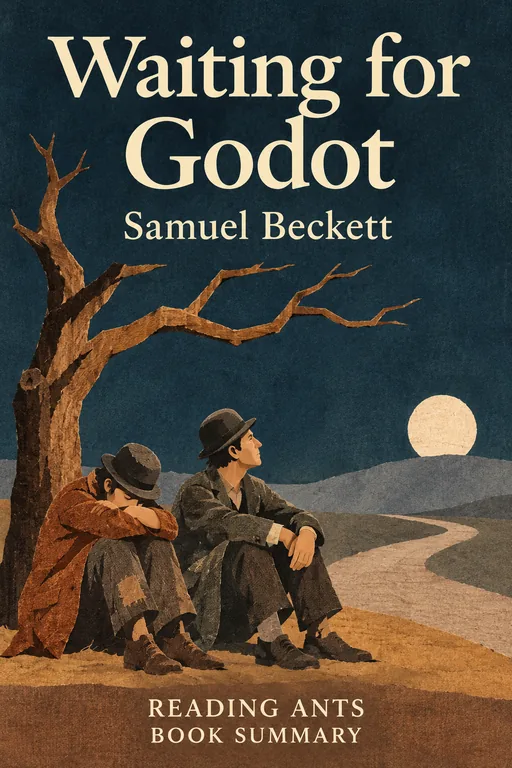
Waiting for Godot
Samuel Beckett
Two tramps wait beside a lonely tree on a country road for a mysterious man named Godot who never arrives, passing the time with games, quarrels and strange encounters in a play about hope, boredom and the meaning of existence.
🎭 Epics, Drama & Poetry
Nausea
Jean-Paul Sartre
A lonely historian in a French port town is overcome by a sickening awareness that things simply exist, without reason, and he searches for a way to live with this.
🌍 World Literature
The Trial
Franz Kafka
A respectable senior bank officer is arrested one morning for a crime nobody will name, and is dragged through a vast, senseless legal system that he can neither understand nor escape.
🌍 World Literature
The Odyssey
Homer
After the Trojan War, the clever hero Odysseus struggles for ten years against monsters, gods and temptations to return home to his faithful wife and son, then must win back his house from the men trying to steal it.
🎭 Epics, Drama & PoetryWant something different?
Pick another topic and we will show you three books to start with.