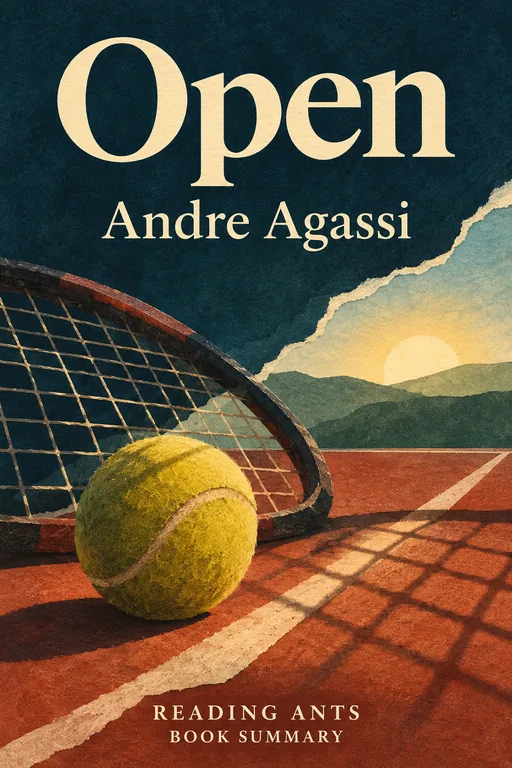
Open
Tennis champion Andre Agassi reveals that he hated the sport that made him famous, and tells the story of a pushed childhood, a self-destructive peak, a dramatic fall and a hard-won comeback.
Overview
Open is a memoir by Andre Agassi, published in 2009, written with the help of the journalist J. R. Moehringer. Agassi was one of the best tennis players in the world from the late 1980s to the mid-2000s, winning eight Grand Slam singles titles. But the book shows that behind the success was a boy who was driven by his father to practice for hours and who felt trapped in a game he did not choose. It is frank about his fears, his mistakes and his drug use. The title suggests both tennis tournaments and the author’s decision to speak openly.
Full Summary
A Boy and the Dragon
Agassi grows up in Las Vegas, the son of Mike Agassi, an Armenian born in Iran who boxed for his country at the Olympics and is determined to make his children into champions. For the backyard court, Mike modifies a ball machine into what Andre calls the dragon. It towers over the small boy and fires balls at more than a hundred miles an hour, and Mike even sets the net higher than the regulation height. Andre is expected to hit about two and a half thousand balls every day. At seven years old he already hates tennis, but he is very good at it, and he fears his father’s anger if he stops.
Boarding School and Rebellion
At about thirteen, Andre is sent to a tennis academy in Florida, run by the coach Nick Bollettieri, which he describes as a kind of prison camp. He is homesick and unhappy, and his grades suffer. As his school marks fall, he rebels more, with drinking, an earring and finally a mohawk dyed pink. At the same time, he is rising quickly in the ranks. At sixteen, he turns professional and is already a rising star. In public, he is seen as a wild figure with long hair, but in private, he is anxious and unsure.
Fame and a First Major
The young Agassi reaches the finals of several major tournaments, but loses, and he is told that he has not yet proven himself. He has also stayed away from Wimbledon for several years, because he resents its rules, including the all-white dress code. In 1992, he wins Wimbledon, the most traditional tournament in the sport, beating Goran Ivanisevic in the final. Critics now treat him as a serious champion, but he feels that the win changes little inside him. Yet fame and money do not give him peace. He remains conflicted about tennis, and about who he is.
Marriage, Doubt and the Fall
Agassi has a high-profile relationship and marriage with the actress Brooke Shields, which he finds difficult, and he loses his drive for the game. In 1997, he pulls out of tournaments, and his ranking drops sharply, to 141 by the end of that year. In this period, he tries a drug, crystal meth, introduced by his assistant, a friend since childhood, and he uses it for a time. When he fails a drug test, he writes a letter to the tennis authorities making up a false excuse, saying that he drank by accident from a spiked drink. They accept it and drop the matter, but he feels ashamed of the lie. The memoir shows a man at a low point, ashamed and unhappy.
The Comeback
Agassi decides to rebuild himself, and he returns to playing smaller tournaments called challengers, a step down for a former star, in order to climb back up the rankings. With the help of his trainer Gil Reyes, and the support of his friends and his coach Brad Gilbert, he rebuilds his fitness and his confidence. His marriage to Brooke Shields ends in divorce in 1999. That year he wins the French Open, completing the set of the four major titles, and he finishes the year at the top of the world rankings. He finds a new reason to play in his bond with the champion Steffi Graf, whom he marries in 2001, and in his charity work for children.
The Last Match
The book itself opens with this ending, on a morning during the 2006 US Open, when Agassi wakes on the floor in pain. He was born with a spinal condition, and in his later years he plays with back pain and uses injections to be able to compete. At the 2006 US Open, he plays his final tournament, and after a defeat in the third round, he is allowed to say a few words to the fans. In this scene, he thanks them for their support, and says that he has found loyalty, inspiration and generosity in the people watching him over the years. In the locker room, his fellow players applaud him. The book closes by looking at his life after tennis, including the school that he founded for children in his hometown, Las Vegas, and a last scene of him and Steffi hitting balls for fun, with him wanting to play a little longer.
Why It Matters
Open was a bestseller and widely praised as an unusually candid and well-written sports memoir. It broke the usual pattern of celebrity autobiography by being honest about weakness and failure, and by admitting that success did not bring happiness. The book also shed light on the pressures that young athletes face from parents and coaches, and on the toll of professional sport. Its candor about drug use and lying caused some controversy, but it also earned respect. It is often read as a story of self-discovery, in which a person who was shaped by others finds his own voice and purpose.
Key Takeaways
- Success is not the same as fulfillment. Agassi won a lot and felt empty.
- Parental pressure has costs. A child’s talent can be turned into a burden.
- Failure can be a turning point. His fall led to a rebuilding of his life.
- Honesty matters. His false letter made the problem go away, but he was ashamed of it, and he chose to tell the truth in this book.
- Purpose goes beyond winning. His school gave meaning to his later years.
What We Can Learn
If you are good at something, ask yourself whether you do it for yourself, or to please others, and whether you enjoy it. Parents and coaches can learn from the book to balance ambition with care for the child. When you fail or hit a low point, remember that it can be the start of a new effort. And find ways to use whatever success you have to help others. Be honest when you have made a mistake, since hiding it, as Agassi did with the drug test, can leave you ashamed. If you feel overwhelmed by pressure, speak to someone you trust.
Criticism and Counterpoints
Some people in the tennis world criticized Agassi over the admissions in the book, including the drug use and the lie that he told the tennis authorities. Some readers feel that the book is selective, and that its portraits of his father, of his coach Nick Bollettieri and of other people are one-sided, and that, as a memoir written with a ghostwriter, its scenes are shaped for effect. One reviewer noted that he spends little time on how he gave up drugs, while exploring other matters, such as his hair loss, in detail. Others say that the book’s candor is exactly what makes it honest.
Who Should Read It
This book is for readers who enjoy sports, and for anyone interested in a candid memoir about pressure, identity and redemption. You do not need to know tennis to enjoy it. It includes drug use and family conflict, so it is best for older teenagers and adults.
Want the whole book?
A summary is a taste, not the meal. Here is where to find the full book.
You reached the end 🎉
Nicely done. Mark this one as read, and we will suggest what to read next.
Read this next
Born to Run
Christopher McDougall
Christopher McDougall searches for the secret of why running hurts so many people and finds a hidden tribe of Mexican runners, a mysterious ultramarathon legend and a case that humans were made to run for the joy of it.
🍎 Health
The Boys in the Boat
Daniel James Brown
Daniel James Brown tells how a group of working-class young men from the University of Washington learned to row as one and won the gold medal for the United States at the 1936 Berlin Olympics, with the story of Joe Rantz at its heart.
🏛️ History
Shoe Dog
Phil Knight
The founder of Nike tells how a young runner with a borrowed idea and almost no money built a small shoe-importing business, through crisis after crisis, into one of the most famous brands in the world.
💼 Business
The Autobiography of Benjamin Franklin
Benjamin Franklin
Benjamin Franklin tells the story of his rise from a poor Boston boy to a successful printer, inventor and public leader in Philadelphia, and shares his methods of self-improvement.
👤 Real Lives
The Glass Castle
Jeannette Walls
Jeannette Walls recounts a childhood with brilliant but irresponsible parents who moved constantly, left their children hungry and unsafe, and still gave them a sense of wonder, and how she and her siblings made their own way out.
👤 Real Lives
Man's Search for Meaning
Viktor E. Frankl
A psychiatrist who survived the Nazi concentration camps explains that even in the worst suffering, people can choose their attitude, and that finding a reason to live is what gives us the strength to endure.
👤 Real LivesWant something different?
Pick another topic and we will show you three books to start with.