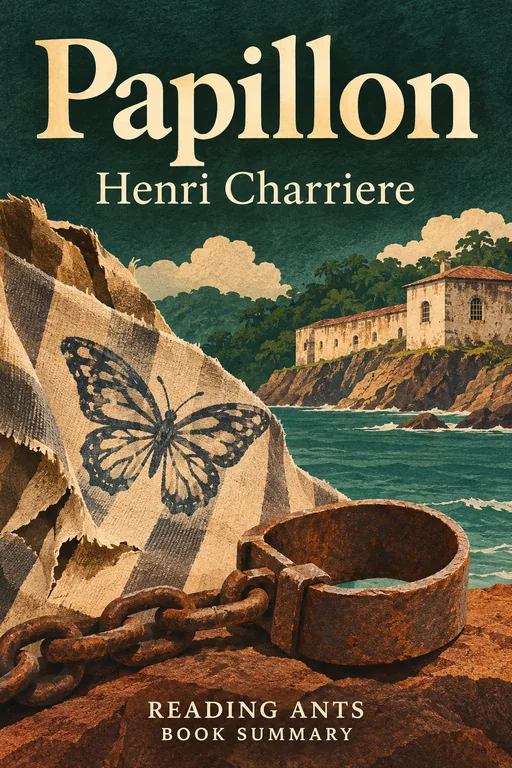
Papillon
Henri Charriere tells how, convicted of a murder he said he did not commit, he was sent to a brutal French penal colony in South America, and how he spent years in repeated and daring attempts to escape.
Overview
Papillon is a memoir published in French in 1969, written by Henri Charriere, a Frenchman nicknamed Papillon, which means butterfly, because of a butterfly tattoo on his chest. He was convicted in 1931 of the murder of a pimp in Paris, a crime he always denied, and was sentenced to the French penal colony in French Guiana. The book describes his years of imprisonment and several escapes. It became a worldwide bestseller and was made into a film in 1973 and again in 2017. Many details are disputed. French officials said he was never held on Devil’s Island itself, and researchers believe that Charriere mixed his own experiences with the stories of other prisoners.
Full Summary
A Verdict and a Voyage
The story begins with Charriere’s arrest in Paris, where he is accused of killing a pimp. He insists that he is innocent, but the court finds him guilty and sentences him to hard labor for life. He is put on a ship with other convicts, bound for French Guiana, a hot and disease-ridden colony in South America. During the voyage, he learns about the violence among the convicts, who often keep money hidden in a metal capsule in their bodies. He befriends Louis Dega, a banker convicted of counterfeiting, and agrees to protect him from men who want his money.
Life in the Prison System
On arrival, the prisoners are sent to camps in a hot, disease-ridden jungle region, where they face brutal guards and hunger. Violence and murder are common among the convicts, who attack one another for money. Charriere refuses to accept the situation, and his only goal is to get out. He pretends to be ill and is sent to the infirmary, where he plots an escape with two other convicts, Clousiot and Maturette.
Escape at Sea
The three men plan their escape with help from the leper colony near the town of Saint-Laurent-du-Maroni, which provides them with a sailboat. They escape in it, going down the river to the Atlantic and then northwest along the coast of South America. They reach Trinidad, where a British family helps them, and then Curaçao, where a Dutch bishop and others help, and more escapees join them. They sail on toward Colombia, but near its coast they are sighted, the wind dies, and they are captured and imprisoned again.
Among Native Peoples
In one of the most colorful sections, Charriere escapes from the Colombian prison and lives for a time with an indigenous community in the Guajira region on the Colombian coast, a village of pearl divers where he is accepted, and forms a close relationship with two young women, sisters. He enjoys a sense of freedom. But he is driven to take revenge on those who wronged him, and so leaves, only to be recaptured. He is held at Santa Marta and then Barranquilla, where he is reunited with Clousiot and Maturette, and his escape attempts there fail. In the end he is sent back to French Guiana. The account shows his mixture of charm, adventure and determination.
The Last Attempt
Back in French Guiana, Charriere is punished with two years of solitary confinement on the island of Saint-Joseph, where prisoners are kept in tiny cells, in silence, for long periods. He describes the effort of staying sane, by thinking, walking in his mind and remembering his past. Later, on another island, he is kept in solitary again after an escape plan is betrayed. After years of imprisonment, he asks to be sent to Devil’s Island, a small rocky island with steep cliffs, in his telling. There it seems impossible to escape. With a fellow convict named Sylvain, he studies the waves and discovers that every seventh wave is large enough to carry objects out to sea. They test the idea with sacks of coconuts, and then use them as rafts, jumping from a cliff into the water and drifting away on the current. They float for days toward the mainland, but Sylvain dies in quicksand near the shore, which is part of the price of the escape.
A Free Man
On the mainland, Charriere makes his way, with help, to Georgetown in British Guiana, and later sails on with other escapees to Venezuela. There they are captured and held in harsh detention camps near the mining town of El Dorado, but Charriere is eventually released. He later gains Venezuelan citizenship and becomes something of a celebrity there. In real life, he opened restaurants in Caracas and Maracaibo. The book closes with his feeling that he has finally recovered his freedom, and its lasting theme is that hope kept him going through all the years.
Why It Matters
Papillon is one of the best-known prison escape stories in modern literature. It drew attention to the French penal colonies, which had been widely criticized and were closed by 1953, and it reflected the human desire for freedom. The book’s adventure and its hero’s cleverness and optimism have made it popular around the world. At the same time, it is a text whose truth has been questioned, and so it has become a case study in how memoirs mix fact and legend. It has inspired later writers and filmmakers, and remains a favorite for readers who love stories of courage.
Key Takeaways
- Hope sustains survival. Charriere refused to give up on freedom.
- Cruel prisons damage people. The penal colony treated prisoners inhumanely.
- Loyalty among friends. Companions helped each other to endure.
- Cleverness and patience. His escapes depended on observation and planning.
- Memory and truth can blur. Memoirs may combine fact and fiction.
What We Can Learn
You can take from the book a lesson about resilience, the ability to keep your mind alive under pressure, and to hold on to hope. It also reminds us of the value of justice and fair trials, and why prisons should treat people humanely. As a reader, practice asking how an author knows what he claims, and compare accounts. And think about the difference between the thrill of a good story and the reality of suffering that it describes. If you read other prison memoirs, compare how different authors describe similar hardships, and notice what rings true.
Criticism and Counterpoints
Researchers who looked into Charriere’s life concluded that parts of his story could not be true, and that some episodes he describes happened to other prisoners. They also say that his dates and places do not match French prison records, and that his claim of innocence cannot be confirmed. One famous example is a rescue of a guard’s daughter from sharks, which critics say was done by another convict. Charriere himself said that the book was about seventy-five percent true. Because of such doubts, many readers now treat it as an adventure that is partly fiction.
Who Should Read It
This book is for adult readers who like thrilling escape stories and are aware that it mixes fact and fiction. It contains violence, harsh prison conditions and some sexual references. Those who want a strictly factual account of the penal colony should consult historical studies.
Want the whole book?
A summary is a taste, not the meal. Here is where to find the full book.
You reached the end 🎉
Nicely done. Mark this one as read, and we will suggest what to read next.
Read this next
The Count of Monte Cristo
Alexandre Dumas
A young sailor, betrayed by jealous rivals and thrown into a dungeon for fourteen years, escapes with the help of a fellow prisoner, finds a vast treasure and returns as a mysterious, powerful count to take elaborate revenge on those who ruined him.
🌍 World Literature
Les Miserables
Victor Hugo
A former convict, transformed by a single act of mercy, spends his life doing good while being hunted by a relentless police inspector, in a sweeping story of love, injustice and redemption in nineteenth-century France.
🌍 World Literature
If This Is a Man
Primo Levi
Primo Levi, an Italian Jewish chemist, describes with clarity and restraint his eleven months as a prisoner in the Auschwitz camp, and asks what it means to remain human when everything is taken from you.
👤 Real Lives
Kon-Tiki
Thor Heyerdahl
Thor Heyerdahl tells how he and five companions sailed a raft of balsa logs across the Pacific Ocean in 1947, to test his theory that ancient South Americans could have settled the islands of Polynesia.
👤 Real Lives
One Day in the Life of Ivan Denisovich
Aleksandr Solzhenitsyn
The novel follows a single ordinary day of a prisoner in a Soviet labor camp, showing how a man keeps his dignity through small acts of skill, shrewdness and kindness.
🌍 World Literature
Man's Search for Meaning
Viktor E. Frankl
A psychiatrist who survived the Nazi concentration camps explains that even in the worst suffering, people can choose their attitude, and that finding a reason to live is what gives us the strength to endure.
👤 Real LivesWant something different?
Pick another topic and we will show you three books to start with.