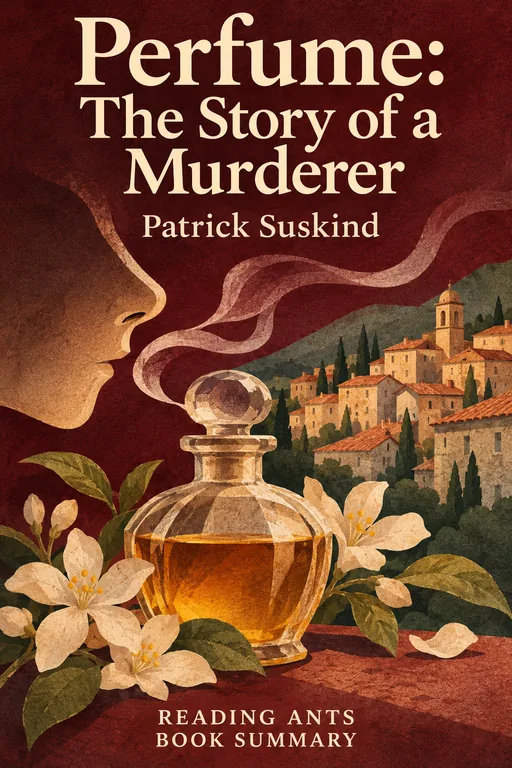
Perfume: The Story of a Murderer
Original title: Das Parfum
A man born with no scent of his own but an extraordinary sense of smell becomes a killer in his search for the perfect perfume.
Overview
Perfume: The Story of a Murderer is a novel by the German writer Patrick Suskind, published in 1985. It is set in eighteenth-century France, mostly in Paris and in the southern perfume town of Grasse. The story follows Jean-Baptiste Grenouille, a boy born in the filth of a fish market, who has a genius for smell and no human feeling. The novel is dark, strange and beautifully written, and it asks what happens when talent has no conscience. It contains disturbing scenes and is meant for mature readers.
Main Characters
- Jean-Baptiste Grenouille: a gifted, cold, solitary man with a perfect sense of smell.
- Baldini: an aging Paris perfumer who teaches Grenouille.
- Madame Gaillard: the woman who runs the home where Grenouille is placed as a baby.
- The Marquis de la Taillade-Espinasse: a pseudo-scientist who takes Grenouille in for a time.
- Antoine Richis: a rich official in Grasse, and the father of a girl whom Grenouille wants.
- Laure Richis: Richis’s daughter, a young girl whose scent Grenouille seeks.
Full Summary
A Child of the Fish Market
Grenouille is born in 1738 in a fish market in Paris, to a mother who has tried to abandon her children before. This time, she is found and arrested, and she is executed. The baby is passed from one home to another. Wet nurses find him disturbing, because he seems to have no smell of his own, and he is too greedy for milk.
As he grows, he shows an amazing talent: he can smell everything in the city, and he can separate any scent into its parts. He has no friends and no love for anyone.
The Perfumer’s Apprentice
When he is a teenager, Grenouille wanders through Paris and follows a scent that overwhelms him: that of a young girl in a back street. He kills her, to keep her from crying out and to take her scent for himself, and he realizes that he has found his purpose. The novel does not excuse the act, and the narrator treats it with cold irony.
He is hired by Baldini, an old perfumer whose business is failing. Grenouille impresses him by copying a famous perfume in a short time, and he makes new ones that bring Baldini fame and money. In return, Baldini teaches him the basic techniques, and Grenouille learns all he can.
Years Alone
Grenouille leaves Paris to find a way to preserve scents. He lives for seven years alone in a cave on a mountain in central France, away from all people. There he realizes that he himself has no scent, and that this is why people ignore him. He decides to make a scent that will make him seem human.
He then goes to Grasse, the center of the perfume trade, to learn the art of extracting scents from flowers.
The Killings in Grasse
In Grasse, Grenouille works in a perfume shop and learns new methods. He becomes obsessed with the scent of young women, and he starts to kill them and take their scent, one after another. The town falls into panic as the bodies are found. People think that a monster is loose, and the girls’ parents guard their daughters.
His final target is Laure, the daughter of the rich Antoine Richis, who has smuggled her out of town to protect her. Grenouille follows her and kills her.
Capture and Execution
Grenouille is caught, and he is condemned to death. On the day of his execution, he wears a drop of his new perfume, which is made from the scents of the girls he killed. As soon as the crowd smells it, a strange effect spreads: everyone is filled with love and awe, and they take him for an angel. The execution is canceled, the judge begs forgiveness, and the crowd gives way to a mass orgy, which the book describes only briefly. Even Richis, the father of the last victim, wants to adopt him, and an innocent man, Druot, who had been Grenouille’s superior at the Grasse workshop, is blamed for the murders.
Grenouille is free, but he finds that he does not feel any joy. He has been loved, but only because of a trick, and he hates people for it, and he cannot love anyone in return.
The End
Grenouille returns to Paris, and goes to the place where he was born. There, a crowd of the poor and the outcast gather around him. He pours the whole bottle of perfume over himself. The crowd is overcome with love, and they tear him apart and eat him, so that a part of him is in each of them.
The people leave the place, and each of them feels that they have done something out of love, though they never speak of it.
Why It Matters
Perfume became one of the best-selling German novels of the twentieth century, and has been translated into dozens of languages. It showed that a literary novel could also be a thrilling story, and it is admired for the way it makes smell, the most neglected of the senses, into the center of a story. It was made into a film in 2006. The book is often discussed as a dark fable about genius, art, power and the longing to be loved, and as a portrait of a monster who is both horrifying and strangely pitiable.
Key Takeaways
- Talent is not goodness. Grenouille’s genius does not make him a good person.
- The need to be loved is deep. His whole life is shaped by his lack of love.
- Appearances can deceive. The crowd is easily fooled by a scent.
- Obsession consumes. His single goal destroys everything around him.
- Art can be misused. Skill without ethics can lead to harm.
What We Can Learn
The book shows how a person with great gifts can still do great harm if he does not care about others. It is a reminder that talent should be paired with empathy and responsibility. It also asks us to notice how much of our judgment of people is based on surface signs, like looks or smells, and not on their real character.
Another lesson is the importance of early care. Grenouille’s cold life begins with rejection, and the story shows how harmful it is to be abandoned. This does not excuse his crimes, but it encourages us to care for children and to build communities where nobody is left alone.
Criticism and Counterpoints
Some readers find the book disturbing and cruel, especially in its portrayal of violence against young women, and they ask whether the story treats the victims as objects. Others criticize the final scene as too extreme and unlikely. A few find the long descriptions of smells tiring, and the narrator’s cold tone can seem distant. Still others say that the book is more about its ideas than about real characters, and that this is a weakness.
Who Should Read It
This book is for mature readers who like dark, literary fiction and unusual ideas. It is not suitable for younger teens, and those who are sensitive to violence should skip it. Readers who enjoy rich description and a fable-like story will find it unforgettable.
Want the whole book?
A summary is a taste, not the meal. Here is where to find the full book.
You reached the end 🎉
Nicely done. Mark this one as read, and we will suggest what to read next.
Read this next
The Tin Drum
Gunter Grass
A boy who refuses to grow up, and who screams glass to pieces, tells the story of Germany's Nazi years from the point of view of an outsider.
🌍 World Literature
Frankenstein
Mary Shelley
A young scientist creates a living being from dead body parts, then abandons it in horror, and his rejected creation, longing for love, turns to revenge.
🚀 Sci-Fi & Fantasy
The Picture of Dorian Gray
Oscar Wilde
A beautiful young man wishes that his portrait would grow old instead of him, and as he lives a life of selfish pleasure and cruelty, his face stays perfect while the painting reveals the ugliness of his soul.
📜 Classics
The Name of the Rose
Umberto Eco
A Franciscan friar investigates deaths in a medieval abbey, where the struggle to control books and laughter proves more dangerous than any supernatural curse.
🌍 World Literature
The Shadow of the Wind
Carlos Ruiz Zafon
A Barcelona boy's devotion to a forgotten novel draws him into the tragic history of its author and a struggle over whether stories and people can escape the past.
🌍 World Literature
The Little Prince
Antoine de Saint-Exupery
A pilot stranded in the desert meets a small boy from a tiny planet, who teaches him that the most important things in life, like love and friendship, can only be seen with the heart.
🌍 World LiteratureWant something different?
Pick another topic and we will show you three books to start with.