 Reading Ants
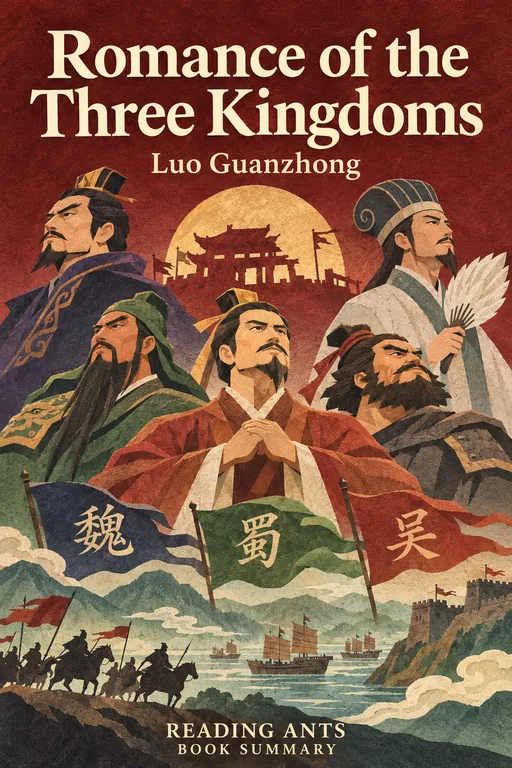
Romance of the Three Kingdoms
Original title: 三國志系列
As the Han dynasty collapses, warlords, strategists and sworn brothers struggle to reunify China, discovering that loyalty and brilliance cannot permanently master political change.
Overview
Romance of the Three Kingdoms is a vast Chinese historical novel based on the fall of the Han dynasty and the competing states of Wei, Shu and Wu. It transforms records, legends and centuries of storytelling into an epic of warfare, diplomacy, loyalty and strategy. The narrative gives special emotional weight to Liu Bei, Guan Yu and Zhang Fei, whose brotherhood represents a moral ideal, and to the strategist Zhuge Liang. Their rival Cao Cao is both ruthless and extraordinarily capable. With hundreds of characters and many campaigns, the novel is too large for a scene-by-scene short summary. Its central movement is from imperial collapse through divided rule to reunification under a new dynasty, emphasizing that political power never remains secure.
Main Characters
- Liu Bei: a leader who claims Han descent and presents his cause as restoration of legitimate, humane rule.
- Guan Yu: Liu Bei’s formidable sworn brother, celebrated for loyalty and martial honor.
- Zhang Fei: their fierce, impulsive sworn brother.
- Cao Cao: a brilliant, suspicious warlord who builds the foundation of Wei.
- Zhuge Liang: Liu Bei’s master strategist, associated with foresight, invention and devotion.
- Sun Quan: the durable ruler who establishes the state of Wu.
- Sima Yi: a patient Wei strategist whose family ultimately benefits from the long conflict.
- Lü Bu: a mighty warrior repeatedly undermined by betrayal and unstable loyalty.
Full Summary
Rebellion and Brotherhood
The Han empire is weakened by corruption, faction and the Yellow Turban Rebellion. Liu Bei meets Guan Yu and Zhang Fei, and the three pledge to live and die as brothers while serving the troubled dynasty. They fight rebels but gain little reward, beginning a long search for a stable base.
At court, the violent Dong Zhuo seizes control of the emperor. A coalition of lords forms against him, but rivalry prevents unity. Lü Bu, Dong Zhuo’s adopted son and greatest warrior, eventually kills him after a scheme involving the beautiful Diaochan. Disorder continues because removing one tyrant does not repair the institutions that enabled him.
Cao Cao Rises
Cao Cao gathers talented officers, controls the emperor and defeats competing northern warlords. He is decisive and rewards ability, but his suspicion and willingness to use terror make him feared. The novel repeatedly presents him as a dangerous alternative to Liu Bei’s moral claims, though his administrative and military gifts are undeniable.
Liu Bei loses territory and is separated from his brothers. Guan Yu temporarily serves Cao Cao under strict conditions, wins great victories and then leaves to rejoin Liu Bei. His journey reinforces his reputation for loyalty. After years of reversals, Liu Bei seeks the reclusive Zhuge Liang, visiting repeatedly before persuading him to serve.
Red Cliffs
Zhuge Liang argues that China can be divided among Cao Cao in the north, Sun Quan in the southeast and Liu Bei in the west. When Cao Cao advances south with a huge force, Liu Bei and Sun Quan form an uneasy alliance. Their commanders use deception, fire and knowledge of river warfare at the Battle of Red Cliffs.
Cao Cao’s fleet is destroyed, stopping immediate unification under Wei. Famous episodes emphasize borrowed arrows, false defections and careful reading of weather, though history and legend are closely mixed. The victory creates the conditions for the three kingdoms, but cooperation quickly returns to competition over strategic provinces.
Three Kingdoms Form
Liu Bei gains territory in the west. The former allies now compete openly, and Guan Yu, attacking north, is caught between Wei and Wu. Captured by Wu, he refuses submission and is executed. After Cao Cao’s death, his son Cao Pi formally ends the Han dynasty and establishes Wei, and Liu Bei declares himself emperor of Shu. Sun Quan later rules Wu.
Grief and anger drive disastrous choices. Zhang Fei is murdered by subordinates he has abused while preparing revenge. Liu Bei launches a massive campaign against Wu despite Zhuge Liang’s advice and suffers a crushing defeat. He dies after entrusting Shu and his heir to Zhuge Liang. The brotherhood that began with hope ends through war, betrayal and flaws within its own heroes.
Zhuge Liang’s Campaigns
As regent of Shu, Zhuge Liang stabilizes the south and repeatedly campaigns against Wei. He uses logistics, diplomacy and psychological tactics as much as battlefield force. His rivalry with Sima Yi becomes a contest between active ingenuity and patient defense. Several celebrated stratagems show Zhuge Liang creating advantage from limited resources.
Yet brilliance cannot remove Shu’s disadvantages. Campaigns fail through weather, supply problems, unreliable officers and the strength of Wei. Zhuge Liang works beyond endurance and dies during a northern expedition. Even after death, his reputation frightens enemies, but personal genius has not achieved reunification.
The Sima Victory
The next generation lacks the founders’ force. Shu continues expeditions that exhaust the state, while court factions weaken all three kingdoms. In Wei, Sima Yi survives political danger, defeats rivals and secures power for his family. His descendants replace the Cao ruling house and establish the Jin dynasty.
Wei first conquers Shu. Wu survives longer but also falls to Jin, formally reuniting the realm. None of the three kingdoms wins. The ending fulfills the novel’s broad cycle: unity gives way to division, and division eventually returns to unity. Heroism shapes how people face history, but no oath, strategy or dynasty escapes time.
Why It Matters
The novel has profoundly shaped popular understandings of the Three Kingdoms era across East Asia. Its heroes, villains and stratagems live in opera, games, film and everyday references. It asks readers to compare moral legitimacy, effective government and military success rather than assuming they always belong together. Liu Bei speaks for humane restoration, Cao Cao demonstrates formidable state-building, and the Sima family ultimately gains what neither side intended.
Its battles are memorable, but the deeper pattern is institutional collapse. Alliances fail when personal ambition outruns shared purpose; talented leaders cannot compensate forever for weak succession or poor resources. The novel also helped make strategists cultural heroes alongside warriors. Intelligence matters, yet Zhuge Liang’s fate warns against believing that one exceptional person can control every variable.
Key Takeaways
- Power and legitimacy are different. Characters continually debate whether ancestry, virtue, ability or victory creates a right to rule.
- Loyalty can inspire and blind. The sworn brothers’ devotion gives courage but also fuels revenge that damages their cause.
- Strategy includes human behavior. Deception succeeds by anticipating fear, pride, greed and expectation.
- Institutions outlast individual brilliance. Great leaders fail when supplies, succession and administration cannot support them.
- Political fortune is temporary. The eventual victor is not one of the three states whose struggles dominate the story.
What We Can Learn
Planning requires more than a clever idea. Zhuge Liang’s campaigns show the importance of supplies, timing, reliable colleagues and fallback options. In teams, skill should be built across the organization rather than concentrated in one exhausted person.
The brotherhood also offers a warning about loyalty. Supporting friends does not require endorsing every angry decision. Honest disagreement may be the more faithful act, especially when revenge threatens innocent people or a shared mission. Cao Cao’s success reminds us not to underestimate capable opponents merely because we dislike their methods. We can recognize competence without excusing cruelty. Finally, the cycle of division and unity encourages humility: present victories are chapters, not permanent endings.
Criticism and Counterpoints
The huge cast and rapid succession of campaigns can reduce civilians to background casualties. Women have limited roles and are often used in marriage diplomacy, sexual schemes or stories that advance male honor. Admiration for clever warfare can also make manipulation and mass violence feel like games.
The novel is historical fiction, not a neutral record. It favors Shu-Han legitimacy and transforms disputed events into memorable legend. Modern readers should compare it with historical scholarship rather than assuming every famous stratagem occurred as narrated.
Who Should Read It
This epic suits readers interested in strategy, political history, warfare and enormous casts. An edition with maps and character lists is highly recommended. Readers who want intimate character development may find it distant, and those avoiding executions, battlefield deaths or suicide should approach carefully.
Want the whole book?
A summary is a taste, not the meal. Here is where to find the full book.
You reached the end 🎉
Nicely done. Mark this one as read, and we will suggest what to read next.
Read this next
The Art of War
Sun Tzu
The greatest victory is the one won without fighting, achieved through careful planning, knowing both yourself and your opponent, and using deception, flexibility and timing.
🕊️ Philosophy & Religion
War and Peace
Leo Tolstoy
Five aristocratic Russian families are swept through the Napoleonic Wars, and through love, loss and searching, three of their young members discover what makes a life meaningful.
🌍 World Literature
The Iliad
Homer
During the final year of the Trojan War, the great Greek warrior Achilles withdraws from battle in anger, and only the death of his dearest friend drives him back to fight, leading to terrible loss and a moment of shared human grief with his enemy.
🎭 Epics, Drama & Poetry
Journey to the West
Wu Cheng'en
A rebellious, magical Monkey King and two monstrous companions protect a gentle Buddhist monk on his long, demon-filled journey from China to India to bring back holy scriptures.
🌍 World Literature
The Little Prince
Antoine de Saint-Exupery
A pilot stranded in the desert meets a small boy from a tiny planet, who teaches him that the most important things in life, like love and friendship, can only be seen with the heart.
🌍 World Literature
Things Fall Apart
Chinua Achebe
Okonkwo, a proud and fearsome leader in an Igbo village in Nigeria, struggles against his own fears and against the arrival of British missionaries and colonial rulers, who change his world forever.
🌍 World LiteratureWant something different?
Pick another topic and we will show you three books to start with.