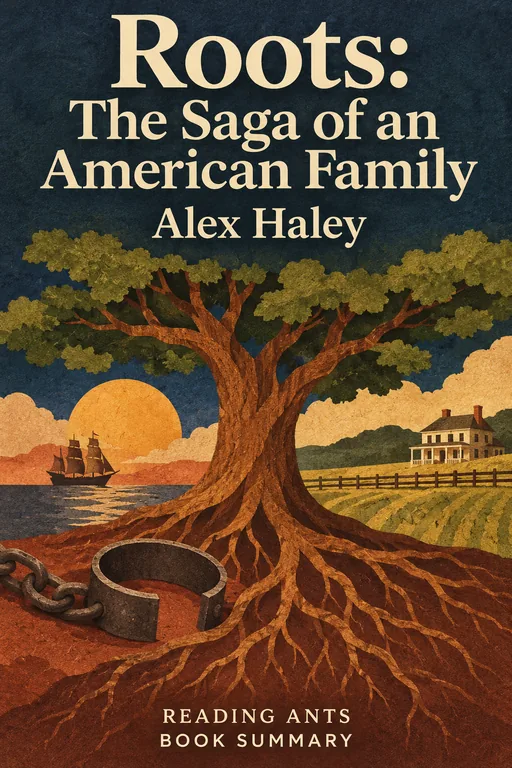
Roots: The Saga of an American Family
Beginning with Kunta Kinte, a young man seized from his village in the Gambia in 1767, this family saga follows seven generations of his descendants through slavery, the Civil War and freedom in America.
Overview
Roots: The Saga of an American Family is a historical novel by Alex Haley, published in 1976. Haley, a journalist who had co-written The Autobiography of Malcolm X, spent about twelve years researching his own family history, which he traced to Kunta Kinte, an ancestor said to have been brought from West Africa to Maryland. The book became a best seller and won a special Pulitzer Prize. It was adapted into a television miniseries in 1977 that was watched by an enormous American audience. Haley presented the story as based on fact, though he later acknowledged that much of it was invented, and that some of his claims were challenged.
Main Characters
- Kunta Kinte: a proud young Mandinka man who is taken into slavery and never accepts it.
- Bell: a kind enslaved woman on the Waller plantation who marries Kunta.
- Kizzy: their daughter, who is sold away from her family as a teenager.
- Chicken George: Kizzy’s son, a skilled trainer of fighting roosters.
- Tom Murray: Chicken George’s son, a blacksmith, and the family’s later leader.
- Cynthia and Will Palmer: later generations, including Haley’s own grandparents.
- Massa Waller and Tom Lea: slaveholders who shape the family’s fate.
Full Summary
Kunta Kinte in the Gambia
The book begins in 1750, in the village of Juffure in the Gambia, where Kunta Kinte is born into a family of farmers and warriors. As a boy, he is trained by his elders and goes through an initiation, learning the traditions and the history of his people. He is proud, and expects to become a man of honor. In 1767, while he is out searching for wood to make a drum, he is captured by slave catchers. He is taken in chains to the coast.
The Middle Passage
Kunta is packed with hundreds of other captives onto a slave ship, the Lord Ligonier. The conditions below deck are horrifying: people are chained, sick and half-starved, and many die. Kunta tries to hold on to his identity, and he and others plan a revolt, which fails. When the ship arrives in Annapolis, Maryland, he is sold at auction to a Virginia planter, John Waller, and is given the name “Toby.” He refuses the name, insisting that he is Kunta Kinte.
Life on the Plantation
On the Waller plantation, Kunta tries repeatedly to escape, and after his fourth attempt he is punished by having part of his foot cut off, to prevent further flight. He slowly befriends the fiddler, an older enslaved man, and later marries Bell, the plantation cook. They have a daughter, Kizzy, and Kunta teaches her about Africa and his language, insisting that she remember who she is. He tells her the Mandinka names of things, so that the family will not forget.
Kizzy
When Kizzy is sixteen, she helps a young man she cares for, Noah, to escape by forging a pass, and she is sold away. She is bought by Tom Lea, a small farmer in North Carolina, who rapes her, and she gives birth to a son, George. She grieves for her family and passes on the stories of her father to the boy, who is raised in a cabin near the Lea house. She never sees her parents again.
Chicken George
George grows up to be a skilled trainer of fighting roosters, earning the nickname Chicken George. He wins a lot of money for his owner and is allowed some freedom. He marries and has children. After the owner loses a bet, George is sent to England for years, and when he returns, he finds that his family has been sold to a new master in Alamance County. Heartbroken, he works to find them. After the Civil War, he leads his family to Tennessee, to start a new life as free people.
Freedom and Henning
The family settles in Henning, Tennessee, where Tom Murray, Chicken George’s son, who is a blacksmith, builds a community. The generations that follow include farmers, teachers and, finally, Haley himself, who ends the book by describing his own search for the family’s origins, including a visit to Juffure in the Gambia, where he meets a griot, an oral historian, who recites the history of the Kinte clan, including the story of Kunta’s capture. The book closes with the idea that the family has survived and keeps its history.
Why It Matters
Roots was a cultural phenomenon. The 1977 television miniseries was seen by an estimated hundred million people, and made the history of slavery part of a national conversation. The book also inspired a surge of interest in genealogy, especially among African Americans, and many people began to trace their own family histories. It was remade as a miniseries in 2016.
By telling the story of slavery from the point of view of an enslaved family, and tracing its roots to Africa, the book gave readers a sense of connection, and an awareness of the human cost.
Key Takeaways
- Family history gives identity. The story passes from generation to generation.
- Slavery destroyed families. Separation and violence mark the story.
- Resistance takes many forms. Kunta insists on his name and culture.
- Memory is a form of survival. The family preserves its stories.
- Freedom is hard won. The family’s journey is long.
What We Can Learn
The novel encourages us to learn about our own families and about the history that shaped them. Knowing where we come from can give us strength and a sense of belonging.
It also shows how deeply slavery harmed individuals and families, and encourages us to confront that history honestly.
Finally, it reminds us of the importance of oral tradition and storytelling, which can preserve a people’s identity even when other things are taken away.
It reminds us that history is made of individual lives, and that knowing a single family’s story can make a vast event, like the slave trade, feel real and personal.
Criticism and Counterpoints
After publication, Haley was accused of plagiarism, and in a lawsuit settled in 1978, he acknowledged that passages of Roots had been taken from Harold Courlander’s novel The African, and paid a settlement. Historians and genealogists have also questioned the accuracy of Haley’s claims about his family’s origins, and whether Kunta Kinte can be traced as he said.
Others criticize the book’s simplifications, such as the cast of heroic enslaved people and cruel whites, and its mix of fact and fiction. Still, many consider it an important cultural event.
Who Should Read It
This book suits mature readers. It is long, with scenes of violence, rape and cruelty. Readers should be prepared for its content, and may read it alongside historical accounts and narratives by formerly enslaved writers.
Want the whole book?
A summary is a taste, not the meal. Here is where to find the full book.
You reached the end 🎉
Nicely done. Mark this one as read, and we will suggest what to read next.
Read this next
Beloved
Toni Morrison
A formerly enslaved woman living in Ohio after the Civil War is haunted by the ghost of the daughter she killed to save her from slavery, and by the painful memories she has tried to bury.
✨ Modern Fiction
Uncle Tom's Cabin
Harriet Beecher Stowe
A devout, gentle enslaved man named Tom is sold from owner to owner and finally dies at the hands of a brutal master, while other enslaved people try to escape, in a novel that shocked America into facing the cruelty of slavery.
📜 Classics
Narrative of the Life of Frederick Douglass
Frederick Douglass
Frederick Douglass tells how he was born into slavery, taught himself to read, resisted a brutal master and escaped to freedom, showing that literacy and courage are weapons against injustice.
👤 Real Lives
The Autobiography of Malcolm X
Malcolm X and Alex Haley
Malcolm X tells, with the help of the writer Alex Haley, how he moved from a troubled childhood and a life of crime to leadership in the Nation of Islam, and then to a broader view of race and faith before his death.
👤 Real Lives
The Color Purple
Alice Walker
Told in letters, the story follows Celie, a poor Black woman in rural Georgia who survives abuse and loss, and through the love of other women finds her voice, her independence and joy.
✨ Modern Fiction
The Kite Runner
Khaled Hosseini
A wealthy boy in Kabul betrays his loyal best friend on the day of a kite tournament, and decades later, after fleeing to America, he returns to a Taliban-ruled Afghanistan to try to make things right.
✨ Modern FictionWant something different?
Pick another topic and we will show you three books to start with.