 Reading Ants
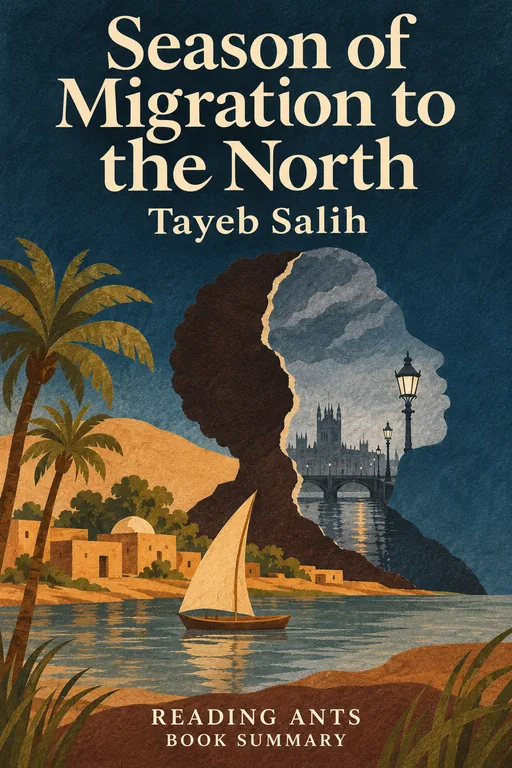
Season of Migration to the North
Original title: موسم الهجرة إلى الشمال
A Sudanese man returns from study in England to his village on the Nile, where he meets a mysterious stranger whose past in Europe reveals the dark side of the encounter between East and West.
Overview
Season of Migration to the North is a novel by the Sudanese writer Tayeb Salih, published in Arabic in 1966. It is set in a small village on the Nile, in northern Sudan, and in London, in the years after Sudan’s independence from British rule, while Mustafa’s story reaches back to an earlier, colonial period. The narrator comes home after seven years of study in England and finds a newcomer, Mustafa Sa’eed, who has his own secrets. The novel is a landmark of postcolonial literature, often described as a reply to Joseph Conrad’s Heart of Darkness. It deals with sexual violence, suicide and killing, and is for mature readers.
Main Characters
- The narrator: a young Sudanese man, educated in England, who returns to his village.
- Mustafa Sa’eed: a brilliant, mysterious man, who had lived in Britain and has settled in the village.
- Hosna Bint Mahmoud: Mustafa’s wife in the village, treated as a widow after he vanishes.
- Wad Rayyes: an older village man, who is loud and crude.
- Jean Morris: an Englishwoman, with whom Mustafa had a destructive relationship.
- The narrator’s grandfather: a wise, old man who represents village life.
Full Summary
Return Home
The narrator returns to his village after seven years in England, where he studied literature. He is delighted to be home, with the river, the palm trees and his family. At a gathering, he sees a newcomer, Mustafa Sa’eed, who has lived in the village for several years and has become respected.
Later, one night when Mustafa has been drinking, he recites a poem in fluent English, a strange thing in a village. The next day, the narrator asks him about it. Mustafa avoids a direct answer, but later, he tells him his story.
Mustafa’s Story
Mustafa was a child prodigy in Khartoum, who went to school in Cairo and then London. In Britain, he became a lecturer in economics, a brilliant man who found that people were fascinated by him. He used their fascination, and seduced a number of English women, who were attracted by his exotic appeal.
Several of the women killed themselves when he left them, or fell into misery. Others were hurt in other ways. Mustafa says that he did not feel guilty, as he saw his actions as a kind of revenge for the colonization of his country.
Jean Morris
His great passion was Jean Morris, a cold, cruel woman, who played games with him. They had a violent relationship, which ended when Mustafa killed her. He was put on trial for her murder. During the trial, he was defended by his supporters, who tried to present him as a victim of a troubled relationship.
He was sentenced to years in prison, and when he was freed, he traveled for a time, and then settled in the village, where he took up farming and married Hosna.
Mustafa’s Disappearance
Mustafa disappears, and it is assumed that he has drowned in the Nile, though this is never confirmed. Before he goes, he asks the narrator to look after his wife and children. The narrator finds in Mustafa’s private room a collection of mementos, and a blank book that was meant for a story. He finds that Mustafa has left him a burden to carry, but not a complete confession that explains everything.
The narrator promises to take care of the family, but he finds the responsibility more difficult than expected.
Hosna
Hosna, whom the village now treats as Mustafa’s widow, is pressured by the village to marry Wad Rayyes, a man much older than she is. She says that she does not wish to, and she turns to the narrator for help. But the narrator, who is bound by tradition and who is also confused, does nothing.
She is forced to marry Wad Rayyes. After she is forced into the marriage, she resists, and the story ends in violence, in which she kills Wad Rayyes and herself. The village is shaken. The narrator feels deeply guilty.
The River
In the last scene, the narrator, who is overwhelmed, goes into the river and swims out. He is in the middle of the stream, and is neither north nor south. He realizes that he has been in danger of letting himself go, and that he wants to live.
He calls out for help. The ending is ambiguous, and it does not tell us whether he is saved, but it points to his decision to choose life, and to face the world around him.
Why It Matters
This novel is regarded as one of the most important Arabic novels of the twentieth century. In a list compiled by Arab writers and critics, it was named the best Arabic novel of the century. It was a landmark in postcolonial writing, as it turns the tables on the colonial story: here, the man from the colony goes to the center of the empire. It is both a love story and a study of the harm done by empire. Its themes are still relevant to debates on race, identity and migration.
Key Takeaways
- Colonialism leaves wounds. The meeting of cultures can bring harm as well as exchange.
- Identity is split. Both the narrator and Mustafa belong to two worlds.
- Revenge hurts the avenger. Mustafa’s attempt at payback destroys him.
- Silence is complicity. The narrator’s failure to act has tragic results.
- Choosing life is an act of courage. The ending is a call to live.
What We Can Learn
The novel invites us to think about how history shapes personal lives, and how those who have been wronged may do wrong themselves. It encourages us to listen to different voices, and to understand perspectives other than our own.
It also shows the cost of staying silent when we see injustice, and the importance of taking responsibility for those who rely on us. Finally, the book suggests that, in a world of divided loyalties, each person must decide how to live and what to value.
Criticism and Counterpoints
Some critics find the portrayal of women in the book troubling, as the women are often victims or objects, and they have little voice. Others find the narrative structure confusing, with its shifts between the narrator and Mustafa. The mix of dreamlike scenes and realism can be hard to follow. The book’s treatment of sexual violence as a form of anticolonial revenge has been strongly debated, and some readers find that this is not adequately questioned.
Who Should Read It
This book is for mature readers who like challenging, literary novels and who are interested in history and culture. It is short but dense. Readers who are sensitive to descriptions of sexual violence or suicide should be careful.
Want the whole book?
A summary is a taste, not the meal. Here is where to find the full book.
You reached the end 🎉
Nicely done. Mark this one as read, and we will suggest what to read next.
Read this next
Heart of Darkness
Joseph Conrad
A sailor named Marlow tells his friends of a journey up the Congo River to find a mysterious ivory trader named Kurtz, and of the horror and moral darkness he finds at the end of it.
📜 Classics
Things Fall Apart
Chinua Achebe
Okonkwo, a proud and fearsome leader in an Igbo village in Nigeria, struggles against his own fears and against the arrival of British missionaries and colonial rulers, who change his world forever.
🌍 World Literature
The Quiet American
Graham Greene
In French colonial Vietnam in the early 1950s, a jaded British journalist, Thomas Fowler, watches an idealistic young American, Alden Pyle, cause harm with his good intentions, and must decide whether to betray him.
📜 Classics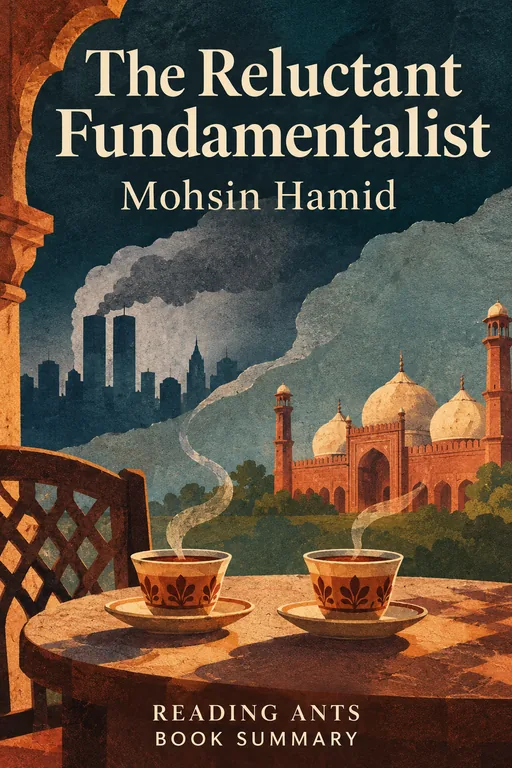
The Reluctant Fundamentalist
Mohsin Hamid
In a Lahore cafe, a Pakistani man tells an American stranger how he rose in New York, how September 11 changed his feelings, and why he came home.
🌍 World Literature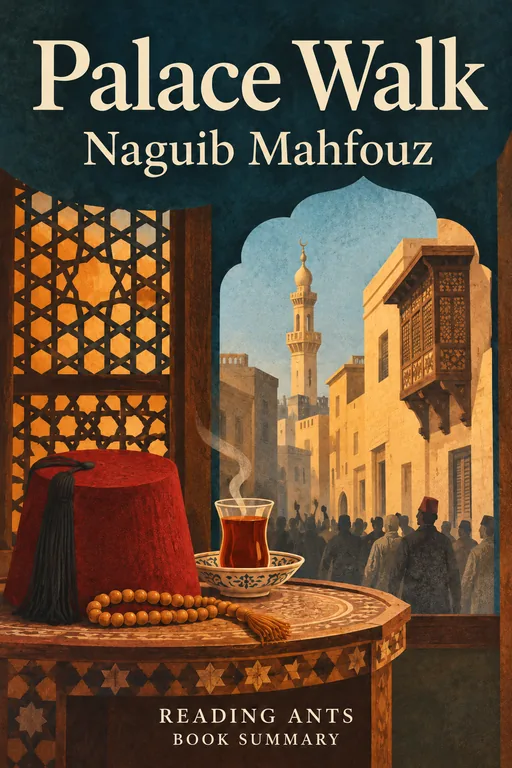
Palace Walk
Naguib Mahfouz
A strict Cairo merchant rules his family with an iron hand, while living a secret life of pleasure, and his household is shaken by love, change and the 1919 revolution.
🌍 World Literature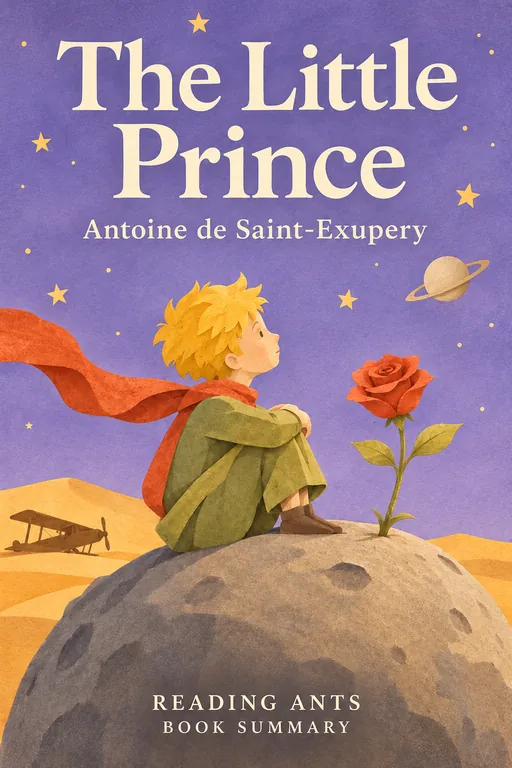
The Little Prince
Antoine de Saint-Exupery
A pilot stranded in the desert meets a small boy from a tiny planet, who teaches him that the most important things in life, like love and friendship, can only be seen with the heart.
🌍 World LiteratureWant something different?
Pick another topic and we will show you three books to start with.