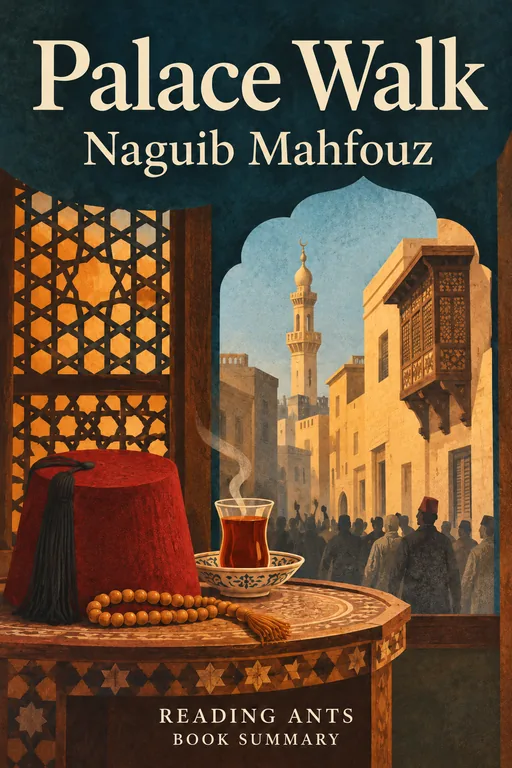
Palace Walk
Original title: بين القصرين
A strict Cairo merchant rules his family with an iron hand, while living a secret life of pleasure, and his household is shaken by love, change and the 1919 revolution.
Overview
Palace Walk is the first novel in the “Cairo Trilogy” by the Egyptian writer Naguib Mahfouz, published in Arabic in 1956. It is set in Cairo in 1917 to 1919, during the First World War and the Egyptian uprising against British rule. It follows the family of Al-Sayyid Ahmad Abd al-Jawad, a merchant who is a tyrant at home and a charming, cheerful man in the evenings. Mahfouz, who won the Nobel Prize in Literature in 1988, gives a rich, warm picture of daily life in an old quarter of Cairo, and of a family and a nation in change.
Main Characters
- Al-Sayyid Ahmad Abd al-Jawad: the father, strict at home, but fond of music, wine and company.
- Amina: his devoted, quiet wife, who is not allowed to leave the house.
- Yasin: the eldest son, from a previous marriage, easy-going and weak.
- Fahmy: a serious young law student, who is passionate about politics.
- Khadija: the sharp-tongued older daughter.
- Aisha: the pretty, gentle younger daughter.
- Kamal: the youngest son, a thoughtful, dreamy boy.
Full Summary
The House
The book opens in the family home, where Amina waits each night for her husband to come home. She must be ready to serve him, and she does not dare to ask where he has been. The children also fear him, and they hide their small acts of rebellion.
The father is a respected man in his neighborhood, a successful merchant who goes to the mosque and is known for his honesty. But after his shop closes, he goes out to meet friends, to drink, sing and spend time with singers and women.
The Children
The family lives in a house on a narrow street in the old part of Cairo, and every part of the day follows a pattern: early rising, coffee on the roof, and long family meals. The women of the house, Amina and her daughters, rarely leave, and they watch the street from behind a wooden screen. The children are close, though they are also afraid of their father’s temper.
Yasin, the eldest son, who has few ambitions, is attracted to women and pleasure, in a way that mirrors his father’s secret life. Fahmy, by contrast, is serious, and falls in love with Mariam, the girl next door, whom he sees only from afar.
Kamal, the youngest, is a curious child, who likes to listen to stories and to follow the British soldiers around the streets, and who adores his brother Fahmy. Khadija and Aisha are both preparing for marriage, though they are very different. Aisha is happy when a suitor comes for her, and she marries a man named Khalil.
The Uprising
In 1919, after the British exile Egyptian nationalist leaders, protests break out across the country. Fahmy joins the demonstrations, though his father has forbidden him. Fahmy is deeply patriotic, and wants to see his country free.
Al-Sayyid Ahmad, though conservative, is worried, and he argues with his son. But Fahmy cannot stay at home, and he marches in the streets with the crowd.
Fahmy’s Death
In a peaceful demonstration, British soldiers fire on the crowd, and Fahmy is shot and killed. The family is shattered. Amina, who has lost her favorite son, is overwhelmed with grief, and the father is deeply shaken, though he hides it behind his authority.
The household is plunged into mourning, and the father’s habits change for a time.
Amina’s Outing
This happens earlier in the story, before the uprising. Amina, who has been confined to the house for years, goes out while her husband is away, encouraged by her children, to visit the mosque of Sayyidna al-Husayn, which she has always wanted to see. On her way back, she is hit by a car and is injured.
When al-Sayyid Ahmad hears of this, he is furious that she has disobeyed him, and he sends her away to her mother’s house. She returns only after some time.
A Door Opens
The book ends on a note of change. The family is left damaged by the loss of Fahmy, and by the father’s double life, which his children begin to see more clearly. The father’s authority remains, but it is shaken. Other threads, such as Yasin’s unhappy marriage, the daughters’ marriages and the father’s affair with the singer Zubayda, run through the story. It continues in the next volume of the trilogy.
Why It Matters
Palace Walk is the first part of a trilogy that is often called the greatest work of modern Arabic fiction. It brought Mahfouz international fame and was a major reason for his Nobel Prize. It is an important portrait of Egyptian society at the time of the 1919 revolution, with its mixture of religion, tradition and a new spirit of nationalism. The family’s story is also the story of a country. It has been admired for its realism and compassion, and for its unforgettable characters. Many Egyptians see themselves, or their grandparents, in the family, and the book has been turned into films and television series. It is also often recommended as a first step into Arabic literature, since it is so warm and so full of everyday detail.
Key Takeaways
- Authority at home can hurt. The father’s strictness causes fear and secrecy.
- Double lives are costly. Al-Sayyid Ahmad’s hypocrisy affects his family.
- Politics enters the home. Fahmy’s patriotism changes the family’s fate.
- Women’s lives are limited. Amina’s world is small, but her strength is great.
- Change comes slowly. The old ways begin to loosen.
What We Can Learn
The book reminds us to think about how we use authority, whether as parents, bosses or leaders. Fear may produce obedience, but it does not produce love or trust. It also asks us to be honest, and to live in a way that is consistent with what we say.
It shows how political events touch ordinary families, and how young people can feel called to act. Finally, it invites us to understand the experience of women and others whose voices were not always heard, and to appreciate the strength of those who care for a family.
Criticism and Counterpoints
Some readers find the pace slow and the detail heavy, especially in the first section. Others criticize the portrayal of women as passive and limited to the home. The book’s treatment of the father is complex, and some feel that he is too easily forgiven. Some also find the nationalist story less detailed than the family drama. Still, the book is widely praised, and critics note that Mahfouz does not simply approve or condemn the father, but shows him as a man of his time, full of contradictions. Some modern readers feel uncomfortable with how much of the story depends on men’s freedom and women’s patience.
Who Should Read It
This book is for readers who like long, rich family stories and who are interested in the history and culture of Egypt. It is the first of a trilogy, so readers who enjoy it may want to continue. Those who prefer fast plots may find it slow.
Want the whole book?
A summary is a taste, not the meal. Here is where to find the full book.
You reached the end 🎉
Nicely done. Mark this one as read, and we will suggest what to read next.
Read this next
One Hundred Years of Solitude
Gabriel Garcia Marquez
Seven generations of the Buendía family live, love, fight and repeat the same mistakes in the magical Colombian town of Macondo, from its founding to its final destruction.
🌍 World Literature
The God of Small Things
Arundhati Roy
In Kerala, India, a pair of twins grows up in a divided family where a forbidden love across caste lines leads to a tragedy that haunts them for the rest of their lives.
✨ Modern Fiction
The House of the Spirits
Isabel Allende
Four generations of a Latin American family, bound by love, anger and the spirits that haunt them, live through the changes of a country moving toward dictatorship.
🌍 World Literature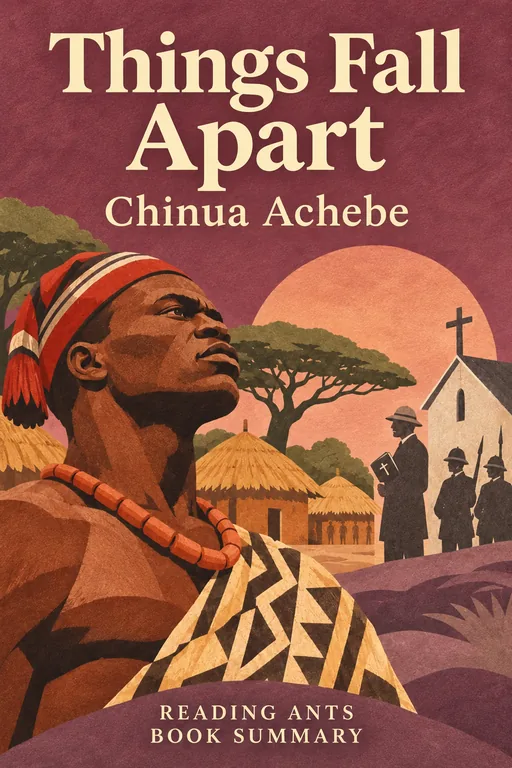
Things Fall Apart
Chinua Achebe
Okonkwo, a proud and fearsome leader in an Igbo village in Nigeria, struggles against his own fears and against the arrival of British missionaries and colonial rulers, who change his world forever.
🌍 World Literature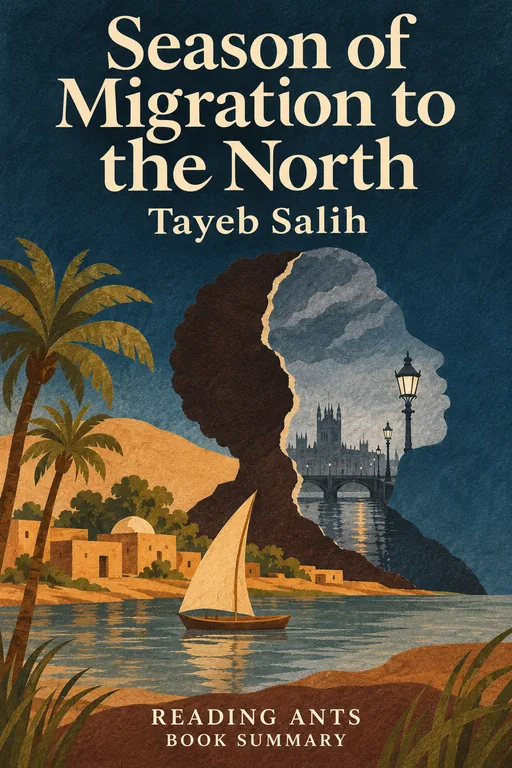
Season of Migration to the North
Tayeb Salih
A Sudanese man returns from study in England to his village on the Nile, where he meets a mysterious stranger whose past in Europe reveals the dark side of the encounter between East and West.
🌍 World Literature
The Little Prince
Antoine de Saint-Exupery
A pilot stranded in the desert meets a small boy from a tiny planet, who teaches him that the most important things in life, like love and friendship, can only be seen with the heart.
🌍 World LiteratureWant something different?
Pick another topic and we will show you three books to start with.