 Reading Ants
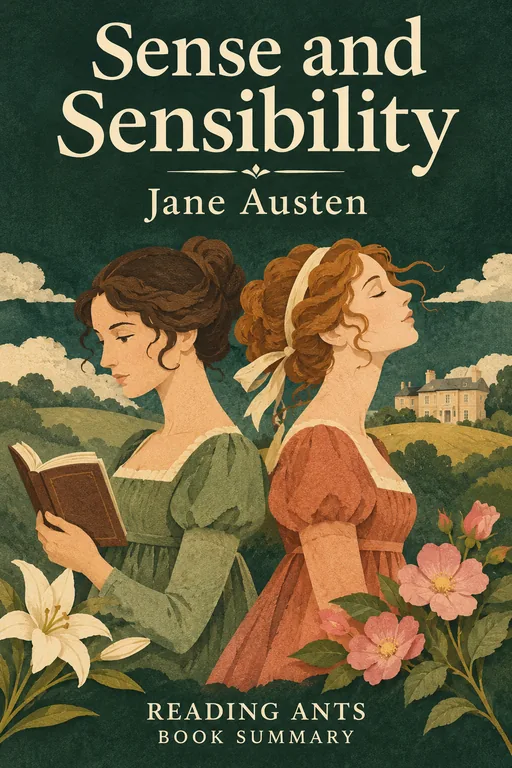
Sense and Sensibility
Two sisters, one sensible and reserved and one passionate and romantic, face heartbreak and the limits placed on women without money in Regency England, and learn from each other.
Overview
Sense and Sensibility was Jane Austen’s first published novel, appearing in 1811 under the name “By a Lady.” It is the story of Elinor and Marianne Dashwood, who are left poor when their father dies and their family estate passes to their half-brother. Elinor, who is calm and thoughtful, represents “sense,” while Marianne, who feels everything strongly, represents “sensibility,” a love of emotion. As they fall in love and face disappointment, they learn that neither extreme is perfect. The novel is both a gentle comedy and a critique of a society in which women’s futures depend on marriage and money.
Main Characters
- Elinor Dashwood: the elder sister, nineteen, sensible and self-controlled, who hides her own pain to protect others.
- Marianne Dashwood: sixteen, romantic, passionate and impulsive.
- Mrs. Dashwood: their mother, warm and generous but impractical.
- Margaret: the youngest sister.
- Edward Ferrars: a shy, honest young man whom Elinor loves.
- John and Fanny Dashwood: the half-brother and his selfish wife.
- Colonel Brandon: a quiet, kind older gentleman who loves Marianne.
- John Willoughby: a charming but unprincipled young man.
- Lucy Steele: a sly young woman with a secret engagement.
Full Summary
Leaving Norland
After Mr. Dashwood dies, his estate, Norland Park, passes to his son John from his first marriage. His wife Fanny convinces him to give his stepmother and half-sisters very little help. The Dashwood women are forced to leave. Meanwhile, Elinor has become close to Fanny’s brother, Edward Ferrars, a gentle man who does not seem eager to follow a grand career. His mother, however, expects him to marry well, and Fanny makes it clear that she disapproves of the attention he gives Elinor, so Mrs. Dashwood decides to leave Norland. The sisters are sad to leave the only home they have known, and Marianne, in particular, mourns the trees and the garden. Elinor, meanwhile, hides her disappointment and helps her mother to plan the move. A cousin, Sir John Middleton, offers them a small cottage at Barton in Devonshire.
Barton and Willoughby
In Devonshire, the Dashwoods meet the Middletons and Colonel Brandon, who admires Marianne, but she thinks him too old and dull. One day, Marianne twists her ankle, and a dashing young man, John Willoughby, carries her home. They share a love of poetry and music, and soon they behave as if they were engaged. Marianne is happy, and does not hide her feelings, though Elinor warns her that she is being too open. Then Willoughby suddenly leaves for London, saying he cannot return. Marianne is shocked and spends days weeping and waiting for a letter, while Elinor tries to reason with her and wonders whether the two were ever really engaged. The household is divided between hope and worry.
Elinor’s Secret Burden
At Barton, before the trip to London, Elinor learns that Edward has long been secretly engaged to Lucy Steele, a young woman who tells her of the engagement. Elinor, who has hidden her love, keeps her composure and her promise not to tell anyone, even as she suffers. She continues to behave graciously toward Lucy and Edward. She is not tempted to reveal her feelings, nor to blame Edward, who, she knows, acted foolishly in his youth. Her kindness to Lucy, who does not deserve it, shows the depth of her character. Her restraint shows her strength, though she feels pain.
London and Heartbreak
Marianne and Elinor go to London with Mrs. Jennings, a cheerful gossip. Marianne waits anxiously for word from Willoughby, who ignores her letters. When they meet at a party, he is cold and engaged to a wealthy woman. Marianne is devastated, and Elinor must comfort her. They learn from Colonel Brandon that Willoughby seduced and abandoned a young ward, which shows his true character. Marianne reads Willoughby’s cold letter returning her own, and she is overcome with misery, refusing to eat or sleep. Elinor tends her, while quietly carrying her own sorrow, and the contrast between the two sisters’ ways of coping becomes clear.
Illness and Reflection
Marianne, ill with grief and caught in the rain, falls seriously sick at Cleveland, the home of friends. Her life is in danger, and Elinor nurses her through the night. While Marianne is in danger, Willoughby appears and confesses his regret to Elinor, who pities him but tells him that it is too late. Colonel Brandon rides to fetch their mother, and Marianne recovers. During her convalescence, Marianne realizes that she has been careless and selfish in letting her emotions rule her, and resolves to be more considerate.
Resolution
Edward’s mother disowns him for refusing to give up Lucy and gives his inheritance to his brother Robert; Lucy then drops Edward and marries Robert instead. Edward, now free, proposes to Elinor, and she accepts. Marianne, in time, comes to value Colonel Brandon’s steady love and marries him. The two sisters live near each other in happiness.
Why It Matters
Sense and Sensibility launched Austen’s career and set up her main themes: marriage, money, manners and the difference between appearance and character. It has been adapted many times, including the acclaimed 1995 film directed by Ang Lee, with a screenplay by Emma Thompson, who starred as Elinor.
The novel is admired for its sharp humor and its portrayal of two sisters, whose bond is the heart of the story. It also shows the limits imposed on women of the time, such as the way that property passed down the male line could leave women dependent on male relatives, and remains a favorite for readers of all ages.
Key Takeaways
- Balance feeling and reason. Both sisters need a bit of the other’s qualities.
- Appearances can deceive. Willoughby’s charm hides his weakness.
- Money shapes lives. Women’s options depended on property.
- Quiet virtue matters. Elinor’s restraint is a form of strength.
- Love requires honesty and steadiness. The best matches are based on character.
What We Can Learn
The novel invites us to see that feelings and reason both have a place. Marianne learns that her unguarded emotions can hurt her and others, while Elinor learns that it is sometimes good to speak.
It also teaches that charm is not the same as goodness. We should judge people by how they act over time, especially toward those with less power.
Finally, it shows the value of family loyalty and resilience. The Dashwood women support each other through difficulty, which helps them to rebuild their lives.
Criticism and Counterpoints
Some readers find Marianne’s sudden change and her marriage to the older Colonel Brandon unconvincing or disappointing, and say that the ending is rushed. Others find the plot driven by coincidence, such as Lucy’s marriage to Robert, and see Edward as a weak hero.
Some modern readers feel that the book is too concerned with money and rank, or that its picture of women’s lives is narrow. Others note that the satire of selfish characters, such as Fanny, is sharp but sometimes harsh. Still, the novel is widely regarded as a classic.
Who Should Read It
This book suits readers from about age ten, though its language and pace are better suited for teenagers and adults. It has a gentle tone and a hopeful ending. A modern edition with notes can help with older vocabulary.
Want the whole book?
A summary is a taste, not the meal. Here is where to find the full book.
You reached the end 🎉
Nicely done. Mark this one as read, and we will suggest what to read next.
Read this next

Pride and Prejudice
Jane Austen
Quick-witted Elizabeth Bennet and the proud, wealthy Mr. Darcy badly misjudge each other, and only by facing their own faults do they find their way to love.
📜 Classics
Emma
Jane Austen
A clever, rich and rather spoiled young woman named Emma Woodhouse believes she is a gifted matchmaker, makes a series of embarrassing mistakes and finally learns to see herself and her own heart clearly.
📜 Classics
Persuasion
Jane Austen
Eight years after being persuaded to break her engagement to a poor naval officer, Anne Elliot meets him again, now rich and successful, and must find out whether their love can be won a second time.
📜 Classics
Northanger Abbey
Jane Austen
A young woman who loves Gothic horror novels goes to Bath and then to a mysterious old abbey, where her overactive imagination leads her into embarrassing mistakes, and she learns to tell fiction from real life.
📜 Classics
Mansfield Park
Jane Austen
A shy, poor girl raised among her wealthy relatives at Mansfield Park holds to her principles while charming newcomers disturb the household, and in the end her quiet integrity is shown to be right.
📜 Classics
Nineteen Eighty-Four
George Orwell
In a future Britain ruled by an all-seeing Party, one man secretly rebels by keeping a diary and falling in love, and discovers just how completely a totalitarian state can crush the human mind.
📜 ClassicsWant something different?
Pick another topic and we will show you three books to start with.