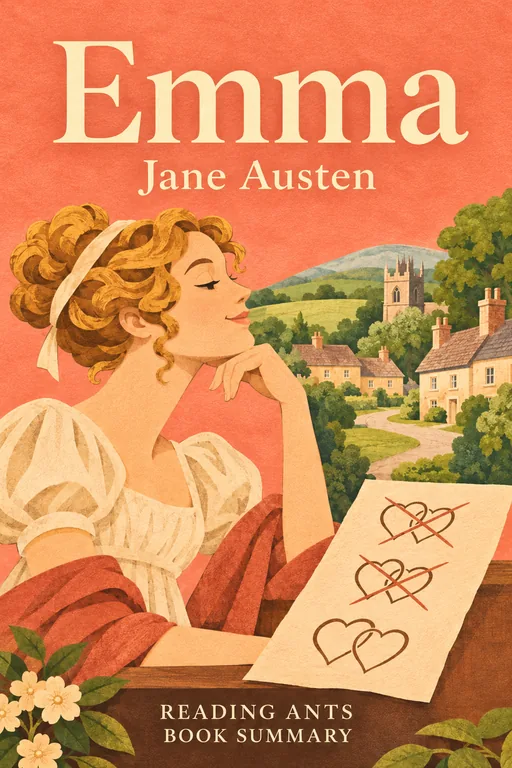
A clever, rich and rather spoiled young woman named Emma Woodhouse believes she is a gifted matchmaker, makes a series of embarrassing mistakes and finally learns to see herself and her own heart clearly.
Overview
Emma is a comic novel by Jane Austen, published in 1815. It is set in the small village of Highbury in the English countryside, where Emma Woodhouse, nearly twenty-one, lives with her anxious father. Having just arranged a match between her former governess and a neighbor, she decides to play matchmaker again, with disastrous results. Austen said that she was creating a heroine whom no one but herself would much like, but Emma’s lively mind and kind heart make her a favorite with readers. The book is a gentle satire of social snobbery and self-deception, and the story of a young woman growing up.
Main Characters
- Emma Woodhouse: a witty, confident, wealthy young woman who loves to arrange other people’s lives.
- Mr. Woodhouse: her kind but fussy father, who worries about health and drafts.
- Mr. George Knightley: a sensible neighbor and family friend, who is the only one to criticize Emma.
- Harriet Smith: a pretty, sweet, but impressionable girl whom Emma takes up as a friend.
- Mr. Elton: the vain local vicar.
- Frank Churchill: a charming young man who arrives in Highbury with a secret.
- Jane Fairfax: a graceful, talented, but poor young woman, who is Emma’s rival in accomplishments.
- Miss Bates: a kindly, talkative spinster.
Full Summary
A Matchmaker’s Beginning
At the opening of the novel, Emma’s governess and friend, Miss Taylor, has just married Mr. Weston, and Emma takes the credit for the match. Left with her father, she takes up Harriet Smith, a young boarder at a local school, who has no known parents. Emma decides that Harriet is too good for the farmer Robert Martin, who proposes to her, and persuades her to refuse. Instead, Emma plans to match Harriet with the vicar, Mr. Elton. Emma’s reasoning is that Harriet is sweet and pretty, and that Mr. Elton, a handsome and well-regarded clergyman, needs a wife. She flatters Harriet, paints her portrait and arranges walks and visits so that the two can meet, convinced that she can see what they cannot.
Misreadings
Mr. Knightley warns Emma that she is wrong, but she does not listen. Emma thinks Mr. Elton is falling in love with Harriet, as he praises Emma’s portrait of her. In reality, he is in love with Emma, and when he proposes to her in the carriage on the way home from a Christmas party, she is shocked and ashamed. Harriet is crushed, and Emma realizes that she has made a serious error. Mr. Elton leaves in a huff and later returns with a vulgar new wife. The new Mrs. Elton is rich, loud and boastful, and she quickly takes a dislike to Emma, insisting on organizing the neighborhood her own way. Her rudeness to Jane Fairfax and Harriet further shows Emma how silly her own snobbery has been.
New Arrivals
Frank Churchill, Mr. Weston’s son, comes to visit Highbury, and everyone says that he and Emma would make a perfect match. Emma enjoys his flirtation and, for a time, believes she may be in love, but she decides that she is not. Jane Fairfax, the niece of Miss Bates, comes home, and Emma, who is jealous of her talent, does not make friends with her. Mr. Knightley, who admires Jane, defends her, and Emma suspects him of loving Jane.
The Box Hill Picnic
At a picnic on Box Hill, the party is dull and Frank behaves badly, flirting with Emma and making sharp remarks. Emma, who is bored, makes a rude joke at the expense of Miss Bates, who is poor and kind and talks too much. Miss Bates is wounded, and Mr. Knightley scolds Emma privately. He tells her that she was cruel to someone who is below her, and Emma is mortified, weeping on the way home. She resolves to make amends, and visits Miss Bates the next day.
Secrets Revealed
Soon the truth about Frank and Jane emerges: they have been secretly engaged for months, and Frank has used flirting with Emma to hide it. Emma, who had suspected a different attachment, has been blind. Harriet confides that she has fallen in love with someone above her station; Emma first assumes that it is Frank Churchill, but Harriet means Mr. Knightley, and Emma realizes that she herself loves him. Emma is anxious that she might lose him. The thought that Knightley might marry someone else, perhaps Harriet, fills her with a pain she had never expected, and she finally understands that she has loved him for a long time without admitting it.
The Right Matches
Mr. Knightley proposes to Emma, and she accepts, to her great joy. Harriet turns out to love Robert Martin after all, and he proposes again, and she accepts. Mr. Woodhouse, who dislikes change, agrees to the marriage only because Knightley agrees to live at Hartfield, so that Emma can stay with her father. The novel ends with weddings, and with Emma wiser and more humble, having learned that her own judgment is not infallible.
Why It Matters
Emma is regarded as one of Austen’s most accomplished novels, and a masterpiece of comic fiction. Its use of free indirect speech, in which the narrator slips into the heroine’s thoughts, was an important development in the novel. It has been adapted many times, including the 1995 film Clueless, which set the story in a modern Beverly Hills high school, and several television and film versions.
The book also gives a rich picture of village life, class and manners in Regency England, and explores themes of self-knowledge and growing up.
Key Takeaways
- Self-knowledge is hard. Emma is wrong about herself and others.
- Good intentions can cause harm. Her meddling hurts Harriet.
- Kindness matters, especially to those with less power. Her words to Miss Bates are wrong.
- Honest friends help us grow. Knightley tells her the truth.
- Love can grow from friendship. Emma and Knightley know each other well.
What We Can Learn
The story shows that it is easy to misread other people when we are sure that we know best. Emma’s mistakes teach us to be more modest about our judgments, and to pay attention to what people actually say and do.
It also teaches that cruelty, even in a joke, can hurt. Emma’s remark to Miss Bates shows how careless words can wound, and how important it is to apologize.
Finally, it shows that growing up involves admitting mistakes. Emma’s willingness to see herself clearly is what makes her worthy of love.
Criticism and Counterpoints
Some readers find Emma snobbish and meddling, and dislike her for much of the book. Others say that the pace is slow, since much of the plot involves conversations and visits, and the hidden engagement of Frank and Jane may seem contrived. The novel’s picture of class, in which Emma judges Robert Martin as beneath her friend, also reflects attitudes that modern readers may dislike.
Some critics argue that Mr. Knightley’s role as a moral guide is a bit paternalistic, especially as he is much older and once saw Emma grow up. Still, the novel is admired for its wit and for the complexity of its heroine.
Who Should Read It
This book suits readers from about age ten, though its language and pace make it better for teenagers and adults. It is gentle and funny, with no violence. Readers may want a modern edition with notes.
Want the whole book?
A summary is a taste, not the meal. Here is where to find the full book.
You reached the end 🎉
Nicely done. Mark this one as read, and we will suggest what to read next.
Read this next
Pride and Prejudice
Jane Austen
Quick-witted Elizabeth Bennet and the proud, wealthy Mr. Darcy badly misjudge each other, and only by facing their own faults do they find their way to love.
📜 Classics
Sense and Sensibility
Jane Austen
Two sisters, one sensible and reserved and one passionate and romantic, face heartbreak and the limits placed on women without money in Regency England, and learn from each other.
📜 ClassicsPersuasion
Jane Austen
Eight years after being persuaded to break her engagement to a poor naval officer, Anne Elliot meets him again, now rich and successful, and must find out whether their love can be won a second time.
📜 ClassicsNorthanger Abbey
Jane Austen
A young woman who loves Gothic horror novels goes to Bath and then to a mysterious old abbey, where her overactive imagination leads her into embarrassing mistakes, and she learns to tell fiction from real life.
📜 ClassicsMansfield Park
Jane Austen
A shy, poor girl raised among her wealthy relatives at Mansfield Park holds to her principles while charming newcomers disturb the household, and in the end her quiet integrity is shown to be right.
📜 Classics
Nineteen Eighty-Four
George Orwell
In a future Britain ruled by an all-seeing Party, one man secretly rebels by keeping a diary and falling in love, and discovers just how completely a totalitarian state can crush the human mind.
📜 ClassicsWant something different?
Pick another topic and we will show you three books to start with.