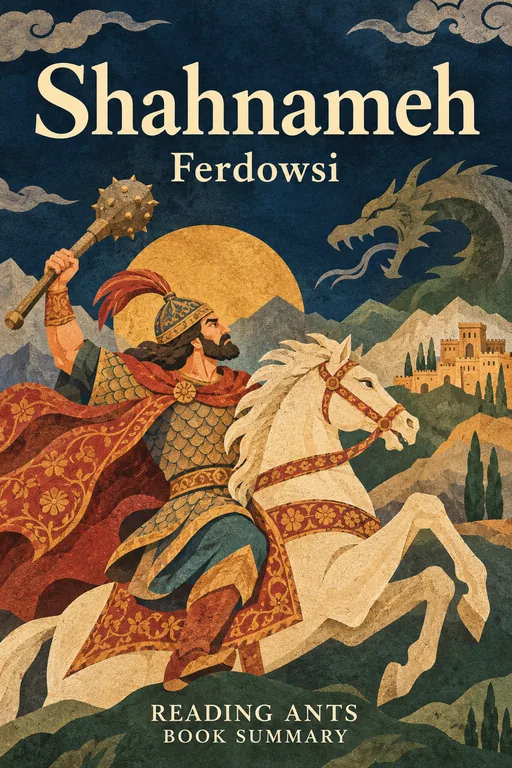
Shahnameh
Original title: شاهنامه
Ferdowsi's vast Persian epic tells the history of Iran from the creation of the world through legendary kings and heroes to the Arab conquest, with the tragic story of the hero Rostam at its heart.
Overview
The Shahnameh, or “Book of Kings,” is an epic poem in Persian written by the poet Ferdowsi and completed around 1010 AD. It contains about fifty thousand couplets, making it one of the longest poems by a single author in the world. Ferdowsi spent some thirty years on it, drawing on older Persian prose histories and oral traditions, and wrote it in a Persian that kept the language free of many Arabic words, in a way that helped preserve it. The poem moves from mythical time, with gods and demons, through heroic ages, to a more historical account of the Sasanian empire. It is regarded as the national epic of Iran, and is loved across the Persian-speaking world.
Main Characters
- Rostam: the greatest Persian hero, mighty, loyal and tragic.
- Zal: Rostam’s father, a white-haired hero raised by the magical bird Simurgh.
- Sohrab: Rostam’s son, who is killed by his father in a tragic mistake.
- Siyavash: a prince of pure heart, who is wrongly accused and killed.
- Kay Kavus and Kay Khosrow: kings of Iran, the first rash and the second wise.
- Afrasiab: the king of Turan, Iran’s great enemy.
- Zahhak and Fereydun: the tyrant with serpents on his shoulders, and the hero who defeats him.
- Esfandiyar: a prince who is a great warrior.
Full Summary
The First Kings and Zahhak
The poem begins with the first kings, who bring civilization: fire, crafts, farming and laws. A demon-possessed prince, Zahhak, seizes the throne by killing his father, and grows serpents on his shoulders, which feed on human brains. He rules as a tyrant for a thousand years, and each day his cooks sacrifice two young men to feed the serpents. A blacksmith named Kaveh rebels, using his leather apron as a banner, and joins the prince Fereydun, who overthrows Zahhak and imprisons him in a mountain. The banner of Kaveh becomes a symbol of the Persian people.
Rostam’s Birth and Rise
Zal, the son of the hero Sam, is born with white hair and is abandoned on a mountain, where the Simurgh, a great bird, raises him. He returns, falls in love with Rudabeh, and their son is Rostam, who grows to enormous size and strength. Rostam rides his horse Rakhsh, and becomes the champion of Iran, defending the kingdom against demons and invaders. In his Seven Labors, he fights lions, a dragon, a witch and the White Demon, in order to rescue the foolish king Kay Kavus.
Rostam and Sohrab
The best-known story of the poem is the tragedy of Rostam and Sohrab. Rostam, while hunting, stays one night with the king of Samangan, and the king’s daughter, Tahmineh, bears him a son, Sohrab, though Rostam does not know. Sohrab grows up to be a great warrior and, wanting to find his father, he leads an army of Iran’s enemies, the Turanians, against Iran. Rostam, who hides his name, meets him in battle, and neither knows the other. After a long fight, Rostam mortally wounds Sohrab, who tells him that he is Rostam’s son, and shows him a token. Rostam is shattered, and the story is a powerful lament for the waste of war.
Siyavash and Kay Khosrow
Siyavash, a young prince, is falsely accused by his stepmother, and proves his innocence by riding his horse through fire. He moves to Turan, where he marries a princess, but he is betrayed and killed by the king, Afrasiab. His son, Kay Khosrow, grows up to avenge him, and becomes a great king. Rostam helps him in the wars against Turan, which fill much of the middle part of the poem.
Later Heroes and the Fall
The poem continues with other heroes and kings, such as Esfandiyar, who is invulnerable except for his eyes, and who comes into conflict with Rostam. In the end, Rostam kills him with the help of the Simurgh, but Esfandiyar’s death brings sorrow, and in his own turn Rostam is betrayed by his half-brother and dies in a trap. Later sections treat Alexander and the Sasanian kings, in a more historical vein, ending with the Arab conquest and the end of the old empire.
The Sasanian section, which includes rulers like Bahram Gur, who hunted wild asses, and Anushirvan, known for justice, gives a picture of court life, law and learning. The poem ends with a sad note about the fall of the last king, Yazdegerd, and the passing of a great age.
Why It Matters
The Shahnameh is a cornerstone of Persian identity and culture. It helped preserve the Persian language and its memory of pre-Islamic Iran in the centuries after the Arab conquest, and it is recited, illustrated and quoted by Iranians, Afghans, Tajiks and others. Its stories are told in coffeehouses, performed in a traditional style and painted in manuscripts of great beauty.
The poem is also appreciated for its stories, many of which have become part of world literature. The Rostam and Sohrab story inspired Matthew Arnold’s poem, and the epic’s imagery remains alive in art and film.
Key Takeaways
- Tyranny is overthrown by the people. Kaveh’s rebellion shows resistance.
- Heroism has a cost. Rostam’s greatest deeds lead to personal tragedy.
- War destroys families. The Sohrab story is a lament.
- Justice and innocence can be tested. Siyavash rides through fire.
- Language and memory preserve identity. Ferdowsi’s poem protected Persian culture.
What We Can Learn
The poem teaches that rulers who abuse their power may be overthrown, and that ordinary people can lead a rebellion. The story of Kaveh the blacksmith is still told as a symbol of resistance.
It also shows how misunderstanding and pride can cause tragedy. Rostam’s failure to recognize Sohrab is a reminder of how conflict can blind us to those who are closest to us.
Finally, it demonstrates how a work of art can preserve a people’s language and history across centuries.
Criticism and Counterpoints
Some readers find the poem repetitive, with many battles and long lists of names. Others note that its view of enemies, especially the Turanians, who are often presented as villains, reflects the attitudes of its time and has been used in nationalist ways. The epic’s treatment of women is mixed: there are strong women, such as Rudabeh and Tahmineh, but many are subordinate.
The poem’s relation to history is debated, since many parts are legendary. There are many translations, of different length and quality. Still, it is deeply loved.
Who Should Read It
This poem suits teenagers and adults. Because of its length, most readers begin with selections, such as the tale of Rostam and Sohrab, in a good translation. It is a rewarding introduction to Persian culture.
Want the whole book?
A summary is a taste, not the meal. Here is where to find the full book.
You reached the end 🎉
Nicely done. Mark this one as read, and we will suggest what to read next.
Read this next
The Iliad
Homer
During the final year of the Trojan War, the great Greek warrior Achilles withdraws from battle in anger, and only the death of his dearest friend drives him back to fight, leading to terrible loss and a moment of shared human grief with his enemy.
🎭 Epics, Drama & Poetry
The Odyssey
Homer
After the Trojan War, the clever hero Odysseus struggles for ten years against monsters, gods and temptations to return home to his faithful wife and son, then must win back his house from the men trying to steal it.
🎭 Epics, Drama & Poetry
Beowulf
Anonymous
A mighty young warrior sails to Denmark to defeat a monster terrorizing a king's great hall, then battles the monster's vengeful mother, and decades later, as an old king, gives his life fighting a dragon.
🎭 Epics, Drama & Poetry
The Epic of Gilgamesh
Anonymous
A proud, powerful king of ancient Mesopotamia gains a true friend, loses him to death, and journeys to the edge of the world in search of eternal life, only to learn that what lasts is the life and legacy we leave behind.
🎭 Epics, Drama & Poetry
The Aeneid
Virgil
After the fall of Troy, the hero Aeneas leads a band of refugees across the sea to Italy, where he is fated to found the line that will build Rome, at great personal cost.
🎭 Epics, Drama & Poetry
Hamlet
William Shakespeare
A grieving prince of Denmark learns from his father's ghost that his uncle murdered the king to take the throne, and his struggle to decide whether and how to take revenge leads to madness and death.
🎭 Epics, Drama & PoetryWant something different?
Pick another topic and we will show you three books to start with.