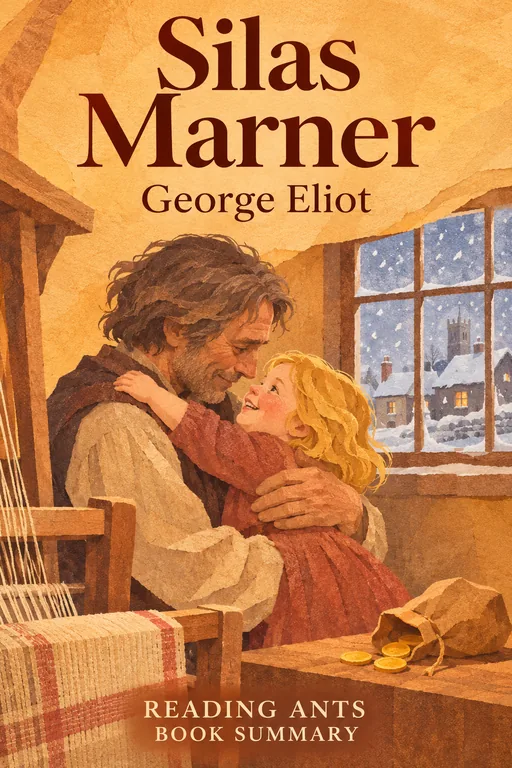
Silas Marner
A lonely weaver, wronged by his friends and turned into a miser, finds his life transformed when a golden-haired toddler wanders into his cottage on a snowy night, after his gold has been stolen.
Overview
Silas Marner: The Weaver of Raveloe is a short novel by George Eliot, the pen name of Mary Ann Evans, published in 1861. It is a moral tale set in a small English village in the early nineteenth century, and it explores how love and community can heal a damaged person. Compared with Eliot’s longer works, it is brief and simple in structure, and has been widely read in schools. Eliot said that the story first came to her as a legend-like tale, sparked by a childhood memory of a linen weaver carrying a bag on his back, and the finished book is gentle and humane.
Main Characters
- Silas Marner: a linen weaver who is withdrawn and bitter after an injustice.
- Eppie: the golden-haired child who comes to Silas, and whom he raises.
- Godfrey Cass: the weak-willed elder son of the squire, with a secret.
- Dunstan Cass: Godfrey’s wicked younger brother, who steals Silas’s gold.
- Nancy Lammeter: a good, upright young woman whom Godfrey loves.
- Dolly Winthrop: a kind neighbor who helps Silas with the child.
- William Dane: Silas’s former friend, who betrays him.
Full Summary
A man cast out
Silas Marner is a weaver in Lantern Yard, in a large manufacturing town, where he has a close friend, William Dane, and a fiancée. But William plots against him: when the church’s treasury is stolen, Silas is accused, and, in the end, the church decides his guilt by drawing lots. Silas, heartbroken and shaken in his faith, finds that his friend has also taken his fiancée. He leaves, and settles in the village of Raveloe, where he lives alone, working at his loom.
The miser of Raveloe
For fifteen years, Silas lives apart, avoiding contact with the villagers, who find him odd and even slightly frightening. He weaves day and night, and his only pleasure is in counting the gold coins he has earned, which he hides under his floor. The money takes the place of human affection. The villagers speculate about him, and some think that he has strange powers, because of the trances that he sometimes falls into. A kindly neighbor, Dolly Winthrop, tries to befriend him, but Silas remains wary.
The theft
Dunstan Cass, the squire’s selfish younger son, who is always in need of money, hears about the weaver’s gold. One foggy evening, while Silas is out, Dunstan enters the cottage and takes the money. He disappears, and no one knows what has happened to him. Silas is devastated and falls into despair. The villagers, hearing of the theft, sympathize with him for the first time, and some of them call on him. But the loss leaves him empty, and he looks at the empty hole where his hoard had been.
The child at the hearth
Godfrey Cass, the elder son, has a secret: he is married to a poor woman, Molly, who is addicted to opium, and has a daughter. On New Year’s Eve, Molly sets out through the snow to confront Godfrey at the Cass family’s party, but she collapses and dies. Her child toddles toward the light of Silas’s cottage and falls asleep by the fire. When Silas, who has fallen into one of his trances, comes to, he sees what he thinks is his gold, and then realizes it is the child’s golden hair.
Silas raises Eppie
Silas decides to keep the child, whom he names Eppie after his mother and sister. Godfrey, who does not want to reveal his secret, does not claim her. Silas is helped by Dolly Winthrop, who teaches him how to look after a toddler. He becomes a devoted father, and the villagers, seeing his love for her, accept him as part of the community. Silas’s heart opens, his faith in goodness returns, and the child brings light into his life. Meanwhile, Godfrey marries Nancy Lammeter, though they remain childless.
Sixteen years later
Years pass, and Eppie grows into a lovely young woman, engaged to Aaron Winthrop, Dolly’s son. The old stone pit near Silas’s cottage runs dry after draining of the nearby fields, and Dunstan’s skeleton is found in it, along with Silas’s stolen gold. Godfrey, shaken, confesses to Nancy that Eppie is his daughter, and the couple go to claim her, offering her a comfortable home. Eppie, however, refuses to leave the father who raised her, and Silas is deeply moved. Godfrey is left with his regret, and Eppie marries Aaron. Silas, with his gold returned, is surrounded by love.
Why It Matters
Silas Marner is one of George Eliot’s best-known novels, partly because of its short length and clarity, and it is often a first introduction to her. It presents a hopeful view of how human sympathy and connection can restore a person, and it contrasts the value of gold with the value of a child’s love. Eliot also depicts village life with realism and humor, and with affection for ordinary people. The novel makes an argument about moral responsibility, since Godfrey’s choice to deny his child leads to loss, while Silas’s choice to take her brings joy.
Key Takeaways
- Love heals isolation. Eppie draws Silas back into the world.
- Gold cannot replace people. The hoard gives no real warmth.
- Evasion has a price. Godfrey’s secrecy costs him his child.
- Community matters. The neighbors’ kindness helps Silas to change.
- Justice can be slow. The truth about the robbery emerges after sixteen years.
What We Can Learn
You can learn from Silas that withdrawing from others after being hurt may bring safety but also emptiness, and that letting people in can restore meaning. The novel also shows the danger of avoiding responsibility, as Godfrey does, and the quiet reward of doing what is right, as Silas does. It reminds us that wealth is no substitute for relationships. If you know someone who is isolated, you might think about how small acts of kindness, like Dolly Winthrop’s, can help.
Criticism and Counterpoints
Some readers find the story too sentimental or neat, particularly the arrival of Eppie at the very moment that Silas loses his gold, and the discovery of the skeleton, which is a convenient coincidence. Others feel that the treatment of religion at Lantern Yard, where lots decide a man’s fate, is harsh, or that the Cass family are one-dimensional. A few say that the novel is less complex than Eliot’s longer works, such as Middlemarch. However, many readers value its warmth, its rural detail, and the human truth at its heart.
Who Should Read It
This book is for readers from about twelve who enjoy classic novels, and for those new to George Eliot, since it is short and clear. It is suitable for school reading and for adults who like moral stories. Readers who want more depth may continue with Middlemarch or The Mill on the Floss.
Want the whole book?
A summary is a taste, not the meal. Here is where to find the full book.
You reached the end 🎉
Nicely done. Mark this one as read, and we will suggest what to read next.
Read this next
Middlemarch
George Eliot
In a provincial English town around 1830, several ambitious people, above all the idealistic Dorothea Brooke and the gifted doctor Tertius Lydgate, make marriages and choices that fall short of their dreams.
📜 Classics
Great Expectations
Charles Dickens
A poor orphan boy suddenly receives a fortune from a secret benefactor and becomes a gentleman in London, but he learns that wealth and status mean nothing without loyalty, kindness and gratitude.
📜 Classics
Oliver Twist
Charles Dickens
An orphan boy born in a workhouse escapes to London, where he falls into a gang of child thieves, and despite cruelty and crime around him, his goodness survives until he finds a loving home and learns the secret of his birth.
📜 Classics
Tess of the d'Urbervilles
Thomas Hardy
A poor country girl named Tess Durbeyfield is wronged by one man and abandoned by another, and her struggle to live honestly against harsh social rules ends in tragedy.
📜 Classics
Jane Eyre
Charlotte Bronte
A poor, plain but fiercely independent orphan becomes a governess, falls in love with her brooding employer, discovers his terrible secret, and refuses to give up her self-respect even for love.
📜 Classics
Pride and Prejudice
Jane Austen
Quick-witted Elizabeth Bennet and the proud, wealthy Mr. Darcy badly misjudge each other, and only by facing their own faults do they find their way to love.
📜 ClassicsWant something different?
Pick another topic and we will show you three books to start with.