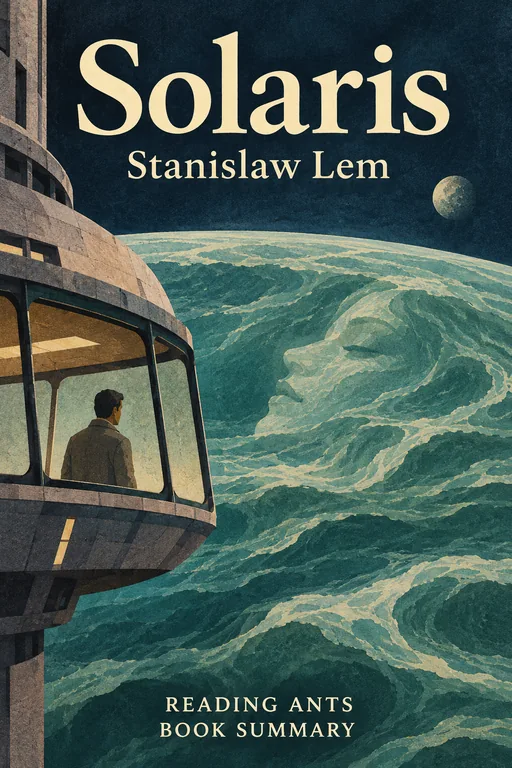
Solaris
A psychologist arrives at a research station above a strange living ocean on a distant planet, where the ocean brings his past to life and shows the limits of human understanding.
Overview
Solaris is a science fiction novel by the Polish writer Stanislaw Lem, published in 1961. It takes place in the future, on a station hovering over the planet Solaris, where a vast ocean covers the surface. Scientists have studied this ocean for many decades without understanding it. The book is less about adventure than about a deep question: can humans truly meet and understand a completely alien mind, or do we only see ourselves in it?
Main Characters
- Kris Kelvin: a psychologist who comes to the station, the narrator.
- Harey (Rheya): a woman who appears at the station, a copy of Kelvin’s lost love.
- Snaut: a scientist on the station, tired and wary.
- Sartorius: a cold, secretive scientist who works in his own laboratory.
- Gibarian: the senior scientist and Kelvin’s old teacher, who has died before Kelvin arrives.
Full Summary
Arrival
Kris Kelvin travels to the station on Solaris, and finds it in disorder. The scientists he expected to meet are not as he thought. His teacher Gibarian is dead, and the remaining two, Snaut and Sartorius, seem nervous and strange. They hint that there is something about the station that he must see for himself. Kelvin is puzzled and uneasy.
Earth scientists have studied the ocean for generations, creating a whole field called Solaristics. The ocean forms shapes and patterns, and is clearly very active, but no one knows whether it is conscious, or whether it has any intentions at all.
Kelvin soon learns that Gibarian has taken his own life shortly before his arrival. Snaut speaks to him in hints and warnings, and Kelvin sees that the people on the station are afraid of something that they do not want to describe. He is told to expect “guests” and not to be alarmed. He does not understand what that means, and he keeps his own mind under tight control, as a scientist should.
The Visitor
The next morning Kelvin finds Harey in his room. She is the image of a woman he once loved, who died long ago, partly because of a decision that he made. He knows that she cannot be real, and he panics, and sends her away in a rocket capsule.
Soon, however, a new Harey appears, a fresh copy, not the same one returning, and he realizes that the ocean is creating these “visitors” from the memories of the people on the station. Each of the scientists has a visitor of their own, drawn from their deepest secrets and guilt.
Living with Harey
Harey does not know at first that she is not human. As she learns what she is, she is shocked and sad. She tries to understand, and she grows into a real personality, with feelings of her own. Kelvin, despite his doubts, comes to care for her.
The scientists try to find a way to stop the visitors, and Sartorius works on a method of destroying them with radiation. Harey, understanding that she causes Kelvin pain, takes drastic action to end her own existence, though a new copy comes back again.
The Ocean’s Mind
The scientists decide to send a beam toward the ocean that carries a recording of Kelvin’s own brain activity. It is a kind of message, meant to show the ocean what the visitors are doing to the people who made them. They do not know how it will be understood, or whether the ocean can understand at all. Over the following days, the visitors stop appearing.
Kelvin has a last and final loss when Harey disappears, this time for good: she asks Snaut to annihilate her, and he does so. He had hoped that he could build a life with her, however strange, and he is left with an empty feeling and a deep sense of the limits of knowledge. Snaut, who has watched all this with weary sympathy, tells him that the ocean may not have meant any harm, and may not have meant anything that humans can grasp.
The Shore
At the end, Kelvin considers staying on Solaris and does not leave at once. He flies out to a newly formed island in the ocean, and he stands on its shore. He puts his gloved hand into the moving surface, and the ocean seems to respond gently, almost as if it were touching him back. Kelvin feels something like hope.
The book ends without a clear answer. The ocean remains a mystery, and Kelvin, who has changed, understands that the search for contact matters more than any final explanation. He is left to wonder whether the ocean’s cruelty and kindness were ever intended at all.
Why It Matters
Solaris is generally considered one of the great science fiction novels, and it is the best-known work of Lem, who became one of the most widely read science fiction writers in the world. It challenges the idea, common in the genre, that aliens will be like us, and shows how hard it could be to understand a truly different mind. It was made into films by the Soviet director Andrei Tarkovsky in 1972 and by Steven Soderbergh in 2002. Lem himself was critical of the film versions in general, saying that they moved away from his ideas, and he objected to reviews that read the story mainly as a love story. The book is also admired for its long, thoughtful passages that invent a whole imaginary science, with its own history, schools and quarrels, and for showing that the real subject of science fiction can be the human mind and not the machines.
Key Takeaways
- The alien may be truly alien. Humans tend to project themselves onto what they do not understand.
- Knowledge has limits. Generations of science have not solved the ocean’s mystery.
- Memory and guilt shape us. The visitors come from the characters’ regrets.
- Love can be real even when its source is strange. Harey becomes a person in her own right.
- The search matters. Contact, even without full understanding, can change us.
What We Can Learn
Solaris encourages humility. We often think we understand the world, but there will always be things that lie beyond our knowledge. It is good to stay curious, and to accept uncertainty without being afraid of it.
The book also shows how our unresolved guilt can shape our lives, and how facing it honestly is better than running away. Finally, it reminds us that when we meet people, ideas or cultures that are different from our own, we should try to listen first, and not simply see what we expect to see.
Criticism and Counterpoints
Some readers find the book slow and abstract, with long passages about the history of Solaristics and few action scenes. The characters can seem cold, and the open ending frustrates readers who want answers. Lem’s own attitude to the film versions was critical, since he felt they made the story into a love story, and in doing so missed his main theme about the unknowable. Some also find that the secondary scientists are sketched only lightly, and that the translation history of the English text, which for many years was made from a French version and not from the Polish, until a direct translation from Polish appeared, has affected how the book is read in English.
Who Should Read It
This book is for older teens and adults who like thoughtful science fiction and enjoy big questions more than fast action. It is short and well written. Readers looking for space battles or clear explanations may be disappointed, while those who love mysteries of the mind will be rewarded.
Want the whole book?
A summary is a taste, not the meal. Here is where to find the full book.
You reached the end 🎉
Nicely done. Mark this one as read, and we will suggest what to read next.
Read this next
The Left Hand of Darkness
Ursula K. Le Guin
A lone envoy from a league of human worlds travels to the frozen planet Gethen, where people have no fixed gender, and learns to trust a local statesman, Estraven, who is exiled for his politics and who comes to the envoy's aid.
🚀 Sci-Fi & Fantasy
Do Androids Dream of Electric Sheep?
Philip K. Dick
In a ruined, nearly empty San Francisco, bounty hunter Rick Deckard is hired to track down and kill six escaped androids, and as he does so he begins to doubt the line between humans and machines.
🚀 Sci-Fi & Fantasy
Project Hail Mary
Andy Weir
A man wakes up alone on a spaceship with no memory, slowly discovers that he is humanity's last hope to stop a microbe that is dimming the sun, and finds an unexpected friend among the stars.
🚀 Sci-Fi & Fantasy
The Three-Body Problem
Liu Cixin
A scientist investigating suicides and impossible experimental results uncovers a secret human movement preparing for an alien civilization whose arrival could end human independence.
🌍 World Literature
Dune
Frank Herbert
When his noble family is betrayed and destroyed, young Paul Atreides escapes into the deserts of the planet Arrakis and rises to lead its native people, the Fremen, in a revolution that will change the universe.
🚀 Sci-Fi & Fantasy
The Little Prince
Antoine de Saint-Exupery
A pilot stranded in the desert meets a small boy from a tiny planet, who teaches him that the most important things in life, like love and friendship, can only be seen with the heart.
🌍 World LiteratureWant something different?
Pick another topic and we will show you three books to start with.