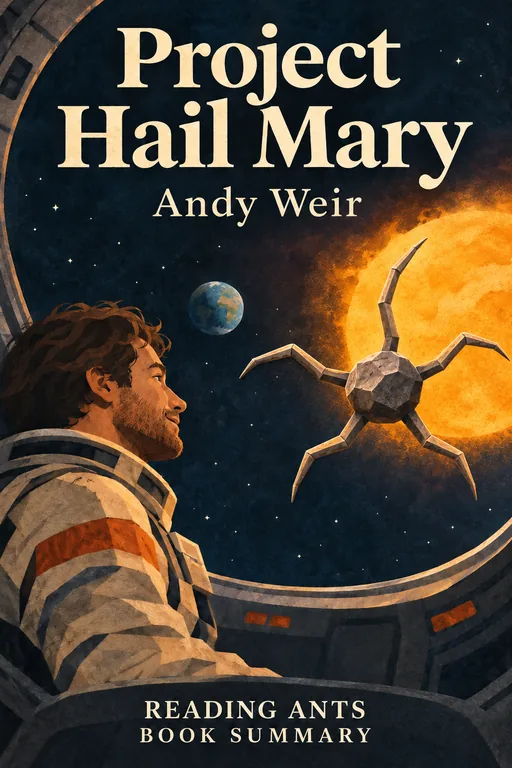
Project Hail Mary
A man wakes up alone on a spaceship with no memory, slowly discovers that he is humanity's last hope to stop a microbe that is dimming the sun, and finds an unexpected friend among the stars.
Overview
Project Hail Mary, by Andy Weir, the author of The Martian, was published in 2021 and became an instant bestseller. It begins with a man waking from a coma aboard a spaceship, unable to remember his name, where he is, or what he is supposed to do. Through flashbacks that return as his memory slowly recovers, he learns that he is Ryland Grace, a middle-school science teacher turned scientist, who was recruited for a desperate mission. A mysterious organism is feeding on the sun’s energy, and Earth will be frozen within decades. Grace has been sent to the star Tau Ceti, the only nearby star that seems immune, to find out why. The story is full of science, humor and a surprising friendship.
Main Characters
- Ryland Grace: a former science teacher and molecular biologist, the narrator.
- Rocky: an alien engineer from another star system, who is Grace’s friend.
- Eva Stratt: the powerful, determined leader of the project.
- Yao and Ilyukhina: Grace’s fellow crew members, a Chinese commander and a Russian engineer.
Full Summary
Waking Up
Ryland Grace wakes up in a medical bed attached to tubes and a robot arm, with a computer voice asking him questions. He doesn’t know who he is. He finds two bodies in the beds beside him, dead after the long journey. Piece by piece, as he explores the ship, the Hail Mary, memories return.
The Astrophage
Years earlier, Grace was a molecular biologist who left research to teach middle school. Scientists discovered a microorganism in space, which they called “Astrophage.” It feeds on the sun’s energy, and it is spreading along a line between the sun and Venus. The sun is dimming, and within thirty years, Earth will be too cold for crops. Eva Stratt, a ruthless administrator with extraordinary powers, assembles a team of scientists to find a solution.
Grace, who earlier wrote a controversial paper about life that doesn’t need water, is pulled back into science. He studies the Astrophage and discovers that it uses infrared light, stores energy at extreme efficiency and travels by following light. Humanity builds a spaceship fueled by Astrophage, powerful enough to go to another star.
The Mission
Astronomers discovered that Tau Ceti, a star twelve light years away, shows no signs of dimming, even though it has Astrophage too. Something there kills the organisms. The plan is to send a crew to find out. The astronauts were chosen for their skills, and the mission is almost certainly one-way. Grace is not an eager volunteer: Stratt makes sure he is sent, because she believes his scientific knowledge could be the difference between success and failure.
Rocky
At Tau Ceti, Grace finds another spaceship in orbit. It belongs to an alien, a creature he nicknames Rocky, who looks like a spider made of stone. Rocky is an engineer from a nearby star, whose sun is also being eaten by Astrophage, and whose crew has all died. They communicate through musical notes and mathematical language. Over time, Grace and Rocky become friends.
They work together to understand how Astrophage can be killed, and they discover a species of microbes, called Taumoeba, that eat Astrophage. Rocky’s species, the Eridians, breathe an atmosphere of ammonia, and Grace learns that Rocky’s own planet, Erid, is in similar trouble. They plan to save both worlds.
The Challenges
Grace and Rocky face one setback after another. Rocky’s ship is damaged. The original Taumoeba are killed by nitrogen, which is common in the atmospheres where they must work, so Grace and Rocky selectively breed a hardier strain that can survive in the atmosphere of Venus, a key to the solution.
At one point, Rocky risks his own life to rescue Grace after an accident. Later, Grace returns the favor. They develop a deep trust.
The Choice
Once they have a hardy strain of the Astrophage-eating microbe, Grace sends a probe carrying the microbes and the data back to Earth, so Earth can be saved without him. He could follow it home as a hero, but that would leave Rocky’s planet to die. Instead of going home, Grace chooses to go to Erid to help save Rocky’s people.
Erid
The story ends with Grace on Erid, where he has become a teacher, instructing young Eridians about science. He has lived to learn that the Sun has recovered and Earth is saved. He lives out his life on a world far from home with his friend Rocky and his students, content with his choice. The book ends on a note of hope.
Why It Matters
Project Hail Mary was a number-one New York Times bestseller and was widely praised as a smart, funny and moving novel. It won the Audie Award for best audiobook and the Goodreads Choice Award for Science Fiction. A film adaptation starring Ryan Gosling followed.
Like The Martian, it blends rigorous science, such as astrophysics, biology and chemistry, with adventure and humor. Many readers loved its portrayal of friendship across species, and of how science, cooperation and curiosity can solve problems. It has been recommended by teachers as a way to interest young people in science.
Key Takeaways
- Science is a tool for survival. Understanding nature helps solve problems.
- Friendship can cross any barrier. Grace and Rocky’s bond transcends species.
- Cooperation saves worlds. Different civilizations unite for a common goal.
- Courage can be found in unlikely people. Grace is a reluctant hero.
- Sacrifice shows character. Grace chooses to help his friend.
What We Can Learn
The novel is a reminder of the power of curiosity. Grace and Rocky solve problems by experimenting, observing and learning from mistakes. Approaching challenges with curiosity makes them easier.
It also shows the value of communication and patience. Grace and Rocky have no shared language, yet they find a way to talk. Working through differences with respect can lead to friendship.
Finally, the book suggests that humanity’s survival depends on cooperation. Facing global threats, like climate change, may need nations and cultures to work together.
Criticism and Counterpoints
Some readers have pointed out that the plot depends on convenient coincidences and unlikely scientific shortcuts, such as the nearly perfect fuel and the ease with which a human and an alien learn to communicate. The science, though heavily researched, has been questioned by experts.
Others feel that the supporting characters on Earth are less developed than Grace and Rocky, or that Grace’s flashbacks interrupt the pace. Some readers who liked The Martian’s lone-survivor tone miss it here. Most agree, however, that the friendship at its heart is irresistible.
Who Should Read It
This novel suits teens and adults who like science fiction, science and humor. It is best read with as little advance knowledge as possible, since much of its pleasure lies in discovery. Fans of The Martian will find a similar tone.
Want the whole book?
A summary is a taste, not the meal. Here is where to find the full book.
You reached the end 🎉
Nicely done. Mark this one as read, and we will suggest what to read next.
Read this next
The Martian
Andy Weir
When a sandstorm forces his crew to abandon him on Mars, believing he is dead, astronaut Mark Watney must use science, ingenuity and humor to survive for more than a year until rescue can arrive.
🚀 Sci-Fi & Fantasy
The Three-Body Problem
Liu Cixin
A scientist investigating suicides and impossible experimental results uncovers a secret human movement preparing for an alien civilization whose arrival could end human independence.
🌍 World Literature
Frankenstein
Mary Shelley
A young scientist creates a living being from dead body parts, then abandons it in horror, and his rejected creation, longing for love, turns to revenge.
🚀 Sci-Fi & Fantasy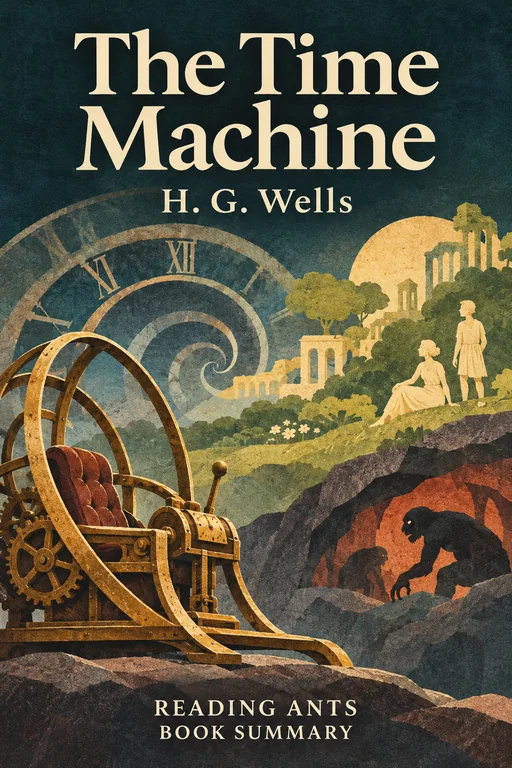
The Time Machine
H. G. Wells
A Victorian inventor, known only as the Time Traveller, builds a machine that carries him to the year 802,701, where he finds humanity split into two species, the gentle Eloi and the monstrous Morlocks, and then to a dying Earth.
🚀 Sci-Fi & Fantasy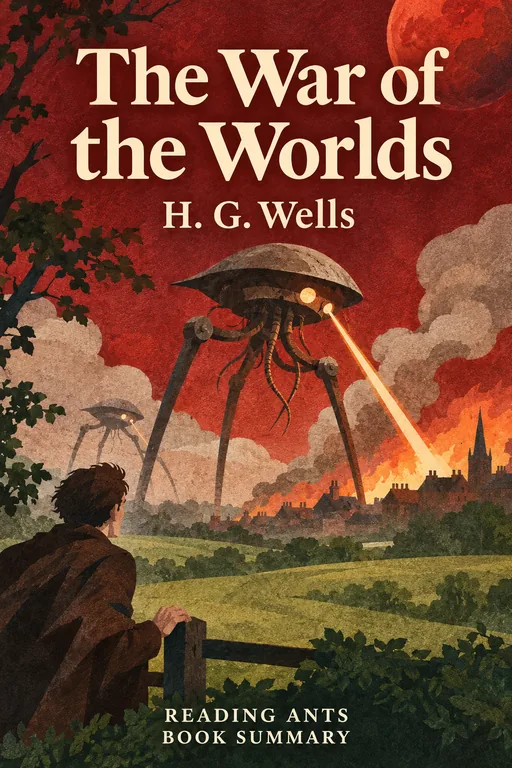
The War of the Worlds
H. G. Wells
Martians land in the English countryside with war machines and heat-rays that overwhelm human armies, until the invaders are brought down by the one thing humans never expected: Earth's smallest germs.
🚀 Sci-Fi & Fantasy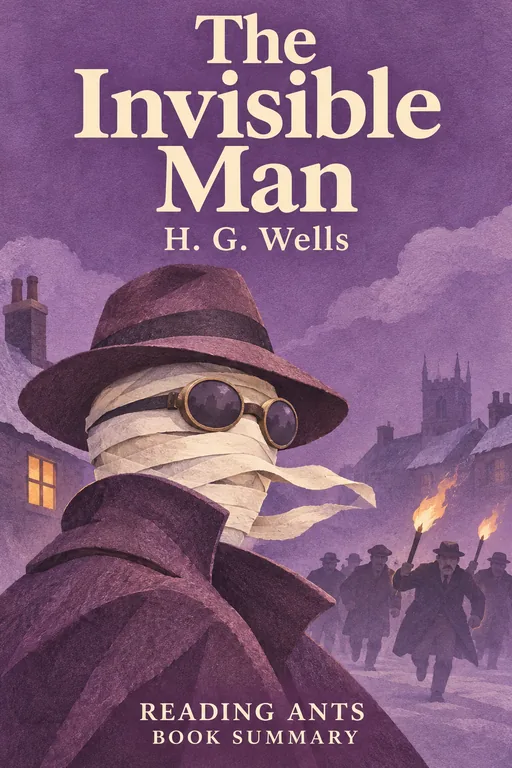
The Invisible Man
H. G. Wells
A brilliant scientist who has discovered how to make himself invisible finds that the power isolates him and drives him toward cruelty, until a frightened community hunts him down.
🚀 Sci-Fi & FantasyWant something different?
Pick another topic and we will show you three books to start with.