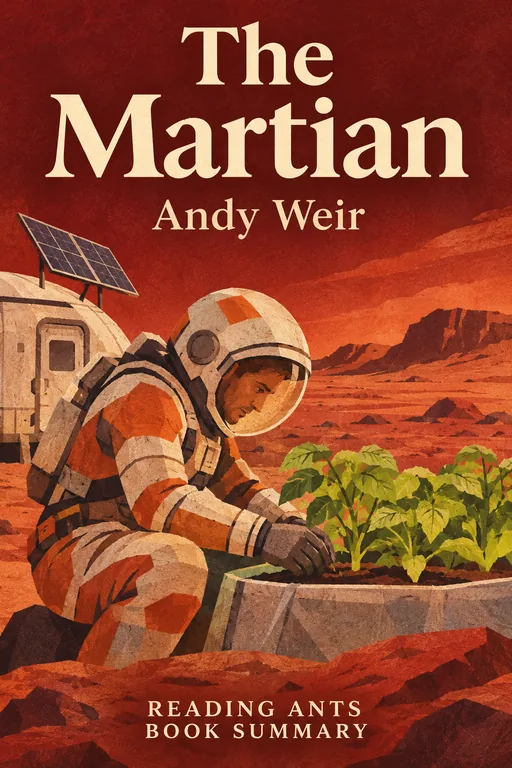
The Martian
When a sandstorm forces his crew to abandon him on Mars, believing he is dead, astronaut Mark Watney must use science, ingenuity and humor to survive for more than a year until rescue can arrive.
Overview
The Martian, by Andy Weir, began as a series of chapters that the author, a software engineer, posted online for free. After readers asked for an e-book, he sold it for ninety-nine cents, and it rose to the top of Amazon’s bestseller lists. It was published as a conventional book in 2014, and was adapted into a successful 2015 film directed by Ridley Scott, starring Matt Damon. The story is set in the near future, when NASA is carrying out its third crewed mission to Mars. During a violent storm, astronaut Mark Watney is hit by debris and presumed dead. Abandoned alone on the planet, with limited food and a damaged habitat, he has to use science and engineering to solve one life-threatening problem after another.
Main Characters
- Mark Watney: a botanist and mechanical engineer, funny and resourceful.
- Commander Melissa Lewis: the leader of the Ares 3 crew.
- Rick Martinez, Beth Johanssen, Chris Beck and Alex Vogel: Watney’s crewmates.
- Teddy Sanders: NASA’s administrator.
- Venkat Kapoor: NASA’s director of Mars missions.
- Mindy Park: a satellite scientist who spots signs that Watney is alive.
- Annie Montrose: NASA’s public relations director.
- Rich Purnell: a young astrodynamicist who devises a daring plan.
Full Summary
Left for Dead
On the sixth day of the Ares 3 mission, the crew is forced to evacuate the Martian surface after a massive dust storm threatens to tip over their ascent vehicle. While racing to the ship, Watney is struck by a flying antenna and thrown out of sight, and his suit’s biometric monitor goes dead. Commander Lewis, believing he has been killed, reluctantly gives the order to take off.
Watney wakes up to find himself alone. The antenna has pierced his suit but the blood sealed the hole. He stumbles back to the habitat, “the Hab,” bandages his wound and takes stock. He has enough food, from the crew’s supplies and reserves, to last for many months, but not nearly long enough: he has to survive for about four years, until the next mission, Ares 4, arrives.
Growing Food
Watney, a botanist, realizes that the only way to survive is to grow food. He cuts up the potatoes that were meant for Thanksgiving dinner, and plants them in soil made from Martian dirt and human waste. He creates water by burning rocket fuel to extract hydrogen and combining it with oxygen, a dangerous process. His potatoes begin to sprout.
He records his daily progress in a log, writing in a witty, informal style, full of jokes and complaints, such as joking that he is the best botanist on the entire planet because he is the only one.
Contact
Watney needs to communicate with Earth. He finds the old Pathfinder lander from a 1997 mission, and uses its transmitter. Slowly, he works out a way to talk to NASA using a simple code based on hexadecimal numbers, with a camera to point to a letter chart.
On Earth, NASA has discovered that Watney is alive through satellite images. Mindy Park, studying satellite photos, realizes that he is alive. Teddy Sanders and Venkat Kapoor begin working on a rescue, while keeping the crew in the dark.
Disasters
Watney faces repeated disasters. Heavy use tears the Hab’s airlock, the sudden loss of air destroys the potato crop, and he runs low on food. Then a supply probe, hastily launched by NASA without the usual checks, fails soon after launch and crashes into the ocean, wiping out his hope of resupply. Later, the Chinese space agency offers hardware that makes a new resupply plan possible.
Meanwhile, a young scientist, Rich Purnell, proposes a plan: a “slingshot” maneuver, in which the Hermes, the crew’s ship, which is still on its way home, would swing around Earth and head back to Mars. The crew learns of the plan and votes to disobey NASA and go for it.
The Rescue Plan
Watney must travel thousands of kilometers over the Martian surface to the landing site of the Ares 4 ascent vehicle. He modifies his rovers, adding solar panels. While he works, he accidentally damages Pathfinder, and contact with NASA is lost for a time. He survives dust storms and mechanical failures. He reaches the site, and finds that the vehicle has to be lightened to reach the Hermes, so he strips off everything he can, including the nose cap, which he covers with canvas from the Hab.
Rendezvous
As Hermes passes Mars, Watney’s stripped-down ascent vehicle launches, but the canvas tears loose and slows the climb, leaving it too far from the ship to meet it. In a daring improvisation, the Hermes crew finds a way to slow their ship and close the remaining gap: Alex Vogel builds a bomb and uses it to blow open an airlock, and the escaping air acts as a brake. Chris Beck then goes out on a tether to catch Watney in mid-space. The crew brings him aboard, to the cheers of people watching around the world. Watney is carried home after more than a year on Mars, and the book closes with him reflecting on the many people who worked together to save him.
Why It Matters
The Martian was a New York Times bestseller and an unexpected publishing sensation. Its journey from free web posts to the bestseller list is one of the most famous self-publishing success stories, and the 2015 film was nominated for seven Academy Awards. The book was praised for its scientific accuracy, which NASA scientists and engineers admired, though some details, such as the force of the Martian storm, are exaggerated.
The novel renewed public enthusiasm for space exploration and engineering. It is widely read in schools and has been used to inspire students toward STEM careers. Its spirit, that problems can be solved one at a time with knowledge and creativity, resonated with readers.
Key Takeaways
- Problems can be solved one at a time. Watney tackles each crisis step by step.
- Humor helps us survive. His jokes keep him sane.
- Science and engineering matter. Practical knowledge saves lives.
- Teamwork is global. Thousands of people work to rescue one man.
- Persistence pays off. Watney never gives up.
What We Can Learn
The novel is a master class in problem-solving. Watney faces one problem after another, and each time he breaks it down, tests solutions and moves on. We can use the same approach to big problems in our own lives.
It also shows that a positive attitude matters. Watney is often afraid, but he keeps a sense of humor and focuses on what he can do.
Finally, it celebrates cooperation. The effort to save Watney involves NASA, the crew and even other countries. Working together toward a common goal is a human strength.
Criticism and Counterpoints
Some readers find the technical detail heavy and the characters thin, apart from Watney. The female characters, such as Commander Lewis, are less developed. The novel’s strong language, much of it from Watney’s frustration, puts off some readers.
Scientists have noted that the storm in the story would not be strong enough to tip a spacecraft, since Mars’s atmosphere is very thin. Others point out that the story’s optimism about government cooperation is idealistic. Even so, most readers enjoy it as a fun, feel-good adventure.
Who Should Read It
This novel suits teens and adults who like science, problem-solving and humor. It contains some strong language. It is a great choice for readers who enjoyed the film, and for anyone who likes the idea of solving problems with math, chemistry and a good sense of humor.
Want the whole book?
A summary is a taste, not the meal. Here is where to find the full book.
You reached the end 🎉
Nicely done. Mark this one as read, and we will suggest what to read next.
Read this next
Project Hail Mary
Andy Weir
A man wakes up alone on a spaceship with no memory, slowly discovers that he is humanity's last hope to stop a microbe that is dimming the sun, and finds an unexpected friend among the stars.
🚀 Sci-Fi & Fantasy
Hatchet
Gary Paulsen
After a plane crash leaves him alone in the Canadian wilderness with only a hatchet, a thirteen-year-old boy must learn to survive, and grows from a frightened city kid into a patient, resourceful young man.
🧸 Children's Books
Robinson Crusoe
Daniel Defoe
After a shipwreck, an English sailor named Robinson Crusoe survives for twenty-eight years on a remote island, building a life with his own skill and faith, and eventually befriending a man he calls Friday.
📜 Classics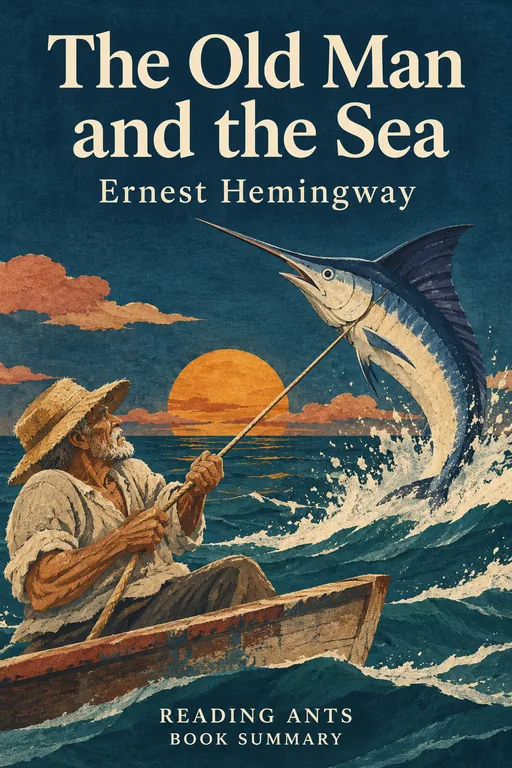
The Old Man and the Sea
Ernest Hemingway
An old Cuban fisherman who has gone eighty-four days without a catch hooks a giant marlin far out at sea and fights it for three days, only to lose it to sharks, yet he returns home undefeated in spirit.
📜 Classics
Frankenstein
Mary Shelley
A young scientist creates a living being from dead body parts, then abandons it in horror, and his rejected creation, longing for love, turns to revenge.
🚀 Sci-Fi & Fantasy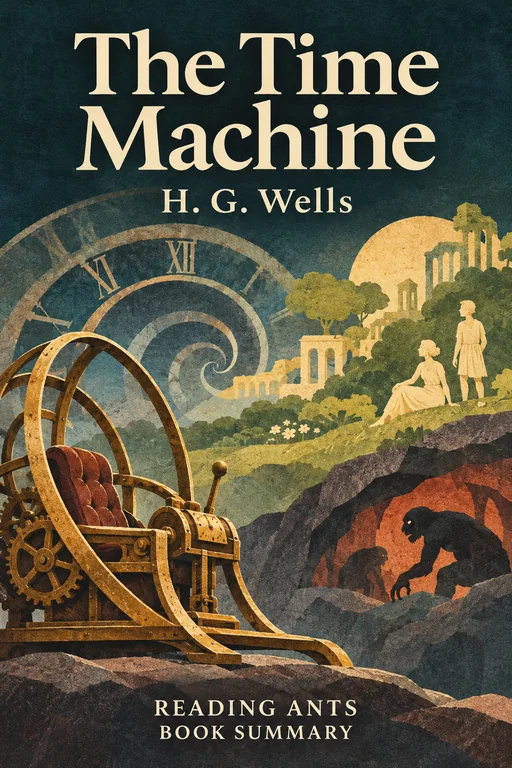
The Time Machine
H. G. Wells
A Victorian inventor, known only as the Time Traveller, builds a machine that carries him to the year 802,701, where he finds humanity split into two species, the gentle Eloi and the monstrous Morlocks, and then to a dying Earth.
🚀 Sci-Fi & FantasyWant something different?
Pick another topic and we will show you three books to start with.