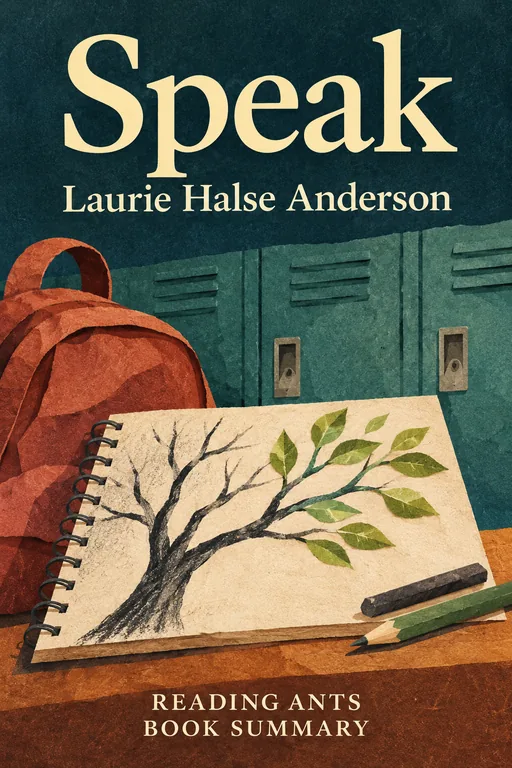
Speak
After a terrible event at a summer party, a high school freshman speaks less and less, and slowly finds her voice through art and courage.
Overview
Speak is a young adult novel by Laurie Halse Anderson, published in 1999. It is told in the voice of Melinda Sordino, a freshman, over the course of her first year at Merryweather High School. The novel is short and written in a sharp, funny, honest voice. It deals with the aftermath of a sexual assault, which Melinda does not tell anyone about, and with the loneliness that follows. It is a popular book for young readers and is widely taught, though it has also been challenged by some adults.
Main Characters
- Melinda Sordino: the narrator, a high school freshman who is silent about what happened to her.
- Mr. Freeman: her free-spirited art teacher, who encourages her to express herself.
- Heather: a new student who befriends Melinda for a short while, until she is drawn to a group of popular girls.
- David Petrakis: her lab partner, who is kind to Melinda.
- Andy Evans: a popular senior, who assaulted Melinda.
- Rachel (Rachelle): Melinda’s former best friend, who now ignores her.
Full Summary
The Outcast
Melinda starts high school as an outcast. At a party at the end of the summer, she called the police, and the party was broken up. The other students do not know why she did it, and they will not forgive her. Even her old friends from middle school turn away. She says very little to anyone, though she makes sharp and funny observations about the school in her own mind.
Her parents are withdrawn, and they are troubled by her falling grades, but they do not seem to notice the deeper changes in her. A new student named Heather, who is eager to be popular, becomes her friend for a while, but soon drops her for a group of popular girls.
The Art Room
In art class, Mr. Freeman is her teacher, and he is free-spirited and kind. Melinda’s project for the school year is to make art about trees. She finds this hard, and she tries again and again to draw and shape them in different ways. She feels that her art is a reflection of her own state.
The art room becomes an outlet for her troubled inner life. Elsewhere in the school, she finds an abandoned janitor’s closet, and she quietly turns it into her private hideout, where she covers the walls with her tree sketches and a poster of the author Maya Angelou.
Small Rebellions
Melinda’s school life is full of small humiliations. Her classmates want nothing to do with her, and her grades drop as she cuts school to avoid what really happened at the party. The book is told in short, jumpy pieces, like a diary, and the jumps in the story copy the way a painful memory keeps breaking into the present.
Still, there are signs of life. Over the school year, she slowly makes a friend of her lab partner, David Petrakis, and she begins to rebuild some of her old relationships. The story is divided into the four quarters of her freshman year, and each one brings her a little further out of hiding.
What Happened
As the year goes on, we learn more about the night of the party. Melinda was raped, while drunk, by Andy Evans, a popular senior, who now goes to the same school. She called the police for help, but then ran home, and she has told no one what happened.
Her silence keeps her isolated, and it makes her wary of danger and unable to trust. She does not recognize herself in mirrors, and she tries to push the memory away, even as it keeps coming back. Andy is still a popular figure at school, and she must see him in the halls.
Reaching Out
Slowly, Melinda begins to reach out. She and David become friends, and he is one of the few people who encourages her to speak up for herself. She keeps working on her tree project with Mr. Freeman’s guidance, and it slowly begins to show promise.
She is troubled to see her former best friend, Rachel, begin to date Andy. She tries to warn Rachel, but Rachel becomes angry and assumes that Melinda is jealous of a girl who is dating a senior. Later, Rachel comes to believe her, when Andy gropes her on prom night even though she told him no. Melinda also finds that other girls have written about Andy’s behavior on a bathroom wall.
Finding Her Voice
Andy finds out that Melinda has accused him, and he attacks her in her janitor’s closet, denying what he did. He tries to assault her again, but this time she fights back. She screams, and she threatens him with a piece of broken mirror glass, and she manages to get help.
The story of how Melinda stood up to Andy spreads among the students, and she earns admiration for her courage. She completes her tree project, and it begins to show life. In the end, she is comforted by Mr. Freeman, and she chooses to use her voice to tell him her story. The book ends with Melinda beginning to speak, and to heal.
Why It Matters
Speak was a National Book Award finalist in 1999, and it received a Printz Honor in 2000. It is one of the best-known young adult novels about sexual assault, and it has helped many readers to find the courage to speak about their own experiences. It was adapted for film in 2004, starring Kristen Stewart. The book has also been challenged and banned in some school districts, which led to public debate about whether young people should read about hard subjects. The author spoke out against censorship, arguing that hiding difficult subjects leaves young people vulnerable. It was a New York Times best seller, and has been translated into sixteen languages.
Key Takeaways
- Silence is not consent. Not speaking does not mean that nothing happened.
- Healing takes time. Melinda’s recovery is gradual.
- Art can express what words cannot. Her tree becomes a symbol of her growth.
- One caring person can help. Mr. Freeman’s support is important.
- Telling the truth is powerful. Speaking out breaks the hold of the abuser.
What We Can Learn
The book teaches us to be kind and patient with people who are withdrawn, as they might be carrying something heavy. It encourages us to believe survivors and to support them.
If something like this has happened to you or someone you know, it is important to tell a trusted adult, a counselor, or a helpline. You did nothing wrong, and help is available. Finally, the book shows that creating something, such as drawing or writing, can be a step toward healing.
Criticism and Counterpoints
Speak has often been challenged by parents and others, who have objected to its depiction of rape, its swearing and its scenes of drinking, and one critic called it soft pornography. Many educators answer that it is handled with care, and that it is useful for talking about issues such as sexual harassment, cliques and family relationships. Its fragmented, diary-like style suits the theme, but it can be hard to follow for some readers. One scholar has also noted that Melinda recovers through her own efforts, without professional help, which is not the usual path for trauma survivors, so the book should not be read as a guide to how healing must go.
Who Should Read It
This book is for readers from about thirteen up, and is a good choice for classroom discussion. It is short and easy to read. Readers who have experienced assault may find it painful, and may wish to read with support.
Want the whole book?
A summary is a taste, not the meal. Here is where to find the full book.
You reached the end 🎉
Nicely done. Mark this one as read, and we will suggest what to read next.
Read this next
The Perks of Being a Wallflower
Stephen Chbosky
A shy, thoughtful boy writes letters about his first year of high school, in which he finds friends and love, and must face the painful secret of his past.
🎒 Young Adult
The Hate U Give
Angie Thomas
After witnessing a police officer kill her unarmed friend, a Black teenager finds her public voice while navigating grief, racism and the different expectations of her neighborhood and private school.
🎒 Young AdultThe Catcher in the Rye
J. D. Salinger
After being expelled from his boarding school, a lonely, sarcastic sixteen-year-old wanders New York City for three days, struggling with grief, phoniness and the frightening idea of growing up.
📜 Classics
Wonder
R. J. Palacio
A ten-year-old boy born with a rare facial difference goes to school for the first time, and through bullying, friendship and courage he helps everyone around him learn to choose kindness.
🧸 Children's Books
The Fault in Our Stars
John Green
Two teenagers with cancer fall in love, travel in search of a novel's missing ending and discover that a short life can hold real meaning without becoming a sentimental lesson.
🎒 Young Adult
The Giver
Lois Lowry
In a perfectly controlled community with no pain, choice or color, a boy about to turn twelve is chosen to hold the memories of the past, and discovers the terrible price his people pay for their safety.
🎒 Young AdultWant something different?
Pick another topic and we will show you three books to start with.