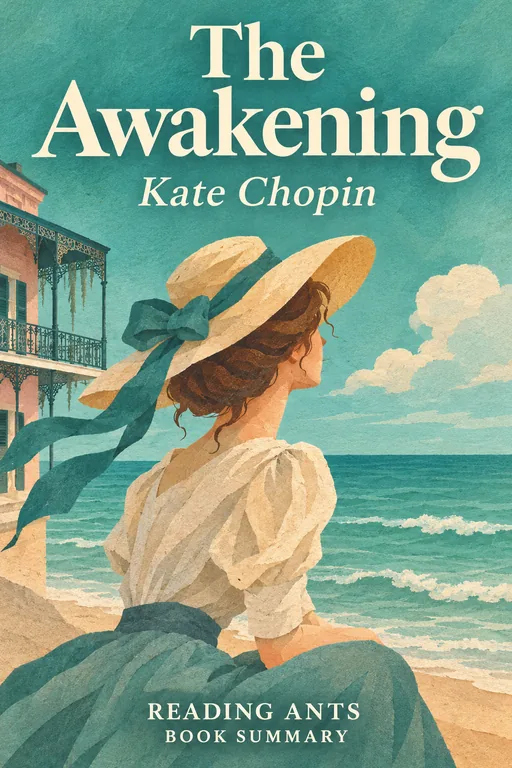
The Awakening
A young wife and mother in nineteenth-century New Orleans begins to awaken to her own desires and her need for independence, and finds that the society around her has no place for her.
Overview
The Awakening is a short novel by the American writer Kate Chopin, published in 1899. It is set in Louisiana, among the Creole society of New Orleans and a nearby seaside resort. The story follows Edna Pontellier, who begins a quiet rebellion against the roles of wife and mother that she is expected to play. The book was criticized by many reviewers when it appeared, for its frank treatment of a woman’s desire, and it fell out of print. It was rediscovered in the twentieth century, and is now regarded as a pioneering work of feminist literature.
Main Characters
- Edna Pontellier: a married woman of twenty-eight, thoughtful, restless and artistic.
- Léonce Pontellier: her husband, a successful businessman, who treats her as a possession.
- Robert Lebrun: a charming young man, who spends time with Edna.
- Adèle Ratignolle: a beautiful mother and wife, who is the ideal of womanhood in that society.
- Mademoiselle Reisz: an independent, eccentric pianist, who inspires Edna.
- Alcée Arobin: a flirtatious man about town, who becomes Edna’s lover.
- Dr. Mandelet: a kindly doctor, who senses Edna’s trouble.
Full Summary
A summer on Grand Isle
The novel opens on Grand Isle, a Gulf Coast island where wealthy Creole families spend their summers. Edna Pontellier, who is from Kentucky and is a stranger to Creole ways, is there with her two young sons, while her husband Léonce works in the city and visits on weekends. She feels somewhat apart from the friendly, open women around her, such as Adèle Ratignolle, who is devoted to her family. She spends time with Robert Lebrun, a young man who flirts with the guests, and who is attentive to her. She finds her own feelings stirring.
Learning to swim
During the summer, Edna learns to swim, which she has always feared. One night, after listening to Mademoiselle Reisz play the piano, which moves her deeply, she finally swims out alone. She feels a thrill of strength and freedom, but also a sudden terror of death before she regains the shore. Her feelings for Robert grow, and, though nothing is said, both seem to understand them. Then Robert abruptly announces that he is leaving for Mexico that very night, and Edna is left feeling bereft.
Back in New Orleans
When the family returns to the city, Edna begins to neglect her social duties. She stops receiving visitors on the day that she is expected to, and she spends time painting, and walking in the streets by herself. Her husband is irritated and puzzled, and he consults the family doctor, Dr. Mandelet, who advises him to let her alone. When Léonce leaves on a business trip to New York, his mother takes the children to stay with her in the country, and Edna feels free for the first time.
A house of her own
While her husband is away, Edna spends time at the horse races, and she becomes involved with Alcée Arobin, a man whom she does not love, but who awakens her physically. She decides to leave her husband’s house and move into a small house around the corner, which her servants call the pigeon house, and she gives a dinner party for her birthday before she goes. She begins to live more independently, with a little money of her own and a few sales of her paintings. She becomes friends with Mademoiselle Reisz, who warns her that an artist needs a courageous soul. Léonce writes to disapprove, but he protects his reputation by having their house remodeled and announcing in the newspaper that the couple are going abroad. Edna continues to long for Robert.
Robert returns
When Robert comes back from Mexico, he and Edna meet by chance, first at Mademoiselle Reisz’s rooms and later at a quiet garden cafe, and Robert keeps his distance. At last, they kiss, and Robert admits that he went away to fight his love for her, a married woman, and that he had dreamed of her somehow becoming his wife. Edna tells him that she is no longer anyone’s possession, to be given or withheld by her husband. She is called away to help Adèle, who is giving birth, and the experience is painful and distressing for her. Adèle begs her to think of the children. On the way home, Dr. Mandelet offers his sympathy. When Edna returns, Robert has gone, leaving a short note saying that he loves her and is saying goodbye because of it.
The sea
Edna, devastated, returns to Grand Isle alone. She walks to the beach, undresses, and swims out into the water, which seems to welcome her. As she swims, she thinks about her husband and children, about Mademoiselle Reisz, about Robert’s note and about the Kentucky meadow of her childhood, and she goes farther, until her strength gives out. The ending is ambiguous but is usually understood as her death. The novel closes on her fading memories of childhood. It suggests that a woman who wants more than society allows has no place to go.
Why It Matters
The Awakening is a landmark of American literature, and one of the first novels to treat a woman’s inner life, and her desire for independence and sexual fulfillment, with honesty and sympathy. It anticipated later feminist writing, and it challenged the accepted idea that motherhood and marriage should be a woman’s whole identity. Its lyrical style and its use of the sea as a symbol have been praised. The book’s reception, which was so hostile that Chopin wrote little after it, is itself an important chapter in the history of literature.
Key Takeaways
- Women have inner lives. Edna’s desires matter, not just her duties.
- Independence has a price. Society punishes her for choosing it.
- Art offers freedom. Painting and music open new worlds for Edna.
- Conventions can imprison. Even Robert is trapped by what others will think.
- Awakening may be painful. Seeing clearly can mean loneliness.
What We Can Learn
You can learn from Edna to pay attention to your own desires and talents, and to ask whether the roles that you play are ones you have chosen. The novel also shows how pressure from family and society can make independence difficult, and why support from others, such as Mademoiselle Reisz, can matter. It raises questions about duty and freedom, particularly for women, which are still relevant. Reading it with others can lead to rich discussions about what makes a fulfilling life.
Criticism and Counterpoints
Some readers consider Edna selfish, since she neglects her children and treats others carelessly, and they argue that the novel does not fully explore her responsibility. Others feel that her story, which ends in despair, offers little hope. Critics have also pointed out that the book mostly reflects a privileged white woman’s experience, and takes servants and the racial order of its setting for granted. A few say that Edna’s change from timid to rebellious is not fully explained. But many readers feel moved and challenged by the book.
Who Should Read It
This book is for mature readers from about fifteen who are interested in classic literature and women’s history. It is short and poetic. It includes adult themes, and some readers may find the ending upsetting. Those who like it may read Madame Bovary or Mrs. Dalloway.
Want the whole book?
A summary is a taste, not the meal. Here is where to find the full book.
You reached the end 🎉
Nicely done. Mark this one as read, and we will suggest what to read next.
Read this next

Madame Bovary
Gustave Flaubert
A romantic young woman, bored by her provincial marriage to a kind but dull doctor, seeks excitement in love affairs and luxury, and is crushed by debt and disillusion.
🌍 World Literature
Jane Eyre
Charlotte Bronte
A poor, plain but fiercely independent orphan becomes a governess, falls in love with her brooding employer, discovers his terrible secret, and refuses to give up her self-respect even for love.
📜 Classics
Anna Karenina
Leo Tolstoy
In imperial Russia, a married aristocrat falls passionately in love with a dashing officer and loses her place in society, while a thoughtful landowner seeks a meaningful life through love, work and faith.
🌍 World Literature
A Doll's House
Henrik Ibsen
A cheerful young wife, treated by her husband like a pretty doll, hides a secret loan she took to save his life, and when the truth comes out, she realizes she must leave him to discover who she really is.
🎭 Epics, Drama & Poetry
Mrs Dalloway
Virginia Woolf
On a June day in 1923, Clarissa Dalloway prepares to host a party in London, while the shell-shocked war veteran Septimus Smith moves toward a crisis, and the two lives touch only at the story's end.
📜 Classics
Pride and Prejudice
Jane Austen
Quick-witted Elizabeth Bennet and the proud, wealthy Mr. Darcy badly misjudge each other, and only by facing their own faults do they find their way to love.
📜 ClassicsWant something different?
Pick another topic and we will show you three books to start with.