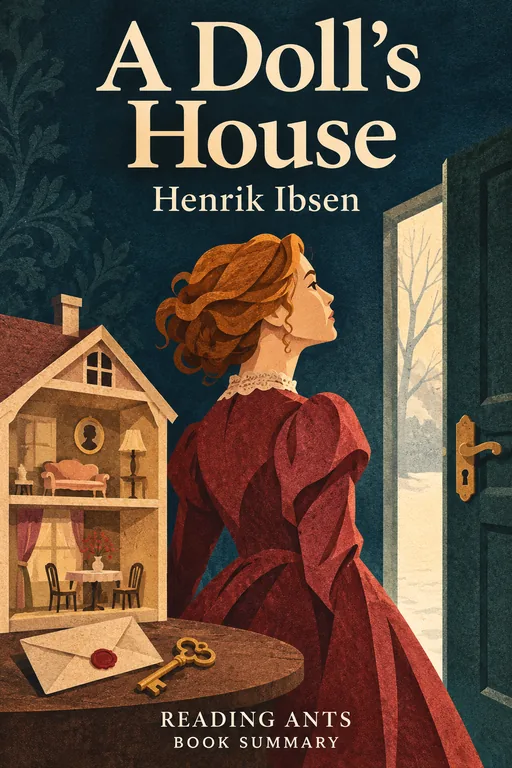
A Doll's House
Original title: Et dukkehjem
A cheerful young wife, treated by her husband like a pretty doll, hides a secret loan she took to save his life, and when the truth comes out, she realizes she must leave him to discover who she really is.
Overview
A Doll’s House is a play by the Norwegian playwright Henrik Ibsen, first performed in 1879. It takes place over three days at Christmas in the comfortable home of Torvald Helmer, a lawyer who has just been promoted to bank manager, and his wife, Nora. Torvald calls Nora pet names like his little songbird and treats her like a charming, helpless child. But Nora has a secret: years ago, when Torvald was seriously ill, she secretly borrowed money to pay for a trip to Italy that saved his life, forging her father’s signature to do it. When the man who lent her the money threatens to reveal everything, Nora’s world begins to crack. The play’s shocking ending made it one of the most important and controversial dramas of its time.
Main Characters
- Nora Helmer: a lively, playful wife with a hidden strength.
- Torvald Helmer: Nora’s husband, a respectable but controlling bank manager.
- Nils Krogstad: an employee at Torvald’s bank who lent Nora money.
- Kristine Linde: Nora’s old school friend, a widow looking for work.
- Dr. Rank: a family friend who is secretly in love with Nora and seriously ill.
- The children and the nanny: who care for the Helmers’ three young children.
Full Summary
A Happy Home
On Christmas Eve, Nora comes home with presents. Torvald teases her about spending money, calling her his little squirrel and songbird, and forbids her to eat macaroons, which she secretly does anyway. He is pleased about his new job as bank manager and their improved finances.
Nora’s old friend, Kristine Linde, visits. She is a widow who married for money to support her family and now needs work. Nora proudly confides her secret: years ago, Torvald was dangerously ill, and doctors said he needed to rest in a warm climate. Nora borrowed a large sum of money secretly, telling Torvald it came from her father, and she has been paying it back little by little by saving from her household budget and doing secret copying work. Torvald, who hates debt and would be humiliated by owing his life to his wife, knows nothing.
Krogstad’s Threat
Krogstad, an employee at Torvald’s bank, arrives. He is the man who lent Nora the money, and Torvald plans to fire him because of an old scandal. Krogstad tells Nora that unless she persuades Torvald to keep him, he will reveal the loan. Worse, he has discovered that Nora forged her dying father’s signature on the loan papers, which is a crime. Nora pleads with Torvald for Krogstad’s job, but Torvald refuses, and sends Krogstad a letter of dismissal.
The Letter in the Mailbox
Krogstad drops a letter into the Helmers’ locked mailbox, revealing the whole truth. Nora is terrified. She considers asking Dr. Rank, a family friend, for money, but he confesses that he loves her, and she decides she cannot ask. Rank also reveals that he is dying.
Nora desperately keeps Torvald from opening the mailbox, distracting him by practicing a wild dance, the tarantella, for a party. Meanwhile, Kristine reveals that she and Krogstad were once in love, and she offers to marry him and help him rebuild his life. Krogstad, moved, offers to take back his letter, but Kristine decides that Torvald should learn the truth, because the marriage needs honesty.
The Truth Comes Out
After the party, Torvald reads Krogstad’s letter. Instead of thanking Nora for saving his life, he explodes with rage. He calls her a liar and a criminal, says she has ruined his reputation and declares she is unfit to raise their children. All he cares about is how it will look to others.
Then a second letter arrives from Krogstad, returning the loan document and promising not to reveal anything. Torvald is instantly relieved and cries out that he is saved. He forgives Nora and goes back to treating her as his little helpless wife.
Nora’s Decision
But Nora has changed. She had secretly hoped that Torvald would take the blame on himself to protect her, a “miracle” proving his love. Instead, she has seen that he cares more about his reputation than about her. Calmly, she sits him down for the first serious conversation of their marriage.
Nora tells him that she has been treated like a doll, first by her father and then by him, and that she has never had her own opinions. She has duties to herself, she says, as well as to her husband and children, and she must educate herself and find out who she really is. Torvald begs her to stay, promising to change, but she says it would take a miracle for them to have a true marriage. She leaves her wedding ring and her keys and walks out. The play ends with the sound of the front door slamming shut.
Why It Matters
A Doll’s House caused a sensation when it was first performed in 1879. At the time, it was almost unthinkable for a wife to leave her husband and children, and audiences and critics argued fiercely about Nora’s choice. Some theaters in Germany insisted on a different ending, in which Nora stays, which Ibsen reluctantly wrote but later called a disgrace.
The play is often called one of the first modern dramas, and Ibsen is called the father of modern realist theater for presenting ordinary people and serious social problems on stage. A Doll’s House became a landmark in discussions of women’s rights and marriage, and the door slam at its end has been described as heard around the world. It remains one of the most performed plays globally.
Key Takeaways
- Equality is essential in relationships. Nora realizes her marriage lacks true partnership.
- Appearances can hide unhappiness. The Helmers’ happy home is built on illusion.
- Everyone deserves to grow. Nora seeks her own identity beyond being a wife and mother.
- Reputation shouldn’t matter more than love. Torvald’s reaction reveals his priorities.
- Honesty strengthens bonds. Secrets and pretending weaken the marriage.
What We Can Learn
A Doll’s House teaches the importance of respect and honesty in relationships. Partners, friends and family members should value each other’s thoughts and abilities, not treat each other like children or decorations.
It also shows that it is never too late to think for ourselves. Nora discovers that she has opinions, strength and responsibilities to herself. Taking time to understand our own values, instead of simply following others’ expectations, is part of growing up.
Finally, the play encourages us to look past appearances. A home or relationship that seems perfect on the outside may hide real problems that need honest conversation.
Criticism and Counterpoints
Many people at the time, and some today, criticized Nora for abandoning her children, arguing that her decision was selfish. Others see it as a necessary act of self-respect in a society that gave women few rights.
Interestingly, Ibsen himself later said that he was not writing specifically about women’s rights, but about the need for every human being to find themselves. Some critics also find the plot’s coincidences, such as Kristine’s past with Krogstad, convenient, and Nora’s sudden transformation in the final scene abrupt. Still, the play’s central conflict remains powerful and relevant.
Who Should Read It
This short play suits teens and adults interested in drama, relationships and social questions. It can be read in an evening and is often studied in schools. It is especially powerful when seen performed, ending with the famous door slam.
Want the whole book?
A summary is a taste, not the meal. Here is where to find the full book.
You reached the end 🎉
Nicely done. Mark this one as read, and we will suggest what to read next.
Read this next
Hedda Gabler
Henrik Ibsen
A restless, clever general's daughter, newly married to a dull scholar, tries to control the lives of others from boredom and fear of scandal, and when she is trapped, chooses to end her own life.
🎭 Epics, Drama & Poetry
The Awakening
Kate Chopin
A young wife and mother in nineteenth-century New Orleans begins to awaken to her own desires and her need for independence, and finds that the society around her has no place for her.
📜 Classics
A Room of One's Own
Virginia Woolf
Virginia Woolf argues that a woman needs money and a room of her own, meaning independence and privacy, in order to write fiction, and explains why women writers have been held back through history.
⚖️ Politics & Society
The Cherry Orchard
Anton Chekhov
A once-wealthy Russian noblewoman returns to her family estate, which is about to be auctioned to pay its debts, but she and her brother cannot bring themselves to act, and the cherry orchard is sold to the son of a former serf.
🎭 Epics, Drama & Poetry
The Odyssey
Homer
After the Trojan War, the clever hero Odysseus struggles for ten years against monsters, gods and temptations to return home to his faithful wife and son, then must win back his house from the men trying to steal it.
🎭 Epics, Drama & Poetry
Hamlet
William Shakespeare
A grieving prince of Denmark learns from his father's ghost that his uncle murdered the king to take the throne, and his struggle to decide whether and how to take revenge leads to madness and death.
🎭 Epics, Drama & PoetryWant something different?
Pick another topic and we will show you three books to start with.