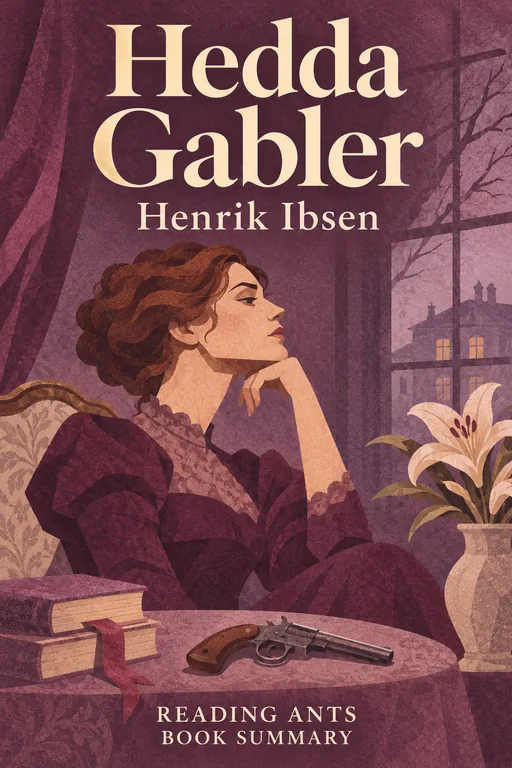
Hedda Gabler
A restless, clever general's daughter, newly married to a dull scholar, tries to control the lives of others from boredom and fear of scandal, and when she is trapped, chooses to end her own life.
Overview
Hedda Gabler is a play in four acts by the Norwegian dramatist Henrik Ibsen, first staged in 1891. It is set in the drawing room of a villa in Christiania, now Oslo. The play is a study of a woman who is intelligent, bored and unable to find a way to use her abilities in a society that offers women few options. Hedda is among the most debated characters in modern drama, and actresses regard the role as a great challenge. The play is tense, with sharp dialogue and a growing sense of entrapment.
Main Characters
- Hedda Gabler Tesman: the daughter of a general, cold, fascinating and restless.
- George Tesman: her husband, a kindly but dull academic.
- Eilert Løvborg: a brilliant writer, Hedda’s former admirer, who is a reformed alcoholic.
- Thea Elvsted: a gentle woman, who has left her husband to help Løvborg.
- Judge Brack: a worldly family friend, who has designs on Hedda.
- Aunt Julle (Juliane Tesman): George’s kind aunt.
- Berte: the family’s maid.
Full Summary
Return from the honeymoon
Hedda and George Tesman return from a six-month honeymoon to their new villa, which they cannot really afford. George is an academic, hoping to be appointed professor, and he spent much of the honeymoon researching in libraries. Hedda is bored and irritated by his devotion and by his old aunt. Aunt Julle hints that she hopes for a child, and Hedda curtly shuts the subject down. Later that day, when Judge Brack visits, she tells him how bored she has been on the honeymoon and in her marriage, and he hints that he would like to be her confidant.
Løvborg and Thea
Hedda’s old friend Thea Elvsted arrives, anxious about Eilert Løvborg, a brilliant but unstable scholar, who has recently published a successful book, and who is now at work on another. Thea has helped him to stop drinking, and she fears that he will fall back. Hedda, who once knew Løvborg, is both jealous and curious. She also learns, from Judge Brack, that Løvborg may compete with George for the academic post, although Løvborg later says that he does not want to stand in George’s way. She is disturbed by the thought that Thea has had such influence over a man, while she has none.
Hedda tempts Løvborg
When Løvborg visits, Hedda is drawn to his old life, and to a sense of freedom that she once felt. In a conversation, she persuades him to take a drink, which he has been avoiding for some time, by suggesting that he does not feel secure in himself. He goes with George and Judge Brack to Brack’s party. Thea waits anxiously in the Tesman home, and Hedda sees her distress with a cold satisfaction. She feels that she has gained power over another person, and she enjoys the thought of it.
The lost manuscript
The next morning, George returns with the news that Løvborg got drunk and lost his precious manuscript, the product of his life’s work, which George has found by the roadside. Hedda says nothing to Løvborg, and hides it. When Løvborg comes in, desperate, he tells Thea that he has torn it up, but he admits to Hedda that he has in effect lost it, and that he means to end his life. She does not tell him that she has it. Hedda gives him one of her father’s pistols, and says that he should do it beautifully. When he is gone, she burns the manuscript in the stove.
Løvborg’s death
Hedda tells George that she burned the manuscript, saying that she did it for his sake. He is horrified at first, but is touched by what he takes to be a sign of her love, and agrees to keep it secret from everyone, including Thea. Then the news arrives that Løvborg has been shot, and is in the hospital, where he dies, after being shot in the rooms of a woman of doubtful reputation, Mademoiselle Diana, in a way that is ugly and perhaps accidental, not the clean death that Hedda had imagined. Thea and George, who still have the notes, begin to piece together a new version of the book, and Hedda feels excluded.
Brack’s power
Judge Brack then tells Hedda that he recognized the pistol found on Løvborg as hers, and that, as long as he says nothing, the police will not trace it. If he speaks, she will face a scandal. Hedda realizes that this puts her in his power, and he implies that he will use it to make demands of her. She sees that she is trapped, and that she will never be free, since she would be under his control. She goes into the next room, and plays a wild tune on the piano. A shot rings out, and George, Thea and Brack rush in to find that she has killed herself.
Why It Matters
Hedda Gabler is one of the best-known plays of modern drama, and it is regularly staged around the world. Hedda has been described as a feminist figure, a monster, a victim, and a study of the destructive effects of boredom and repression, and critics continue to argue about her character. The play is a landmark of realism, with a closed setting, subtle psychology and an unforgettable ending. It shows Ibsen’s interest in how social convention shapes individuals, a theme he also explored in A Doll’s House, and it has influenced writers and directors for over a century.
Key Takeaways
- Boredom can be dangerous. Hedda’s idle power leads to harm.
- Convention constrains. She fears scandal above all.
- Control is not freedom. Her manipulation does not bring her happiness.
- Power over others corrupts. She uses people to feel alive.
- Entrapment can lead to despair. Brack’s threat closes her last option.
What We Can Learn
You can learn from Hedda’s story that when people feel powerless and unfulfilled, they may use the little power they have to harm others, and that finding a meaningful outlet for talent and energy matters. The play also shows the danger of valuing appearance and reputation over honesty. If you read it, you might think about the choices open to Hedda, and what a different society might have offered. It encourages empathy for people who feel trapped, and attention to the signs of despair.
Criticism and Counterpoints
Some critics see Hedda as a cruel, selfish woman who destroys the lives of others, and find it hard to feel sympathy for her. Others argue that she is a victim of a sexist society, with no opportunity for a career or independence, and that the play is a protest against such restrictions. Some readers find the plot melodramatic, with its pistols and burned manuscript, and the characters types. A few find the ending too abrupt. The play’s ambiguity is part of what keeps it alive.
Who Should Read It
This book is for mature readers from about fifteen who enjoy drama, psychology and classic literature. It is short and can be read in an evening, though it is better seen on stage. Readers who like it may go on to A Doll’s House, or to Ibsen’s Ghosts.
Want the whole book?
A summary is a taste, not the meal. Here is where to find the full book.
You reached the end 🎉
Nicely done. Mark this one as read, and we will suggest what to read next.
Read this next
A Doll's House
Henrik Ibsen
A cheerful young wife, treated by her husband like a pretty doll, hides a secret loan she took to save his life, and when the truth comes out, she realizes she must leave him to discover who she really is.
🎭 Epics, Drama & Poetry
The Awakening
Kate Chopin
A young wife and mother in nineteenth-century New Orleans begins to awaken to her own desires and her need for independence, and finds that the society around her has no place for her.
📜 Classics
Madame Bovary
Gustave Flaubert
A romantic young woman, bored by her provincial marriage to a kind but dull doctor, seeks excitement in love affairs and luxury, and is crushed by debt and disillusion.
🌍 World Literature
Anna Karenina
Leo Tolstoy
In imperial Russia, a married aristocrat falls passionately in love with a dashing officer and loses her place in society, while a thoughtful landowner seeks a meaningful life through love, work and faith.
🌍 World Literature
The Bell Jar
Sylvia Plath
A talented young woman named Esther Greenwood, who seems to be on the path to success in 1950s America, sinks into depression and a suicide attempt, and slowly begins to recover.
📜 Classics
The Odyssey
Homer
After the Trojan War, the clever hero Odysseus struggles for ten years against monsters, gods and temptations to return home to his faithful wife and son, then must win back his house from the men trying to steal it.
🎭 Epics, Drama & PoetryWant something different?
Pick another topic and we will show you three books to start with.