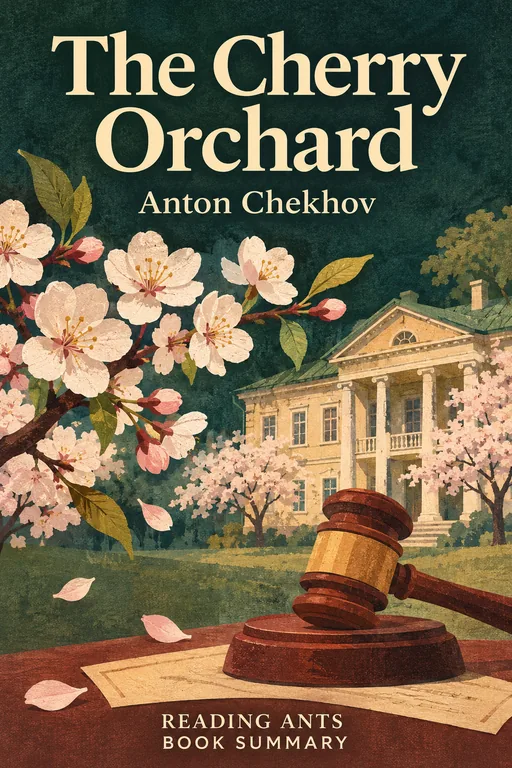
The Cherry Orchard
Original title: Вишнёвый сад
A once-wealthy Russian noblewoman returns to her family estate, which is about to be auctioned to pay its debts, but she and her brother cannot bring themselves to act, and the cherry orchard is sold to the son of a former serf.
Overview
The Cherry Orchard is a play in four acts by the Russian writer Anton Chekhov, first performed in 1904 in Moscow, the year of his death. Chekhov called it a comedy, though the Moscow Art Theatre director Konstantin Stanislavski staged it as a tragedy, and the dispute over its tone has continued. The play is set on the estate of Lyubov Ranevskaya, whose beautiful cherry orchard symbolizes a fading way of life. The story shows the end of the old Russian aristocracy, the rise of a new middle class and the passing of time, and it is told through conversation, not action.
Main Characters
- Lyubov Ranevskaya: the owner of the estate, charming, generous and impractical.
- Leonid Gayev: her brother, who talks a lot and does little.
- Anya: Ranevskaya’s seventeen-year-old daughter, hopeful and idealistic.
- Varya: her adopted daughter, who manages the estate.
- Lopakhin: a rich merchant, the son of a serf, who suggests a plan to save the estate.
- Trofimov: a student and perpetual idealist, who was the tutor of Ranevskaya’s dead son.
- Firs: the old servant, loyal to the old order.
- Yasha and Dunyasha: a young manservant and a maid.
Full Summary
Act One: Return
In May, Ranevskaya returns from Paris to her estate in Russia, after five years away, with her daughter Anya. She is greeted with joy and tears, and she is moved by the old nursery. The family is deeply in debt, and the estate is to be sold at auction in August. Lopakhin, a merchant who is the son of a former serf on the estate, offers a solution: cut down the cherry orchard, build vacation houses and rent them out. Ranevskaya and Gayev are horrified at the idea of destroying the orchard, which is mentioned in the encyclopedia as a famous one.
The family discusses the past with great feeling: Ranevskaya looks out at the white blossoms and says that nothing has changed. She remembers her young son Grisha, who drowned in the river, and the loss still haunts her. Trofimov, who was his tutor, reminds her of it, and she is upset.
Act Two: The Field
In the second act, the family gathers outside, on a field near the orchard, in the evening. Lopakhin again urges them to act, saying that the time is short. But they brush him off, and speak of other things. Trofimov gives a speech about the future of Russia, and says that everyone must work. Ranevskaya talks about her love of a man in Paris who has treated her badly, and about the death of her young son, which was her great sorrow. A distant sound, like a breaking string, is heard, and everyone is unsettled.
Lopakhin, who is practical, says that he has urged them on, but he is a man who feels the burden of his past: his father was a peasant, and he has made money, but he feels unrefined and says that he was poorly educated and that his handwriting is bad. In this act, we see that all of the characters are unsure of what they want, and the sound in the distance is like a prediction.
Act Three: The Auction
On the day of the auction, the family holds a ball, though they cannot afford it. Ranevskaya waits anxiously for news. Gayev returns from the auction, tired, and cannot speak. Lopakhin arrives, drunk with excitement, and announces that he has bought the estate himself, outbidding the others. He is proud that he, the son of a serf, now owns the property where his father and grandfather were not even allowed in the kitchen. Ranevskaya weeps, while he orders the orchard to be cut down.
Even during the party, there is a feeling of doom. The guests dance, and a conjuror entertains them, while Ranevskaya watches the door for her brother. When Lopakhin, shaking with emotion, tells them, he says that he will play the music for them to dance, and that he is the new master of the cherry orchard.
Act Four: Departure
In October, the family packs to leave. Everyone makes plans: Ranevskaya returns to Paris, Gayev takes a bank job, Anya looks forward to studying and starting a new, independent life, encouraged by Trofimov, and Varya takes a job as a housekeeper. Lopakhin is expected to propose to Varya, but he does not, and it stays uncertain how much he ever wished to. The family says goodbye to the house, and as they leave, the stage is empty. Firs, the old servant, who has been forgotten and locked in, appears, lies on a sofa and says that life has passed him by.
The Sound of the Ax
In the final moments, the audience hears the distant sound of the breaking string again, and then the thud of an ax on a tree. The cherry orchard is being cut down, and the old life with it. The play ends in silence, with the sound of loss.
Why It Matters
The Cherry Orchard is among the most performed plays in the world, and one of the great works of modern drama. It showed that a play can be moving without dramatic plot, and that talk, silence and small gestures can reveal deep feeling. It influenced playwrights from Samuel Beckett to Arthur Miller, and has been staged in countless versions.
The play also captures a moment in Russian history, just before the revolutions of 1905 and 1917, when the old order was coming apart. Its mixture of comedy and sadness is often seen as a mark of Chekhov’s style.
Key Takeaways
- Change is inevitable. The old order gives way to the new.
- Inaction can be costly. The family does nothing to save the estate.
- Nostalgia can blind us. They cling to the past.
- Social roles are shifting. Lopakhin, the serf’s son, buys the estate.
- Comedy and tragedy overlap. Chekhov blends laughter with sorrow.
What We Can Learn
The play warns that avoiding hard decisions does not stop change from coming. Ranevskaya and Gayev prefer to talk about beauty and memory, and so lose what they love.
It also shows that progress comes at a cost, since Lopakhin’s practical plan destroys beauty, and the play does not clearly choose a side. This can encourage us to think carefully about what we lose when we modernize.
Finally, it reminds us to appreciate what we have while we have it.
Criticism and Counterpoints
Some readers find the play slow, with little action, and its characters passive and irritating. Others find it unclear whether it is a comedy or a tragedy, and directors have chosen different approaches. The play’s attitude toward the servants, particularly Firs, who is abandoned, and the peasants may seem patronizing.
Others note that the picture of Lopakhin, who is both kind and a bit brutal, is ambiguous. Some say that Chekhov’s picture of the nobility is too sympathetic. Still, it is regarded as a masterpiece.
Who Should Read It
This play suits teenagers and adults. It is short and quiet, and is best enjoyed in performance on stage or screen. A modern translation with notes helps with the Russian names and the formal ways of address.
Want the whole book?
A summary is a taste, not the meal. Here is where to find the full book.
You reached the end 🎉
Nicely done. Mark this one as read, and we will suggest what to read next.
Read this next

Hamlet
William Shakespeare
A grieving prince of Denmark learns from his father's ghost that his uncle murdered the king to take the throne, and his struggle to decide whether and how to take revenge leads to madness and death.
🎭 Epics, Drama & Poetry
Long Day's Journey into Night
Eugene O'Neill
Over a single August day in 1912, the four members of the Tyrone family, locked in a cycle of blame, addiction and regret, fight, forgive and fight again in a play that O'Neill based on his own family.
🎭 Epics, Drama & Poetry
The Odyssey
Homer
After the Trojan War, the clever hero Odysseus struggles for ten years against monsters, gods and temptations to return home to his faithful wife and son, then must win back his house from the men trying to steal it.
🎭 Epics, Drama & Poetry
The Epic of Gilgamesh
Anonymous
A proud, powerful king of ancient Mesopotamia gains a true friend, loses him to death, and journeys to the edge of the world in search of eternal life, only to learn that what lasts is the life and legacy we leave behind.
🎭 Epics, Drama & Poetry
The Iliad
Homer
During the final year of the Trojan War, the great Greek warrior Achilles withdraws from battle in anger, and only the death of his dearest friend drives him back to fight, leading to terrible loss and a moment of shared human grief with his enemy.
🎭 Epics, Drama & Poetry
The Aeneid
Virgil
After the fall of Troy, the hero Aeneas leads a band of refugees across the sea to Italy, where he is fated to found the line that will build Rome, at great personal cost.
🎭 Epics, Drama & PoetryWant something different?
Pick another topic and we will show you three books to start with.