 Reading Ants
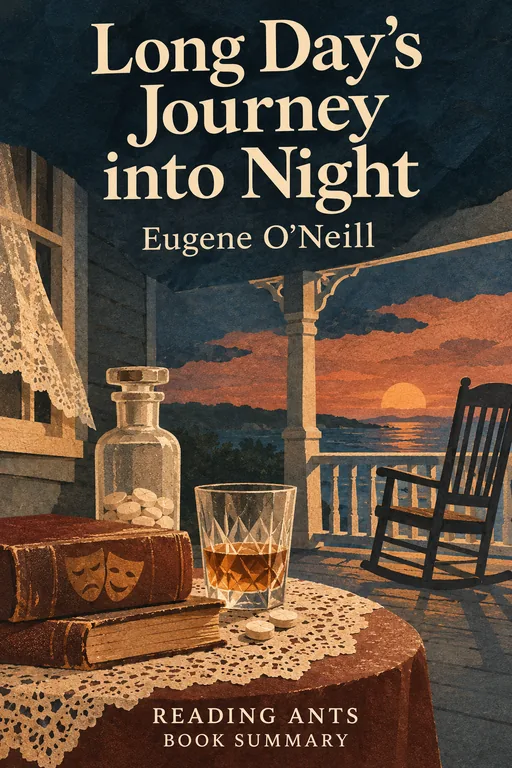
Long Day's Journey into Night
Over a single August day in 1912, the four members of the Tyrone family, locked in a cycle of blame, addiction and regret, fight, forgive and fight again in a play that O'Neill based on his own family.
Overview
Long Day’s Journey into Night is a four-act play by Eugene O’Neill, written between 1939 and 1941 but not published until 1956, three years after his death (it was first staged in Sweden that year, and on Broadway later in 1956), although he had asked that it be held back for twenty-five years after his death. It won the Pulitzer Prize for Drama in 1957. It is set in the Connecticut summer home of the Tyrone family, a thinly disguised version of O’Neill’s own family. The mother is addicted to morphine, the father is a miserly actor, the older son is an alcoholic and the younger son is ill. O’Neill described it, in a dedication to his wife, as a play of old sorrow, written with tears and blood. It is regarded as one of the great American tragedies.
Main Characters
- James Tyrone: the father, a famous actor who grew up in poverty and is obsessed with money.
- Mary Tyrone: the mother, a fragile, nervous woman who has long been dependent on morphine.
- James “Jamie” Tyrone Jr.: the older son, a cynical alcoholic and failed actor.
- Edmund Tyrone: the younger son, a sensitive writer, who is seriously ill.
- Cathleen: the family’s maid, who is young and talkative.
Full Summary
Morning
The play begins in the morning, after breakfast. The family seems cheerful, and James teases his wife, who has put on weight and seems nervous. Mary says that she did not sleep, and that the sound of the foghorn bothers her. The men are worried about her, since she has just returned from a sanatorium where she was treated for addiction. Edmund has a persistent cough, and the family fears that it may be something worse than a summer cold. There is an undercurrent of suspicion and a fear that the old patterns will return.
The Doctor’s News
By midday, the tension is rising. Mary worries about Edmund, and James and Jamie argue about money and the choice of a cheap doctor. Edmund goes to see the doctor, and the family waits. Mary, who is alone for long periods, retreats to the upstairs room, and when she returns, her eyes are bright and her manner is distant. The men realize that she has begun taking morphine again. They accuse each other of causing the relapse.
Afternoon: Revelations
Edmund returns with the news that he has consumption, or tuberculosis, and must go to a sanatorium. Mary, in a state of denial, insists that it is only a cold. James, who is a miser, agrees to send Edmund to a state sanatorium, which angers Edmund, who knows that it is cheap. The family begins to confess old grievances: James regrets giving up a promising acting career for a money-making play, and Mary recalls that she gave up her dream of becoming a nun or a pianist when she married.
Edmund also tells his father of the despair he feels when he looks at his family and thinks about death. James, for his part, says that he never meant to cheat the boys, and that he did what he could. The scene shows that the two men are less different than they seem, and that their love is real even when it is poorly expressed.
Evening: The Fight
In the evening, the quarrels turn bitter. Jamie, who is drunk, confesses to Edmund that, although he loves him more than anyone, he has wanted him to fail and has led him astray. Edmund tells his father about his life at sea, and about moments of beauty and freedom, and then a scene in which father and son speak openly of regret and love. James tells how he grew up poor and started working at ten, and why he fears the poorhouse.
Night: Mary’s Return
At the end, the men wait in the dark living room, while Mary comes downstairs in a daze, holding her old wedding dress, and speaks as though she were a young girl at the convent, before everything went wrong. She says that she wanted to be a nun, and she remembers her first meeting with James. The men watch, helpless, and the play ends with the family sitting in silence, trapped in the past, while Mary says that she fell in love with James and was happy for a time.
Why It Matters
Long Day’s Journey into Night is widely regarded as O’Neill’s masterpiece and one of the greatest American plays. Its honesty about addiction, blame and love within a family set a new standard for dramatic realism and influenced playwrights from Arthur Miller to Sam Shepard. It has been adapted for film, notably in 1962 with Katharine Hepburn, and revived many times on stage.
The play is also a record of O’Neill’s own life, and an act of forgiveness toward his family, which gives it a unique emotional weight.
O’Neill, who won the Nobel Prize in Literature in 1936, left instructions that the play not be staged until long after his death, and his wife, Carlotta, released it against that wish. Its publication is often seen as a gift to the theater, even if it was a betrayal of his instructions.
Key Takeaways
- Addiction affects the whole family. Mary’s morphine use shapes their lives.
- Blame is a cycle. Each character accuses the others.
- Love and resentment coexist. The Tyrones care but cannot stop wounding each other.
- The past is inescapable. Old choices still haunt them.
- Forgiveness is hard. The family can understand, but not escape.
What We Can Learn
The play shows how addiction and unspoken wounds can trap a family in patterns of blame and silence. Seeing the characters’ pain can encourage compassion for those in similar situations.
It also shows that understanding someone’s history, as when James describes his poverty, does not remove hurt, but it can make forgiveness possible.
Finally, it invites us to be honest and open in our own families before it is too late.
It also reminds us that stories we tell about the past, such as who is to blame, can imprison a family if no one is willing to listen to a different version.
Criticism and Counterpoints
Some critics find the play too long, with repetitive arguments, and the characters trapped in a loop that gives little sense of progress. Others point out that the portrayal of Mary as a victim of her husband’s stinginess and her sons’ behavior leaves her little agency. The play’s gloom can be hard to bear.
Some also feel that its autobiographical nature makes it indulgent. Nonetheless, many consider it a profound work.
Who Should Read It
This play suits mature readers and theatergoers. It is long and emotionally heavy, with addiction and illness. It is best read or seen in a single sitting, if possible.
Readers may find it helpful to take breaks between acts.
Want the whole book?
A summary is a taste, not the meal. Here is where to find the full book.
You reached the end 🎉
Nicely done. Mark this one as read, and we will suggest what to read next.
Read this next
The Glass Menagerie
Tennessee Williams
Tom Wingfield remembers the cramped St. Louis apartment where he lived with his domineering mother Amanda and his painfully shy sister Laura, and the evening when a gentleman caller briefly brought hope, and then ended it.
🎭 Epics, Drama & Poetry
Death of a Salesman
Arthur Miller
An aging traveling salesman, losing his job and his grip on reality, clings to the dream of being "well liked" and rich, and in his last days wrecks his relationship with his sons before taking his own life so his family can collect insurance money.
🎭 Epics, Drama & Poetry
A Streetcar Named Desire
Tennessee Williams
A fading Southern belle arrives at her sister's cramped New Orleans apartment, clinging to illusions of refinement, and clashes with her sister's brutal husband in a collision that ends in her breakdown.
🎭 Epics, Drama & Poetry
Our Town
Thornton Wilder
Through the ordinary lives of two neighboring families in a small New Hampshire town in the early 1900s, the play shows how precious everyday moments are, and how seldom we notice them while they last.
🎭 Epics, Drama & Poetry
The Cherry Orchard
Anton Chekhov
A once-wealthy Russian noblewoman returns to her family estate, which is about to be auctioned to pay its debts, but she and her brother cannot bring themselves to act, and the cherry orchard is sold to the son of a former serf.
🎭 Epics, Drama & Poetry
The Odyssey
Homer
After the Trojan War, the clever hero Odysseus struggles for ten years against monsters, gods and temptations to return home to his faithful wife and son, then must win back his house from the men trying to steal it.
🎭 Epics, Drama & PoetryWant something different?
Pick another topic and we will show you three books to start with.