 Reading Ants
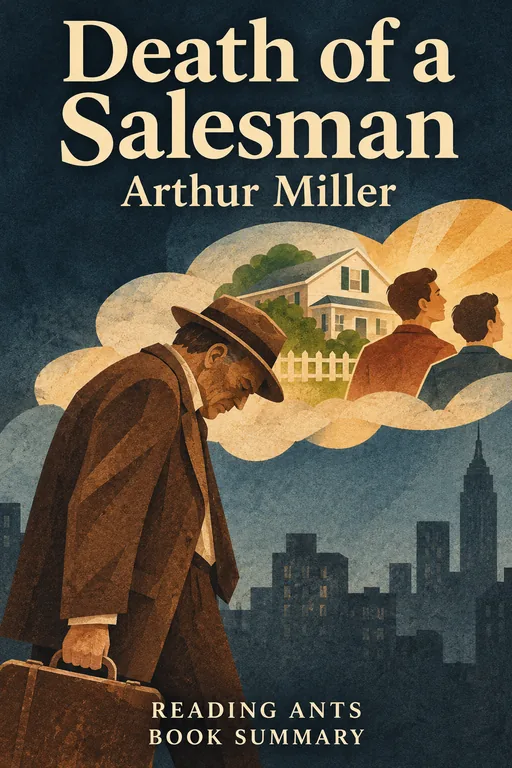
Death of a Salesman
An aging traveling salesman, losing his job and his grip on reality, clings to the dream of being "well liked" and rich, and in his last days wrecks his relationship with his sons before taking his own life so his family can collect insurance money.
Overview
Death of a Salesman is a play by Arthur Miller, first staged in 1949, and one of the most important American dramas of the twentieth century. Willy Loman, in his sixties, has worked as a salesman for decades and believes that success comes from being well liked and personally attractive. But now he is exhausted, no longer making sales and slipping into confusion, constantly drifting into memories of the past. His wife, Linda, loves him and tries to protect him, while his sons, Biff and Happy, are disappointed adults who have never lived up to his dreams. The play moves fluidly between the present and Willy’s memories. It explores the American Dream, family, pride and the cost of living a lie.
Main Characters
- Willy Loman: a tired, proud salesman clinging to his dreams.
- Linda Loman: Willy’s loyal, loving wife.
- Biff Loman: Willy’s older son, once a high school football star.
- Happy Loman: Willy’s younger son, who lives in his brother’s shadow.
- Charley: Willy’s kind neighbor and friend.
- Bernard: Charley’s son, once a studious boy, now a successful lawyer.
- Ben: Willy’s dead older brother, who appears in his memories.
- The Woman: a woman Willy had an affair with.
Full Summary
Home Again
Willy Loman comes home late one night to his small Brooklyn house, exhausted after canceling a sales trip to New England because he kept losing concentration while driving. His wife, Linda, suggests that he ask his boss, Howard, to let him work in New York instead of traveling. Willy complains that his older son, Biff, who has just returned home after years of working on farms in the West, has no direction in life.
Biff and his younger brother, Happy, overhear Willy talking to himself downstairs. Biff is shocked by how confused his father has become. The brothers talk about their dreams: Biff hates office work and wants to buy a ranch, while Happy lives in the city, chasing women and dreaming of a promotion.
Memories
As the play goes on, Willy slips into vivid memories of the past. He sees his sons as teenagers, when Biff was a star football player and everyone seemed to admire them. Willy tells them that being well liked is the key to success, and that Biff doesn’t need to study. Bernard, the quiet neighbor boy, warns Biff that he is failing math and will not graduate, but Willy laughs at Bernard for being a nerd.
Willy also remembers his older brother, Ben, who went to Africa and came back rich, saying he walked into the jungle at seventeen and came out at twenty-one a wealthy man. Willy envies him and believes that success is a matter of daring and charm.
Fired
Willy goes to see his boss, Howard, who is more interested in showing off his new recording machine than in listening. Willy asks to stop traveling, but Howard refuses and fires him after thirty-four years. Willy’s own sales have fallen off, and Howard says he has no place for sentiment.
Willy visits his neighbor Charley, who has always helped him, lending him money each week and offering him a job. But Willy is too proud to accept it, insisting that he is still a salesman. He meets Bernard, now a successful lawyer who is about to argue a case before the Supreme Court. Bernard asks what happened with Biff, who seemed to give up on everything after a trip to Boston.
The Dinner
That evening, Biff, Happy and Willy meet at a restaurant. Biff tried to get a loan from an old employer, but waited all day and was ignored, and in a moment of frustration he stole the man’s fountain pen. He realizes his entire life has been based on lies. He tries to tell his father the truth, but Willy refuses to listen. Biff admits he was never a salesman, and Willy goes back into a flashback.
In it, we see the cause of the break between father and son. Years ago, Biff, hoping to get his father’s help with failing math, went to Boston to find him and found Willy with another woman in his hotel room. Biff’s faith in his father was shattered. Willy, in the present, is overwhelmed by shame. Happy and Biff leave Willy alone in the restaurant bathroom, Happy going off with two women.
The Last Night
At home, Linda is furious with the sons for abandoning their father. Biff tries to make peace and to explain to Willy that he is not a leader, just a regular guy, and that neither of them is special. He hopes for honesty at last. Willy answers angrily, but when Biff breaks down and cries, hugging him, Willy is stunned that his son loves him.
But Willy has already made a terrible decision. Believing he is worth more dead than alive, he plans to kill himself so that Biff can use the twenty thousand dollars of life insurance to start a business. Ben appears to him, encouraging him. Willy drives off in his car and dies in a crash.
Requiem
At the funeral, only a few people come: the family, Charley and Bernard. Linda cannot cry; she keeps saying that she doesn’t understand why he did it, now that they have finally paid off the house and no one is left at home. Biff says that Willy had the wrong dreams. Happy insists that he will fulfill his father’s dream and win in the city. Linda begs Willy’s forgiveness and says goodbye.
Why It Matters
Death of a Salesman won the Pulitzer Prize for Drama in 1949 and the Tony Award for Best Play, and it is often named among the greatest American plays. Its portrayal of an ordinary man destroyed by false dreams gave a new meaning to tragedy: Miller argued that the common man is as suited to tragedy as kings are.
The play remains a cornerstone of American theater and classroom study. “Attention must be paid” to Willy has become one of theater’s best-known lines, and the term “Willy Loman” refers to anyone chasing an empty dream. Its critique of the American Dream, the belief that success comes from charm and hard work, remains relevant to workers, parents and anyone judged by their earnings.
Key Takeaways
- The American Dream can be an illusion. Willy’s belief in being well liked leads to failure.
- Self-deception is dangerous. Willy cannot face reality or accept his limits.
- Our worth is not our job. Willy sees his value only through sales and money.
- Honesty heals families. Biff’s truth-telling is painful but necessary.
- Pride can block help. Willy refuses Charley’s generous offer.
What We Can Learn
Death of a Salesman reminds us to value people for who they are, not just what they earn or achieve. Willy believes his worth depends on success, and this leaves him desperate and alone.
It also teaches the importance of honest communication in families. Years of lies and unspoken disappointments tear the Lomans apart. Talking openly, listening and forgiving can strengthen relationships.
Finally, the play encourages us to accept help. Willy refuses Charley’s job offer out of pride. Being willing to ask for and accept support when we’re struggling is a sign of strength.
Criticism and Counterpoints
Some critics have argued that Willy is too weak and foolish to be a true tragic hero, since he has no great stature to fall from. Miller defended him as an ordinary person whose struggle still has deep meaning. Others feel the female characters are underdeveloped: Linda is mostly a loyal, suffering wife, and “the Woman” is little more than a symbol of Willy’s betrayal.
Modern readers have also noted that the play’s version of the American Dream focuses on a white, middle-class family, and that Willy’s sexism and his teaching of dishonest values to his sons are hard to sympathize with. Others praise its clear structure, powerful dialogue and moving ending.
Who Should Read It
This play suits teens and adults and is a common high school and college text. It is especially meaningful for anyone thinking about work, success and family expectations. Watching a stage or film version adds to its emotional impact.
Want the whole book?
A summary is a taste, not the meal. Here is where to find the full book.
You reached the end 🎉
Nicely done. Mark this one as read, and we will suggest what to read next.
Read this next

A Streetcar Named Desire
Tennessee Williams
A fading Southern belle arrives at her sister's cramped New Orleans apartment, clinging to illusions of refinement, and clashes with her sister's brutal husband in a collision that ends in her breakdown.
🎭 Epics, Drama & Poetry
The Crucible
Arthur Miller
In 1692 Salem, Massachusetts, a group of girls accuse their neighbors of witchcraft, and fear, jealousy and religious certainty spiral into a wave of false accusations and hangings that one honest farmer refuses to join.
🎭 Epics, Drama & Poetry
A Raisin in the Sun
Lorraine Hansberry
A Black family in Chicago in the 1950s receives a ten-thousand-dollar insurance check after the father's death, and each member has a different dream of how to use it, which tests their love and their pride.
🎭 Epics, Drama & Poetry
The Great Gatsby
F. Scott Fitzgerald
A mysterious millionaire throws lavish parties on Long Island in the hope of winning back the woman he loved years ago, but his dream collides with the careless cruelty of the rich.
📜 Classics
A Doll's House
Henrik Ibsen
A cheerful young wife, treated by her husband like a pretty doll, hides a secret loan she took to save his life, and when the truth comes out, she realizes she must leave him to discover who she really is.
🎭 Epics, Drama & Poetry
The Odyssey
Homer
After the Trojan War, the clever hero Odysseus struggles for ten years against monsters, gods and temptations to return home to his faithful wife and son, then must win back his house from the men trying to steal it.
🎭 Epics, Drama & PoetryWant something different?
Pick another topic and we will show you three books to start with.