 Reading Ants
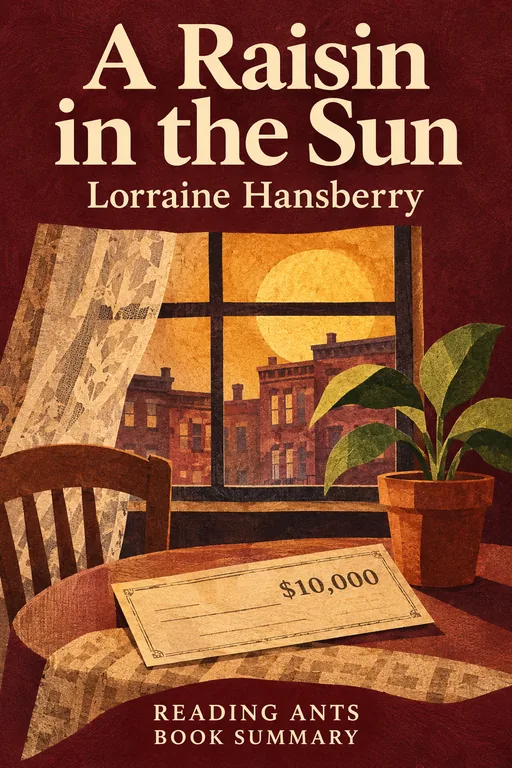
A Raisin in the Sun
A Black family in Chicago in the 1950s receives a ten-thousand-dollar insurance check after the father's death, and each member has a different dream of how to use it, which tests their love and their pride.
Overview
A Raisin in the Sun is a play by Lorraine Hansberry, which opened on Broadway in 1959. It was the first play by a Black woman to be produced on Broadway, and its director, Lloyd Richards, was the first Black director of a Broadway play. The title is taken from a poem by Langston Hughes, which asks what happens to a dream deferred, and whether it dries up like a raisin in the sun. The play is set in a cramped apartment on Chicago’s South Side, where three generations of the Younger family live together. It is a play about family, money, dignity and the fight against discrimination, based in part on Hansberry’s own experiences.
Main Characters
- Lena Younger (Mama): the matriarch, a strong, religious widow who wants a home for her family.
- Walter Lee Younger: her son, a chauffeur who is frustrated and dreams of owning a business.
- Ruth Younger: Walter’s wife, tired and loyal, who holds the family together.
- Beneatha Younger: Walter’s sister, a college student who wants to become a doctor.
- Travis Younger: Walter and Ruth’s young son.
- George Murchison and Joseph Asagai: Beneatha’s suitors, one wealthy and assimilated, the other a Nigerian student.
- Karl Lindner: a white representative of a neighborhood association.
Full Summary
The Check
The play begins on a Friday morning, in the Younger apartment, where the family is waiting for a check for ten thousand dollars, the insurance payment after the death of Mama’s husband. Each person has plans. Walter wants to use it to invest in a liquor store with two friends, and sees it as his one chance to change his life. Beneatha needs money for medical school. Ruth wants to move out of the cramped apartment. Mama, who is the owner of the check, is more cautious.
Dreams and Arguments
Walter pleads with Mama to give him the money, but she refuses to put it in a liquor store, since she does not believe in it. Walter feels that he is being denied the chance to be a man, and lashes out at Ruth, whom he feels does not support him. Beneatha, meanwhile, is dating the wealthy George Murchison, who dismisses her ideas, and a Nigerian student, Asagai, who talks to her about her heritage and about the future of Africa. When Ruth finds out that she is pregnant and considers ending the pregnancy, the family’s problems deepen.
The House
Mama, thinking of her family, makes a down payment on a house in Clybourne Park, a white neighborhood, because it is the only place that she can afford. She tells the family that the house has a yard and room for everyone, and Ruth is overjoyed. She gives Walter the rest of the money, with the instruction that he put part in a savings account for Beneatha’s education and use the rest as he sees fit. Walter, however, gives all of it to his friend Willy Harris, who disappears with it.
Lindner’s Offer
Before the move, Karl Lindner, from the neighborhood association, visits the apartment and offers to buy the house back at a profit, so that the Youngers will not move in. He is polite but his message is clear: they are not welcome. The family refuses, to Mama’s pride. But when Walter loses the money, he considers calling Lindner and accepting the offer, as a way to recover something.
The Choice
Walter calls Lindner and invites him back. Beneatha is furious, and calls him a traitor. Mama sees that her son is suffering and says that she has seen a man grow small, and begs him to remember his father’s dignity. When Lindner arrives, Walter, with his son Travis watching, says that the family will move into the house, because his father earned it and his family is proud. He rejects the offer. His decision is the moment of his growth.
Moving Day
The family packs to leave, and Mama takes her little plant, which she has kept alive through years of poor light. They joke and argue, but with a new sense of unity. Mama is the last to go, looks around the room, and exits, carrying the plant, a symbol of her hope. The play ends as the family moves toward the future, aware of the risks, but willing to face them together.
Why It Matters
A Raisin in the Sun was a landmark in American theater, winning the New York Drama Critics’ Circle Award and introducing Black family life to a wide audience. It has been adapted for film in 1961 and 2008, and its stories of fair housing and dreams have remained relevant. Hansberry, who died young in 1965, became a major voice in the civil rights era.
Its title has become a common phrase in discussions of postponed hopes, and the play is widely taught.
Many later writers and actors have credited it as a turning point. Its story of a family trying to buy a house in a white neighborhood echoes the real struggle over housing discrimination, which Hansberry’s own family had fought in a famous legal case in Chicago.
Key Takeaways
- Dreams deferred can cause pain. Walter’s frustration grows.
- Dignity matters more than money. Walter rejects the buyout.
- Family is a source of strength. The Youngers fight and stay together.
- Racism limits opportunities. The housing offer is a form of discrimination.
- Hope can be nurtured. Mama’s plant shows her patient faith.
What We Can Learn
The play shows how financial pressure and unfulfilled dreams can strain a family, and how the most important decisions are about values. Walter’s final choice is to put dignity ahead of money.
It also shows how discrimination, such as unfair housing practices, affects people’s lives, and invites us to consider how to counter it.
Finally, it demonstrates the value of listening to and supporting one another, even when the dreams of family members differ.
It also shows that patience and faith, like Mama’s care for her small plant, can keep hope alive in difficult conditions.
Criticism and Counterpoints
Some critics note that the play fits a traditional realistic style and a family drama model, and that it has a somewhat conventional, hopeful ending. Others say that the portrayal of Beneatha’s assimilationist suitor, George, is a bit of a caricature, and that the women’s roles remain limited by the time.
Some have criticized the play’s reliance on melodrama, such as the stolen money. Others, such as the later play Clybourne Park, have answered it. Still, it is widely admired.
Who Should Read It
This play suits teenagers and adults. It is accessible and moving, and is often read in school. It deals with racism and family stress, and invites discussion.
Teachers often pair it with Langston Hughes’s poem and discuss the meaning of a dream deferred.
Want the whole book?
A summary is a taste, not the meal. Here is where to find the full book.
You reached the end 🎉
Nicely done. Mark this one as read, and we will suggest what to read next.
Read this next
The Glass Menagerie
Tennessee Williams
Tom Wingfield remembers the cramped St. Louis apartment where he lived with his domineering mother Amanda and his painfully shy sister Laura, and the evening when a gentleman caller briefly brought hope, and then ended it.
🎭 Epics, Drama & Poetry
Death of a Salesman
Arthur Miller
An aging traveling salesman, losing his job and his grip on reality, clings to the dream of being "well liked" and rich, and in his last days wrecks his relationship with his sons before taking his own life so his family can collect insurance money.
🎭 Epics, Drama & Poetry
Native Son
Richard Wright
Bigger Thomas, a young Black man in 1930s Chicago who feels trapped by poverty and racism, accidentally kills a white woman and then commits another crime, and the novel shows how a society shaped him and then condemned him.
📜 Classics
Our Town
Thornton Wilder
Through the ordinary lives of two neighboring families in a small New Hampshire town in the early 1900s, the play shows how precious everyday moments are, and how seldom we notice them while they last.
🎭 Epics, Drama & Poetry
The Odyssey
Homer
After the Trojan War, the clever hero Odysseus struggles for ten years against monsters, gods and temptations to return home to his faithful wife and son, then must win back his house from the men trying to steal it.
🎭 Epics, Drama & Poetry
Hamlet
William Shakespeare
A grieving prince of Denmark learns from his father's ghost that his uncle murdered the king to take the throne, and his struggle to decide whether and how to take revenge leads to madness and death.
🎭 Epics, Drama & PoetryWant something different?
Pick another topic and we will show you three books to start with.