 Reading Ants
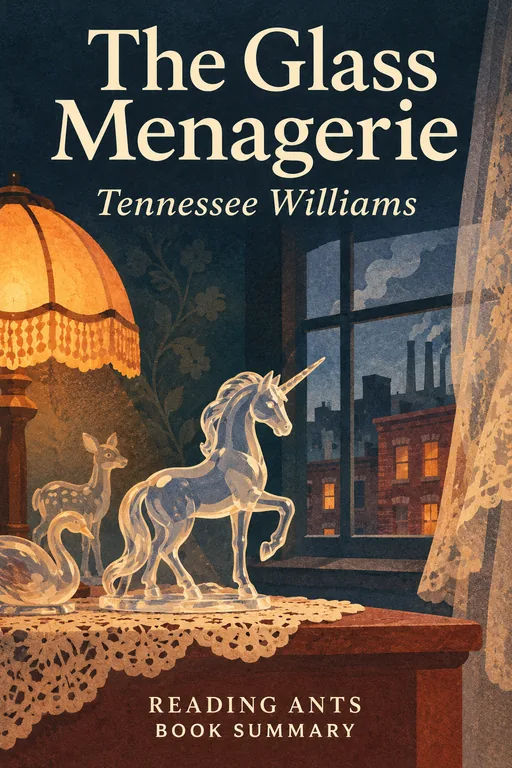
The Glass Menagerie
Tom Wingfield remembers the cramped St. Louis apartment where he lived with his domineering mother Amanda and his painfully shy sister Laura, and the evening when a gentleman caller briefly brought hope, and then ended it.
Overview
The Glass Menagerie is a play by Tennessee Williams, first performed in 1944 and a Broadway success in 1945. Williams called it a “memory play,” meaning that it is a remembered story, told by Tom, the narrator, who admits that memory is not realistic. The play is partly based on Williams’s own family, especially his sister Rose and his mother, and is set in a St. Louis tenement in the 1930s, during the Great Depression. Its title refers to the collection of tiny glass animals that Laura keeps, which are fragile like her hopes. It was Williams’s first big success, and is one of the classics of American theater.
Main Characters
- Tom Wingfield: the narrator and a poet who works in a warehouse and dreams of escape.
- Amanda Wingfield: Tom’s mother, a faded Southern belle who lives in the past and pushes her children.
- Laura Wingfield: Tom’s sister, who is shy, has a limp and collects glass animals.
- Jim O’Connor: the “gentleman caller,” an old high school friend of Tom’s who is friendly and ambitious.
- Mr. Wingfield: the absent father, who left and whose photograph hangs on the wall.
Full Summary
Tom’s Opening
Tom steps forward and introduces himself as a character and as the narrator. He tells the audience that the play is a memory, and so it is dimly lit and sentimental, and not realistic. He sets the scene in the 1930s, a time of unemployment and a looming war. He mentions his father, who left the family long ago, and whose smiling photograph stays on the wall, a symbol of someone who escaped.
Life at Home
At dinner, Amanda, who talks of her youth in Mississippi and the seventeen gentlemen callers who once came, nags Tom about how he eats. Tom, who works in a shoe warehouse and secretly writes poems, feels trapped, and goes to the movies each night to escape. Amanda finds out that Laura, who is shy and has a mild disability, has stopped attending the business college where she was enrolled, and has been wandering in parks and museums. Amanda is shocked, and decides that the only future for Laura is marriage.
Planning for a Caller
Amanda presses Tom to find a suitable man at the warehouse to bring home for dinner. He reluctantly agrees, and invites Jim O’Connor, a co-worker. Amanda is thrilled, and plans the meal, buying a new lamp and a dress for Laura. Laura is nervous, since she remembers Jim from high school, where she had a crush on him, and where he was a star. She worries that she cannot get through the evening.
Laura tells her mother that she cannot face a stranger, and that she is different from other girls because of her limp, which she exaggerates in her mind. Amanda insists that it is hardly noticeable, and that charm is what counts. Their conversation shows how love and pressure are mixed in the household.
The Gentleman Caller
Jim arrives, and Laura, overcome with shyness, can hardly speak. After dinner, the power goes out because Tom has not paid the bill, and the family continues by candlelight. Later, Jim and Laura talk alone in the parlor. He is kind, and helps her relax, telling her that she should believe in herself, and that her shyness is a kind of inferiority complex. She shows him her glass collection, particularly a unicorn, which he holds carefully.
The Dance and the Truth
Jim and Laura dance, and in the dance he accidentally knocks the unicorn over, breaking off its horn; Laura says that now it is like the other horses. He kisses her, but then he tells her that he is engaged to another girl, and must leave. Laura, who had begun to hope, is stunned. She gives him the broken unicorn as a keepsake. Amanda, entering, learns the truth, and, in her bitterness, blames Tom for bringing a man who was already engaged. Tom, who is hurt and angry, argues with her, and says that he is going to leave.
Tom’s Escape
Soon after, Tom leaves home and joins the merchant marine, traveling far away. But he tells the audience that he cannot escape the memory of his sister, and that he is haunted by her image, and by the small objects that remind him. As Laura blows out her candle, he says goodbye to her across the years, asking her to blow it out. The play ends in the dark.
Why It Matters
The Glass Menagerie made Williams a major figure in American drama, and it has been revived many times, often with famous actresses as Amanda. It was adapted for film and television. Its poetic style, use of symbols and focus on fragile characters influenced later writers.
The play also captures the emotional pressures of family life, and the tension between duty and the wish to escape. Its picture of Laura, who is easily wounded, has become one of the most familiar in theater.
Williams drew on his own life, including a sister who suffered from mental illness, which gives the play a feeling of truth. It has been staged by many famous actors, and its closing speech, in which Tom speaks of candles and the dark, is one of the best known in American drama.
Key Takeaways
- Memory is subjective. Tom’s story is shaped by his guilt.
- Fragility is beautiful. Laura and her glass animals are delicate.
- Illusions can be a refuge. Amanda lives in the past.
- Escape has a price. Tom leaves but cannot forget.
- Hope can be cruel. Jim’s visit gives Laura hope, then removes it.
What We Can Learn
The play invites us to look at how our families shape us, and how love can be mixed with disappointment. Amanda’s pushing is a result of fear for her children, and it also stifles them.
It also warns about the dangers of living in illusions. Amanda’s memories and Laura’s collection protect them, but also keep them from facing the present.
Finally, it shows how guilt can linger, and encourages us to treat family with understanding.
It also encourages us to be gentle with people who are fragile, and to notice how small acts of cruelty, even careless ones, can affect them for a long time.
Criticism and Counterpoints
Some critics find that the play is sentimental, and that Amanda is a caricature of a faded belle. Others point out that Laura’s disability, and the use of her limp as a symbol of weakness, can feel dated. Some think that Tom, who leaves his sister behind, is treated too sympathetically.
The play’s reliance on symbols, such as the unicorn, can seem heavy-handed to some. The role of women in the play is also limited by the time. Still, it remains a classic.
Who Should Read It
This play suits teenagers and adults. It is short and moving, especially in performance. It contains family conflict and sadness, but is not graphic.
It is a good play for reading aloud in a small group, where the voices of the characters can come alive.
Want the whole book?
A summary is a taste, not the meal. Here is where to find the full book.
You reached the end 🎉
Nicely done. Mark this one as read, and we will suggest what to read next.
Read this next

A Streetcar Named Desire
Tennessee Williams
A fading Southern belle arrives at her sister's cramped New Orleans apartment, clinging to illusions of refinement, and clashes with her sister's brutal husband in a collision that ends in her breakdown.
🎭 Epics, Drama & Poetry
Death of a Salesman
Arthur Miller
An aging traveling salesman, losing his job and his grip on reality, clings to the dream of being "well liked" and rich, and in his last days wrecks his relationship with his sons before taking his own life so his family can collect insurance money.
🎭 Epics, Drama & Poetry
Our Town
Thornton Wilder
Through the ordinary lives of two neighboring families in a small New Hampshire town in the early 1900s, the play shows how precious everyday moments are, and how seldom we notice them while they last.
🎭 Epics, Drama & Poetry
Long Day's Journey into Night
Eugene O'Neill
Over a single August day in 1912, the four members of the Tyrone family, locked in a cycle of blame, addiction and regret, fight, forgive and fight again in a play that O'Neill based on his own family.
🎭 Epics, Drama & Poetry
A Raisin in the Sun
Lorraine Hansberry
A Black family in Chicago in the 1950s receives a ten-thousand-dollar insurance check after the father's death, and each member has a different dream of how to use it, which tests their love and their pride.
🎭 Epics, Drama & Poetry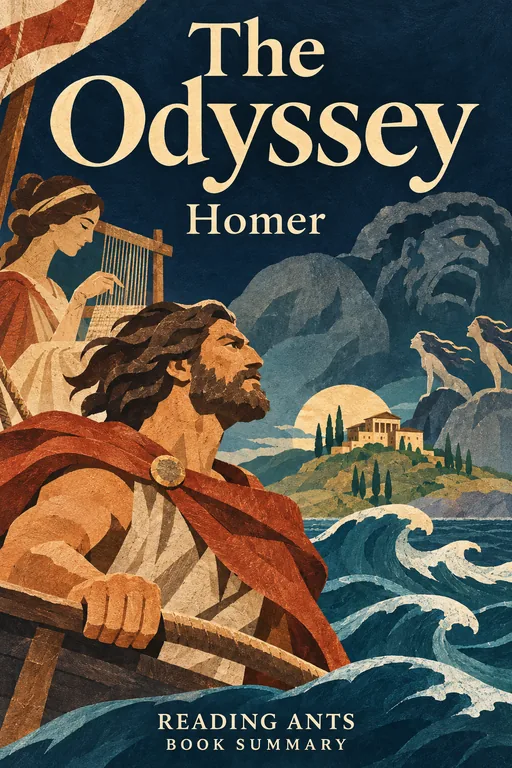
The Odyssey
Homer
After the Trojan War, the clever hero Odysseus struggles for ten years against monsters, gods and temptations to return home to his faithful wife and son, then must win back his house from the men trying to steal it.
🎭 Epics, Drama & PoetryWant something different?
Pick another topic and we will show you three books to start with.