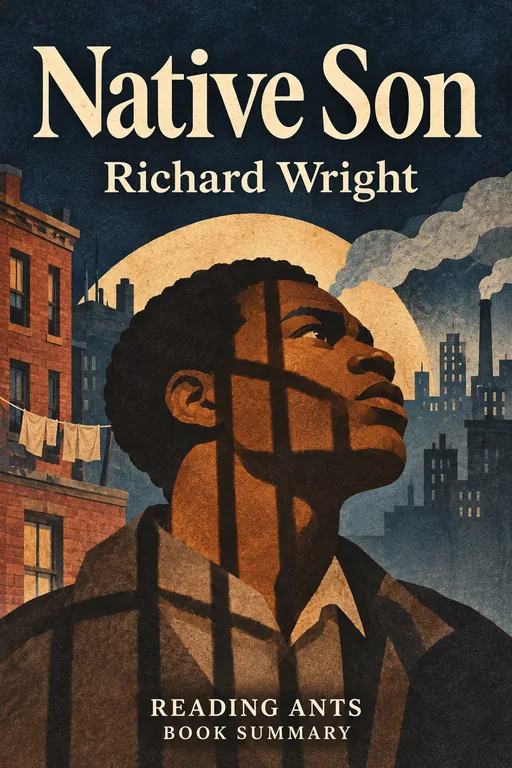
Native Son
Bigger Thomas, a young Black man in 1930s Chicago who feels trapped by poverty and racism, accidentally kills a white woman and then commits another crime, and the novel shows how a society shaped him and then condemned him.
Overview
Native Son is a novel by Richard Wright, published in 1940, and was the first novel by a Black writer to be a Book-of-the-Month Club selection. It is set in Chicago’s South Side, in a crowded, segregated Black neighborhood in the 1930s, during the Great Depression. Wright was inspired by the experiences of Black men he knew in Chicago and by his own struggle with poverty and racism. The book follows Bigger Thomas over a few days of violence, and then through his trial. It is a harsh, powerful story about how racism and fear can produce violence, and it is considered a landmark of American literature.
Main Characters
- Bigger Thomas: a twenty-year-old Black man, who is angry, frightened and ambitious.
- Mr. and Mrs. Dalton: a wealthy white couple who employ Bigger as a chauffeur, and who give money to Black causes.
- Mary Dalton: their daughter, a rebellious young woman.
- Jan Erlone: Mary’s boyfriend, a Communist who tries to befriend Bigger.
- Bessie Mears: Bigger’s girlfriend.
- Boris Max: a Jewish Communist lawyer who defends Bigger.
- Buckley: the state’s attorney who prosecutes him.
Full Summary
Bigger’s World
Bigger lives with his mother, brother and sister in a one-room apartment on Chicago’s South Side. He feels hemmed in by poverty and by the invisible walls that separate Black people from white, and he is filled with fear and anger. He and his friends plan a robbery of a white-owned store, but Bigger, afraid to rob a white man and unwilling to admit it, attacks his friend Gus with a knife to hide his fear, and the plan falls apart. His family urges him to take a job as a chauffeur for the Dalton family, rich white philanthropists.
Bigger’s mother prays and his sister Vera sews, and his younger brother Buddy admires him. A rat runs through the room and Bigger kills it with a skillet, and he then terrorizes his sister with its dead body until she faints, which shows the mix of cruelty and fear that fills him. He feels that he lives in a world that offers him nothing but the cinema and the street.
The Daltons
Bigger starts work, and is nervous to be in a rich white household. Mary Dalton, the daughter, is friendly, and she and her Communist boyfriend, Jan, treat him as an equal, which makes him uncomfortable. They ask him to take them to a restaurant in the Black neighborhood, and to eat with them, which makes him feel exposed. They drink heavily, and Bigger drives Mary home, as she is too drunk to walk.
The Accident
Bigger carries Mary to her bedroom. When Mary’s blind mother enters the room, Bigger, terrified that he will be found with a white woman and accused of rape, covers Mary’s face with a pillow to keep her quiet. When Mrs. Dalton leaves, he finds that Mary has died. Panicking, Bigger disposes of her body in the furnace in the basement. The act is not planned, and the narration makes clear how fear shapes his behavior.
Covering Up
Bigger tries to cover up the death by casting suspicion on Jan, and by sending a ransom note to the family. He tells his girlfriend, Bessie, who is frightened. When the body is discovered in the furnace, Bigger flees, but he fears that Bessie will betray him. He takes her to an abandoned building, where he rapes her and then kills her, and dumps her body. The police and a mob hunt him across the city’s rooftops, and he is finally captured.
The newspapers describe Bigger as a beast and demand his death, while white mobs attack Black neighborhoods. Bigger, on the run, sees that every Black person in the city is made to suffer for what he has done. Wright shows how an individual crime can be used to justify the punishment of an entire community.
The Trial
Bigger is put on trial. The public and the press want to see him punished, and the prosecutor, Buckley, uses racial fears in his arguments. His lawyer, Boris Max, argues that Bigger is a product of a society that has denied him opportunity, and that the death penalty would not solve the underlying problem.
Max makes a long speech to the judge in which he says that Bigger is not just a murderer but the product of conditions that produce many more like him, and that the nation has created its own enemy. The prosecutor responds by calling for a swift execution, and the judge sentences Bigger to death.
The End
In his cell, Bigger talks to Max, and for the first time tries to express what he feels. He says that he has killed because he had been made to feel invisible, and in killing he has felt alive. Max is horrified, but he tries to understand. The book ends with Bigger awaiting execution, with a final sense of a kind of acceptance.
Why It Matters
Native Son was a bestseller and an immediate sensation, and it made Wright the most famous Black writer in America at the time. It brought attention to how racism in housing, jobs and the justice system could shape Black lives, and it was an important work of protest fiction. The 1941 stage version was directed by Orson Welles.
Later writers such as James Baldwin and Ralph Ellison reacted to it, with Baldwin criticizing it in an essay and then acknowledging its influence. The book is still widely taught in schools and universities.
Key Takeaways
- Society shapes behavior. Bigger’s environment pushes him toward violence.
- Fear drives actions. His crimes arise from panic and shame.
- Racism limits lives. Black people had few opportunities.
- Justice is shaped by prejudice. The trial is influenced by public hatred.
- Understanding is not excusing. The novel invites us to see how and why.
What We Can Learn
The novel invites us to look at crime in its social context, and to ask how conditions of poverty and prejudice contribute to violence. It does not excuse Bigger’s acts, but it shows that they did not come from nowhere.
It also demonstrates the damage caused by dehumanization. Bigger feels that he is not seen as a person, and the novel makes the reader see him.
Finally, it challenges us to consider how a society responds to people it has failed.
Criticism and Counterpoints
James Baldwin criticized Native Son in his essay “Everybody’s Protest Novel,” saying that Bigger is a symbol, not a full human being, and that the novel reinforces the stereotypes it opposes. Others have criticized the book’s depiction of women, since Mary and Bessie are both killed and treated mainly as victims or objects, and some have said that its extensive speeches by Max are preachy.
Some readers find the violence disturbing and unrelenting. The novel was also controversial for its depiction of Communism. Still, it is seen as a groundbreaking work.
Who Should Read It
This book suits mature teenagers and adults. It contains violent scenes, racist language and disturbing events, and is best read with discussion. It is an important book for understanding American literature and history.
Want the whole book?
A summary is a taste, not the meal. Here is where to find the full book.
You reached the end 🎉
Nicely done. Mark this one as read, and we will suggest what to read next.
Read this next
Invisible Man
Ralph Ellison
An unnamed young Black man moves from the South to Harlem and passes through one false identity after another, until he realizes that he is invisible to a society that sees only what it expects, and he retreats underground to write his story.
📜 Classics
The Fire Next Time
James Baldwin
Through a letter to his nephew and a longer essay about religion and race, James Baldwin tells white and Black Americans the truth about racism and urges them to face it with love and courage before it destroys the country.
⚖️ Politics & Society
The Color Purple
Alice Walker
Told in letters, the story follows Celie, a poor Black woman in rural Georgia who survives abuse and loss, and through the love of other women finds her voice, her independence and joy.
✨ Modern Fiction
Their Eyes Were Watching God
Zora Neale Hurston
Janie Crawford tells her best friend the story of her three marriages, as she moves from a girl taught to find security to a woman who finds love and her own voice in the Florida of the early twentieth century.
📜 Classics
To Kill a Mockingbird
Harper Lee
In a small Alabama town in the 1930s, young Scout Finch watches her father, a lawyer, defend a Black man falsely accused of a crime, and learns hard lessons about prejudice, courage and seeing the world through other people's eyes.
📜 Classics
Pride and Prejudice
Jane Austen
Quick-witted Elizabeth Bennet and the proud, wealthy Mr. Darcy badly misjudge each other, and only by facing their own faults do they find their way to love.
📜 ClassicsWant something different?
Pick another topic and we will show you three books to start with.