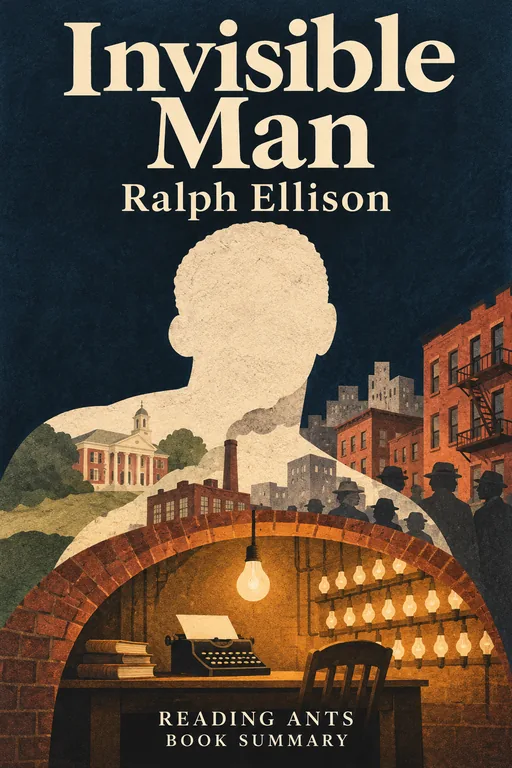
Invisible Man
An unnamed young Black man moves from the South to Harlem and passes through one false identity after another, until he realizes that he is invisible to a society that sees only what it expects, and he retreats underground to write his story.
Overview
Invisible Man is a novel by Ralph Ellison, published in 1952, and it won the National Book Award in 1953. It is narrated by a man who is never named, who tells his story from a hidden basement room lit by 1,369 light bulbs. He is invisible, he says, not because of any physical fact, but because people refuse to see him. The book moves through a college in the South, a paint factory in New York, the streets of Harlem and a political group called the Brotherhood. It combines realism, satire and surreal scenes, and it is a powerful exploration of race, identity and power in America.
Main Characters
- The narrator: a bright, ambitious, naive young man who wants to succeed.
- Dr. Bledsoe: the president of the Black college that the narrator attends, who is powerful and deceitful.
- Mr. Norton: a wealthy white trustee of the college.
- Brother Jack: the charismatic leader of the Brotherhood.
- Ras the Exhorter: a Black nationalist who is angry and eloquent.
- Tod Clifton: a young Brotherhood member who leaves the group.
- Rinehart: a shape-shifting figure who lives many lives in Harlem.
- Mary Rambo: a kind Harlem landlady who helps the narrator.
Full Summary
The Battle Royal
The narrator begins with the story of his grandfather, a former slave, who on his deathbed told the family to keep up the appearance of cooperation, to “overcome ‘em with yeses.” The narrator, a good student, is invited to give his graduation speech to a gathering of prominent white men in his town. Before he speaks, the boys are made to fight blindfolded in a boxing ring, and then to scramble for coins on an electrified rug. Despite this humiliation, the narrator gives his speech, and is rewarded with a scholarship to a Black college.
The College
At the college, the narrator is assigned to drive a white trustee, Mr. Norton. Norton asks to be taken beyond the campus, and the narrator takes him to the cabin of a poor farmer, Jim Trueblood, who tells a shocking story about incest. Norton is disturbed, and faints, and the narrator takes him to a bar full of veterans, where he is roughed up. For this, Dr. Bledsoe expels the narrator, saying that he had shown the white man the wrong side of Black life. Bledsoe gives him sealed letters of recommendation, but they in fact ask their recipients to keep him from ever returning to the college, sending him on from one hopeful but fruitless job search to the next.
Paint and Harlem
In New York, the narrator discovers the trick and takes a job at Liberty Paints, a factory known for a bright white paint. He is hurt in an explosion, and wakes in a hospital where doctors give him an electric treatment. He is taken in by Mary Rambo, a kindly woman in Harlem. One day, he sees an eviction of an elderly couple, and makes an impassioned speech to the crowd, which draws the attention of Brother Jack, who invites him to join the Brotherhood.
The Brotherhood
The Brotherhood claims to work for the poor and to seek justice. The narrator becomes a speaker, rising in the group and enjoying being a leader. He is renamed and given a new identity. He clashes with Ras the Exhorter, a Black nationalist who argues that the Brotherhood is using Black people. The narrator comes to realize that the Brotherhood has its own agenda, which is to use the community, and that its leaders see him as a tool.
Clifton
Tod Clifton, a young member, leaves the group, disillusioned, and begins to sell dolls on the street, small black dancing figures. When a policeman tries to stop him, Clifton is shot and killed. The narrator gives a moving funeral oration, but the Brotherhood is displeased, and he learns that they are willing to sacrifice Harlem’s interests for their own plans.
Riot and Underground
The narrator, disguised in dark glasses and a hat, is mistaken for a man called Rinehart, who is a numbers runner, a preacher and a lover, and he sees that identity can be a performance. As Harlem erupts in a riot, he is chased by Ras and a mob, and he falls into an open manhole. Underground, he burns the papers in his briefcase, which hold the symbols of the false identities that he has taken. He decides to stay below, thinking and writing until he is ready to return.
Epilogue
In the epilogue, the narrator reflects that he must come back up, and that his invisibility is an issue for everyone. He says that he has been trying to speak on the lower frequencies, and he asks whether he may be speaking for the reader, too.
Why It Matters
Invisible Man is regularly ranked among the greatest American novels of the twentieth century. It changed the conversation about race in America by showing how racism distorts both the seen and the unseen, and by rejecting both subservience and simple protest. It is a rich novel of ideas that also tells a comic and tragic story.
Ellison, who wrote little else in his lifetime, became a major figure, and the novel has been widely taught and imitated.
The book’s opening lines and its image of the man in the basement have become shorthand for the experience of being overlooked, and many later American writers have acknowledged its influence on how fiction handles race and identity.
Key Takeaways
- Invisibility is a social act. People see what they expect, not the person.
- Identity cannot be dictated by others. The narrator must find his own.
- Institutions can betray individuals. College, factory and Brotherhood all use him.
- Power hides behind kindness. Bledsoe and Jack both pretend to help.
- Self-knowledge takes time. The narrator learns through painful experience.
What We Can Learn
The novel invites us to look at how we treat people, and to ask whether we see individuals or categories. The narrator’s experience shows how damaging it is to be seen as a type.
It also teaches us to be wary of any group that demands total loyalty. The Brotherhood begins with noble words but ends up using people, which can help us to notice when ideals are turned into tools.
Finally, it encourages us to define ourselves, and to resist the labels that others offer, even when it is difficult.
Criticism and Counterpoints
Some critics found that the novel is too ironic or detached to support the cause of civil rights, and that it is hostile to both the white left and Black nationalism. Others criticize its portrayal of women, who are mostly seen through the narrator’s eyes, and as objects. A few readers find the surreal chapters confusing, and the book long.
Writers like Richard Wright, whose Native Son took a different approach, were uneasy about its more individual vision. Some say that the ending is vague. Despite this, its status as a classic is secure.
Who Should Read It
This book suits mature readers. It is long and complex, with racial slurs, violence and humiliation scenes. It is a landmark worth reading for those who can handle its material.
Want the whole book?
A summary is a taste, not the meal. Here is where to find the full book.
You reached the end 🎉
Nicely done. Mark this one as read, and we will suggest what to read next.
Read this next
Native Son
Richard Wright
Bigger Thomas, a young Black man in 1930s Chicago who feels trapped by poverty and racism, accidentally kills a white woman and then commits another crime, and the novel shows how a society shaped him and then condemned him.
📜 Classics
The Fire Next Time
James Baldwin
Through a letter to his nephew and a longer essay about religion and race, James Baldwin tells white and Black Americans the truth about racism and urges them to face it with love and courage before it destroys the country.
⚖️ Politics & Society
Their Eyes Were Watching God
Zora Neale Hurston
Janie Crawford tells her best friend the story of her three marriages, as she moves from a girl taught to find security to a woman who finds love and her own voice in the Florida of the early twentieth century.
📜 Classics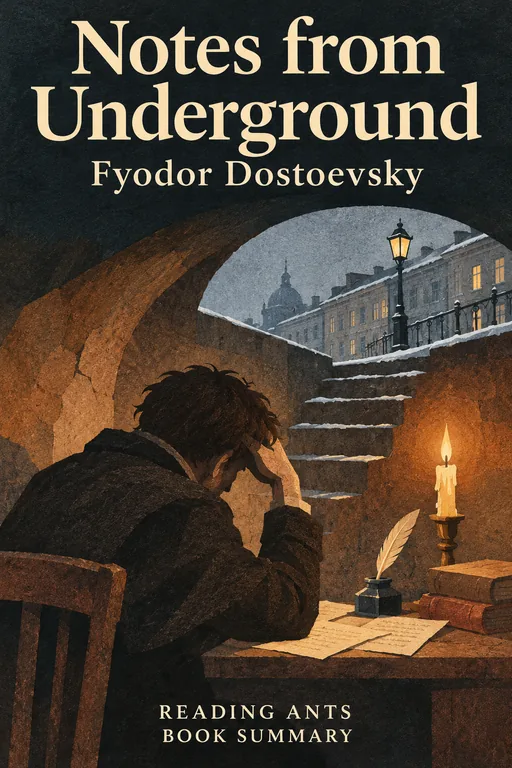
Notes from Underground
Fyodor Dostoevsky
A bitter, lonely former clerk who lives in a squalid underground existence writes an angry confession about his own spite, his contempt for the world and a humiliating episode from his past.
🌍 World Literature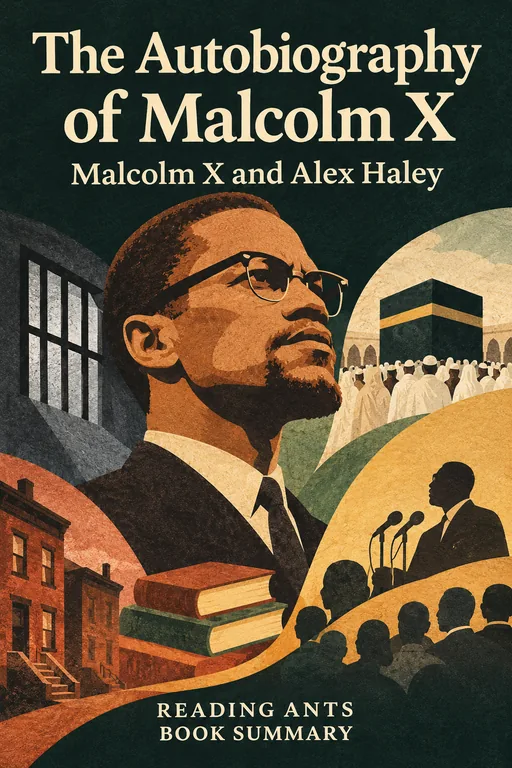
The Autobiography of Malcolm X
Malcolm X and Alex Haley
Malcolm X tells, with the help of the writer Alex Haley, how he moved from a troubled childhood and a life of crime to leadership in the Nation of Islam, and then to a broader view of race and faith before his death.
👤 Real Lives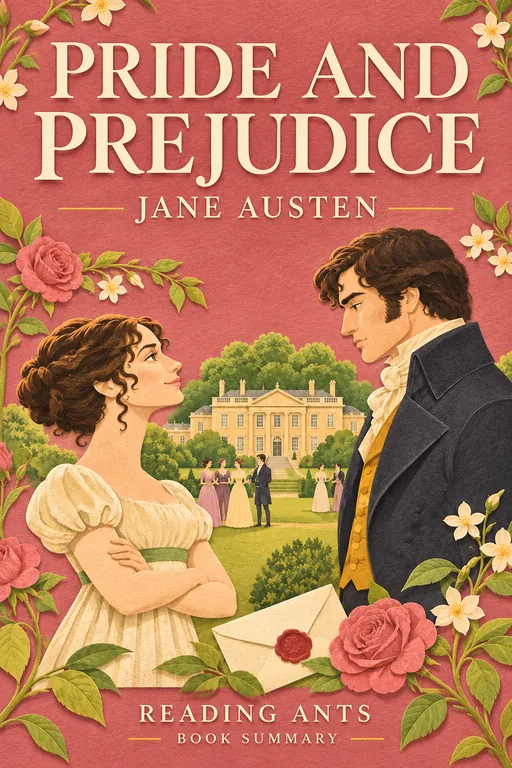
Pride and Prejudice
Jane Austen
Quick-witted Elizabeth Bennet and the proud, wealthy Mr. Darcy badly misjudge each other, and only by facing their own faults do they find their way to love.
📜 ClassicsWant something different?
Pick another topic and we will show you three books to start with.