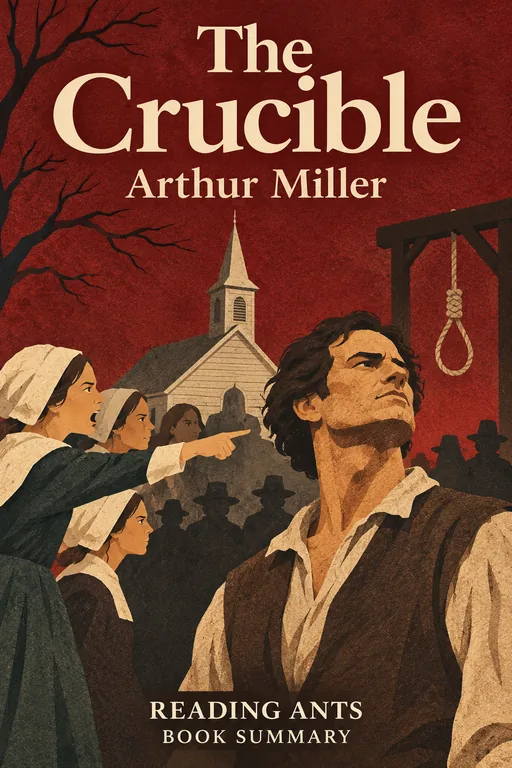
The Crucible
In 1692 Salem, Massachusetts, a group of girls accuse their neighbors of witchcraft, and fear, jealousy and religious certainty spiral into a wave of false accusations and hangings that one honest farmer refuses to join.
Overview
The Crucible is a play by Arthur Miller, first staged in 1953, based on the real Salem witch trials of 1692 and 1693. In the strict Puritan village of Salem, a group of teenage girls is caught dancing in the woods, and to escape punishment, they claim they were bewitched. Soon the accusations spread, and ordinary people are arrested, tried and condemned on the word of the girls. Miller wrote the play during the “Red Scare” of the early 1950s, when Senator Joseph McCarthy and others accused many Americans of being secret communists, ruining careers and lives. Miller himself was later questioned by Congress. The play is a timeless warning about mass hysteria and the danger of false accusations.
Main Characters
- John Proctor: a stubborn, honest farmer burdened by guilt.
- Elizabeth Proctor: his strict, honest wife.
- Abigail Williams: a young woman who once worked for the Proctors and wants John for herself.
- Reverend Parris: Salem’s anxious, greedy minister.
- Reverend Hale: a witchcraft expert who arrives to investigate and slowly begins to doubt.
- Deputy Governor Danforth: the stern judge presiding over the trials.
- Mary Warren: the Proctors’ timid servant girl.
- Giles Corey and Rebecca Nurse: respected elderly villagers who are accused.
- Tituba: Reverend Parris’s enslaved servant.
Full Summary
The Woods
In the village of Salem, Reverend Parris finds his daughter Betty lying ill after he discovered her and a group of girls, including his niece Abigail, dancing in the forest at night. Rumors of witchcraft spread quickly. Abigail, who was dismissed from the Proctor household after an affair with John Proctor, threatens the other girls into silence. When Reverend Hale is called in, Tituba, terrified, confesses to witchcraft and accuses other women. Abigail and the girls begin to name more villagers, discovering that accusing others protects them from punishment.
The Proctors
At home, John Proctor and his wife Elizabeth are still struggling after his affair. Elizabeth cannot quite trust him, and John resents being constantly judged. Mary Warren, their servant, reveals that she is now an official of the court, and that the girls are naming people. Elizabeth’s name has been mentioned. Elizabeth begs John to expose Abigail’s fraud, but John worries that Abigail will tell the court about their affair.
When Reverend Hale visits, he tests Proctor’s religious knowledge, and Proctor stumbles over the Ten Commandments, forgetting adultery. Soon after, officers arrive and arrest Elizabeth, because a poppet, a small doll with a needle in it, was found in the house. Abigail had stabbed herself with a needle at Reverend Parris’s house, claiming Elizabeth’s spirit had attacked her, and the doll, which Mary Warren made and gave Elizabeth, is taken as proof of witchcraft.
The Court
The Salem court, led by Deputy Governor Danforth, treats accusation as proof: anyone who denies being a witch is considered a liar and sentenced to death, while confessing leads to survival. Proctor brings Mary Warren to testify that the girls are pretending. Mary begins to tell the truth, but the court is suspicious of her story.
In a desperate attempt to discredit Abigail, Proctor confesses publicly to his affair. To test his honesty, the court calls in Elizabeth, who has never lied in her life, and asks whether her husband was unfaithful. Not knowing that John has already confessed, she lies to protect his name. Then, when Abigail and the girls pretend that Mary is bewitching them, Mary collapses in fear and turns against Proctor, accusing him of working for the devil. Proctor is condemned. Hale denounces the proceedings and quits the court.
The Prison
Months later, Salem is in chaos. Abigail has stolen money and fled the village. Many have been hanged, and others, including Giles Corey, who was crushed to death for refusing to enter a plea, have died, and Rebecca Nurse awaits execution. Reverend Hale, now ashamed, returns to persuade the condemned to confess falsely to save their lives.
Proctor is offered a choice: sign a confession of witchcraft and live, or hang. He agrees to sign, and Elizabeth tells him that she forgives him and that he must decide for himself. But when Danforth insists that the confession be posted on the church door, Proctor refuses to let his name be used to condemn others. He tears up the paper, declaring that a man’s name is all he has. He is led to the gallows with Rebecca Nurse, and Elizabeth refuses to plead with him, saying he now has his goodness.
Why It Matters
The Crucible is one of the most frequently performed and taught plays in the world. When it opened in 1953, audiences immediately understood the connection to the anti-communist investigations of the McCarthy era, and a few years later, Miller was himself called before the House Un-American Activities Committee and convicted of contempt of Congress for refusing to name others. The conviction was later overturned.
The play remains a powerful reminder of how fear and rumor can destroy lives, and it is frequently cited in discussions of witch hunts, whether political, social or online. It has been adapted into a famous 1996 film, an opera and countless stage productions around the world.
Key Takeaways
- Fear can overpower reason. Whole communities turn against neighbors based on rumor.
- False accusations spread easily. The accused have almost no way to defend themselves.
- Integrity is a personal choice. Proctor chooses honor over survival.
- Authority can be dangerous. The court insists that doubt equals guilt.
- Guilt can drive action. Proctor’s shame over his affair shapes his decisions.
What We Can Learn
The Crucible warns us to be careful about rumors and accusations, in person and online. Before joining a pile-on against someone, it is worth asking what evidence exists and who benefits from the accusation.
It also shows the cost of standing up for the truth. Proctor, Rebecca Nurse and Giles Corey risk everything to stay honest. Being willing to speak up, even when it is frightening, protects the innocent.
Finally, the play invites us to examine our own motives. Many accusers act out of jealousy, greed or fear. Honest self-reflection helps us avoid harming others for selfish reasons.
Criticism and Counterpoints
Historians point out that Miller changed facts to make a better drama. The real Abigail Williams was about eleven years old, not seventeen, and there is no evidence of an affair with John Proctor, who was in his sixties. Miller admitted he changed these details to tell a story about guilt and conscience.
Some critics argue that comparing the Salem trials to McCarthyism is unfair, since there were real communist spies in the United States in the 1950s, while there were no actual witches in Salem. Others find the characters too black and white, with heroes and villains drawn more simply than in real life. Despite these criticisms, its central message about mass hysteria endures.
Who Should Read It
This play suits teenagers and adults and is a staple of high school literature classes. It is a powerful choice for anyone interested in history, justice or politics. Seeing a performance helps bring out its tension.
Want the whole book?
A summary is a taste, not the meal. Here is where to find the full book.
You reached the end 🎉
Nicely done. Mark this one as read, and we will suggest what to read next.
Read this next
Death of a Salesman
Arthur Miller
An aging traveling salesman, losing his job and his grip on reality, clings to the dream of being "well liked" and rich, and in his last days wrecks his relationship with his sons before taking his own life so his family can collect insurance money.
🎭 Epics, Drama & Poetry
The Scarlet Letter
Nathaniel Hawthorne
In seventeenth-century Boston, a young woman named Hester Prynne is forced to wear a scarlet letter A for adultery, and she bears her shame with dignity while the secret father of her child, a respected minister, is eaten alive by guilt.
📜 Classics
A Streetcar Named Desire
Tennessee Williams
A fading Southern belle arrives at her sister's cramped New Orleans apartment, clinging to illusions of refinement, and clashes with her sister's brutal husband in a collision that ends in her breakdown.
🎭 Epics, Drama & Poetry
Lord of the Flies
William Golding
A group of British schoolboys stranded on a deserted island try to govern themselves, but fear and the desire for power slowly turn them into savages, revealing the darkness inside human nature.
📜 Classics
Animal Farm
George Orwell
The animals of an English farm overthrow their cruel human owner to create a fair society, but the clever pigs who lead them slowly become just as tyrannical as the humans they replaced.
📜 Classics
The Odyssey
Homer
After the Trojan War, the clever hero Odysseus struggles for ten years against monsters, gods and temptations to return home to his faithful wife and son, then must win back his house from the men trying to steal it.
🎭 Epics, Drama & PoetryWant something different?
Pick another topic and we will show you three books to start with.