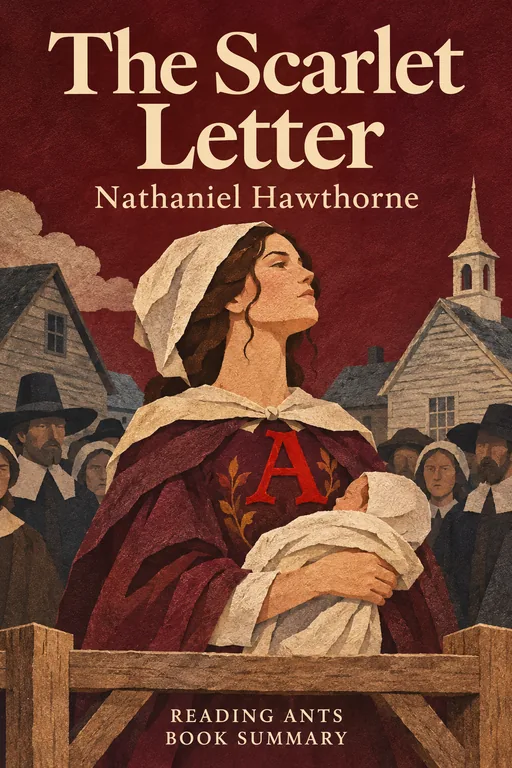
The Scarlet Letter
In seventeenth-century Boston, a young woman named Hester Prynne is forced to wear a scarlet letter A for adultery, and she bears her shame with dignity while the secret father of her child, a respected minister, is eaten alive by guilt.
Overview
The Scarlet Letter is a novel by Nathaniel Hawthorne, published in 1850. It is set in the 1640s in a Puritan settlement in Massachusetts, a community ruled by strict religious laws. Hawthorne, who was descended from a judge in the Salem witch trials, was interested in guilt, sin and the effects of secrets. The story begins with Hester Prynne standing on a scaffold in the marketplace, holding her baby, as the town judges her. The novel explores how people deal with sin, whether hidden or public, and how a society can judge harshly while hiding its own failings.
Main Characters
- Hester Prynne: a young woman who is strong, proud and passionate, who endures public shame.
- Pearl: Hester’s daughter, a wild, perceptive and spirited child.
- Arthur Dimmesdale: the young, revered minister, who is Pearl’s secret father and is tormented by guilt.
- Roger Chillingworth: Hester’s husband, an older scholar and physician who comes to Boston in disguise to seek revenge.
- Governor Bellingham and the magistrates: the stern leaders of the town.
- Mistress Hibbins: a woman accused of being a witch.
Full Summary
The Scaffold
Hester Prynne emerges from the prison door, wearing a letter A embroidered in scarlet on her dress, with her infant, Pearl, in her arms. She has been convicted of adultery: her husband, an older scholar, sent her ahead to the colony and has not been heard from for two years, so that he is thought lost at sea, and she had a child by another man. She is put on a scaffold to be shamed publicly. The magistrates and the young minister, Arthur Dimmesdale, urge her to name the father, but she refuses. In the crowd stands a stranger, who is her missing husband, now calling himself Roger Chillingworth.
Hester’s Life
After her release, Hester lives in a cottage at the edge of town. She supports herself and Pearl by sewing, and the beautiful work she produces is in demand, though the townspeople treat her as an outcast. The letter, which she has embroidered in gold thread, becomes a mark of her endurance. Pearl grows into a wild, imaginative child who seems to be an embodiment of the letter, and who often asks about it. Hester also helps the sick and the poor, and slowly, some people begin to see the A as standing for “able.” She is gentler with others, and when an epidemic comes, she is among the first to help, nursing the sick and comforting the dying. Her actions, over years, begin to soften opinion, though the leaders do not forgive her.
Chillingworth’s Revenge
Chillingworth, who practices medicine, vows to find Hester’s lover, and demands that she not reveal his identity. He becomes close to Dimmesdale, who is ill with a mysterious ailment, and they live together. Chillingworth suspects the minister, and begins to torment him by hints and questions. Dimmesdale, tormented by guilt, whips himself in secret, and holds a night vigil on the scaffold, where he is joined by Hester and Pearl, but not publicly.
Hester Reveals the Truth
Hester sees that Dimmesdale is being destroyed by Chillingworth’s attentions and by his own secret. She decides to tell him that Chillingworth is her husband. She meets the minister in the forest, and they express the love that they have both felt. She urges him to flee with her and Pearl to Europe, and he agrees, regaining a sense of hope. For a moment, she removes the letter and lets down her hair, and Pearl, who sees them, is uneasy.
The Election Day Sermon
On Election Day, Dimmesdale gives the best sermon of his life. As the procession leaves the church, he climbs the scaffold, calls Hester and Pearl to stand with him, and confesses publicly. He tears open his shirt to reveal a mark on his chest, which many see as a scarlet letter. He then dies in Hester’s arms, and Pearl kisses him.
Aftermath
Chillingworth, who has lost the object of his revenge, withers and dies within a year, leaving his property to Pearl. Hester and Pearl leave Boston, and Pearl’s later life in Europe is known only through rumor and gifts, which suggest that she grew up wealthy and perhaps married. Years later, Hester returns alone to the town, and voluntarily resumes wearing the letter. She becomes a counselor to women in trouble. When she dies, she is buried next to Dimmesdale, and the two share a gravestone bearing a scarlet A on a black field.
Why It Matters
The Scarlet Letter is one of the central works of American literature, and is regularly read in schools. It was Hawthorne’s first major success, and its depiction of Puritan society, with its theological rigor and its hypocrisy, remains influential. The book has been adapted for stage, film and opera, and its image of the scarlet letter has become a symbol of public shaming.
It has also been central to discussions of women’s roles and sexuality in American history, and Hester has been celebrated by many readers as an early feminist heroine who stood her ground.
Key Takeaways
- Hidden guilt eats at the soul. Dimmesdale suffers from his secret.
- Public shame can hide private sin. The town judges Hester but not itself.
- Revenge destroys the avenger. Chillingworth is consumed by hatred.
- Dignity can survive disgrace. Hester turns shame into strength.
- Honesty can be freeing. Dimmesdale finds peace in confession.
What We Can Learn
The novel shows that secrets can be a heavier burden than the truth. Dimmesdale’s inner suffering is worse than Hester’s public ordeal, because she has nothing to hide.
It also warns against self-righteous judgment. The Puritans who punish Hester are guilty of their own faults, and the book invites us to ask who has the right to judge.
Finally, it suggests that a mark of shame can be transformed by how one lives. Hester’s work and kindness change the meaning of the letter for those around her.
Criticism and Counterpoints
Some readers find the writing dense, slow and heavy with symbols, and the plot thin. Others say that the characters, particularly Dimmesdale and Chillingworth, are types more than people, and that Pearl is a symbol rather than a believable child. Feminist critics note that Hester is admirable but that she does not escape her limited role, and that the male minister’s sin is treated as a tragic flaw, while she is shamed publicly.
Some also criticize the novel’s moral views, such as its sympathy for the adulterers while suggesting that sin brings suffering. Still, it remains a respected classic.
Who Should Read It
This book suits teenagers and adults. The language is old, the pace is slow, and the introduction, “The Custom-House,” is long. It deals with adultery and shame in an indirect way. It is a good choice for discussion.
Want the whole book?
A summary is a taste, not the meal. Here is where to find the full book.
You reached the end 🎉
Nicely done. Mark this one as read, and we will suggest what to read next.
Read this next

The Crucible
Arthur Miller
In 1692 Salem, Massachusetts, a group of girls accuse their neighbors of witchcraft, and fear, jealousy and religious certainty spiral into a wave of false accusations and hangings that one honest farmer refuses to join.
🎭 Epics, Drama & Poetry
Moby-Dick
Herman Melville
A young sailor joins a whaling voyage and discovers that its captain is obsessed with hunting down the giant white whale that bit off his leg, a quest for revenge that leads the whole crew to destruction.
📜 Classics
Jane Eyre
Charlotte Bronte
A poor, plain but fiercely independent orphan becomes a governess, falls in love with her brooding employer, discovers his terrible secret, and refuses to give up her self-respect even for love.
📜 Classics
Madame Bovary
Gustave Flaubert
A romantic young woman, bored by her provincial marriage to a kind but dull doctor, seeks excitement in love affairs and luxury, and is crushed by debt and disillusion.
🌍 World Literature
Pride and Prejudice
Jane Austen
Quick-witted Elizabeth Bennet and the proud, wealthy Mr. Darcy badly misjudge each other, and only by facing their own faults do they find their way to love.
📜 Classics
Nineteen Eighty-Four
George Orwell
In a future Britain ruled by an all-seeing Party, one man secretly rebels by keeping a diary and falling in love, and discovers just how completely a totalitarian state can crush the human mind.
📜 ClassicsWant something different?
Pick another topic and we will show you three books to start with.