 Reading Ants
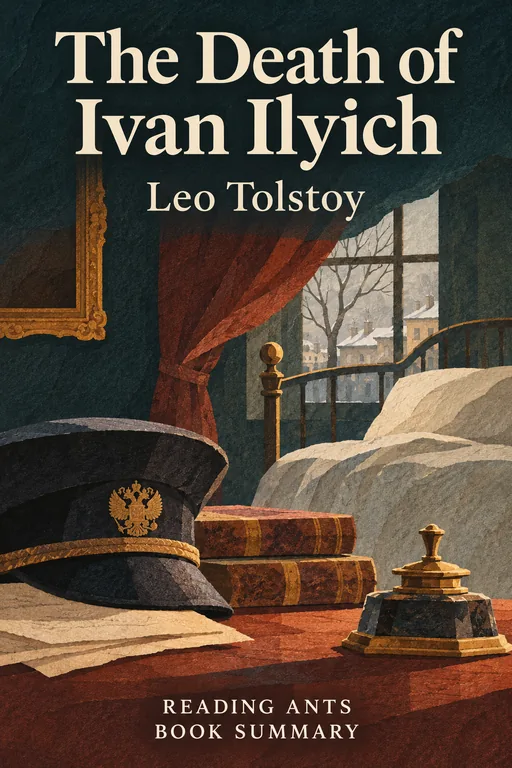
The Death of Ivan Ilyich
Original title: Смерть Ивана Ильича
A successful, conventional Russian judge falls ill and dies, and in his last weeks he realizes that his comfortable life was not really a good one.
Overview
The Death of Ivan Ilyich is a short novel, or novella, by Leo Tolstoy, published in 1886, after his religious crisis. It begins with the news of the judge’s death and the reaction of his colleagues, who think mostly of promotions and card games. It then goes back through his life, from his ordinary career and marriage to the illness that kills him. The story is among the most famous accounts of death in literature, and it asks what makes a life worth living. It is short, direct and powerful, and has been read by doctors, philosophers and general readers.
Main Characters
- Ivan Ilyich Golovin: a respected judge who lives a proper, ordinary life.
- Praskovya Fedorovna: his wife, with whom he has a distant marriage.
- Gerasim: a young peasant servant who cares for him with simple kindness.
- Peter Ivanovich: a colleague at the start of the story.
- The doctors: a series of physicians who offer opinions but no answer.
- Vasya: Ivan Ilyich’s young son.
Full Summary
The News
The story opens in a courthouse, where Ivan Ilyich’s colleagues read of his death in the newspaper. They are not sad. Each one thinks first about how the death will change their own chances of promotion. Peter Ivanovich goes to the house for the memorial service before the funeral, where he sees the widow, who is more interested in the money she will receive than in her grief. He leaves the service early to play cards.
The scene sets the tone: death is treated as a social problem, not a human one, and the people around it want to avoid thinking of it.
A Pleasant Life
The story then goes back to Ivan Ilyich’s life. He was a clever, easygoing man who did well in school and in his career. He became a judge, and he enjoyed the power and respect that it brought. He married a woman who was suitable and attractive, but their marriage soon became cold, and he spent more and more time on work, which gave him a sense of order.
He lived “pleasantly and properly,” and he made sure to do what was expected of him. He enjoyed card games, polite society and furnishing his home. In his own mind, he was a good man who had done everything right.
The Illness
One day, while showing how to hang the curtains in his new house, Ivan Ilyich slips, catches himself, and strikes his side. The injury seems small, and the book never gives a reliable medical explanation. The pain does not go away, and he starts to feel sick. He consults a series of doctors, who talk in long phrases and cannot tell him what is wrong. They treat him like a case, not a man. His family and friends do not want to face the idea that he is seriously ill, and they behave as if nothing is wrong.
His wife grows annoyed by his complaints. He feels more and more alone. He realizes that the people around him find his illness inconvenient, and that they do not want to hear about death.
The Question
As the illness advances, Ivan Ilyich begins to ask himself why this is happening. He thinks of the logic that he learned, that all men are mortal, and that he is a man, but he cannot connect it to himself. His own death seems impossible.
In the long days and nights, he reviews his life and begins to doubt it. He had thought that he had lived well, but now he sees how little of it was real. His work, his marriage and his social life were all a performance, driven by what others expected. He realizes that he has been avoiding his own feelings, and he is filled with fear and bitterness.
Gerasim
The person who treats him with the plainest kindness is Gerasim, a young servant who helps care for him. Gerasim does not pretend. He understands that his master is dying, and he is simple and calm about it. He holds Ivan Ilyich’s legs up at night, which eases his pain, and he says that we will all die someday, and that it is no trouble to help.
This honesty is a comfort, and it shows Ivan Ilyich the difference between a life of show and a life of real feeling. He also notices the frightened pity of his young son Vasya, a schoolboy who seems to understand him better than the others do.
The Light
In his last days, Ivan Ilyich screams in pain and fear for three days. He wonders whether the life he has lived was wrong, and he understands that he has not lived as he should. Near the end he glimpses a light, just as his son takes his hand and kisses it. He feels sorry for the boy and for his wife, and he tries to ask for their forgiveness, though the word comes out wrong. Then he sees that the fear of death is gone. In its place there is only that light, and, on a religious reading, a sense that death is not an ending, though the book does not narrate an afterlife.
He dies at peace. The final lines suggest that he has found, at the last moment, what he had missed all his life.
Why It Matters
The Death of Ivan Ilyich is regarded as one of the greatest short works of fiction. Its analysis of how a person can lead a conventional life without ever thinking about what it means has been widely admired, and its picture of dying has been cited by doctors and writers on illness. Many readers find its message, that how we live matters more than what we achieve, still true.
It is also notable for its style, which is plain and direct, and for its structure, which moves from the news of the death back through the whole life to the end. It influenced later authors who wrote about death and meaning, such as the existentialists.
Key Takeaways
- A conventional life can be an empty one. Ivan lives to please others.
- Death is hard to face. People around him avoid the subject.
- Real kindness is simple. Gerasim is honest and caring.
- It is never completely too late. Ivan finds peace at the end.
- Society prizes appearances. The mourners care about status, not grief.
What We Can Learn
The story invites us to ask what we are living for. Ivan Ilyich chases promotion and comfort, and, at the end, he sees that these were hollow. We can ask ourselves regularly whether our choices come from our own values or from what others expect.
It also teaches us how to treat the sick and the dying. Gerasim does not pretend, and he is present and kind. We can try to be honest and gentle with people who are suffering, instead of looking away.
Finally, the book shows that change is possible even late in life. Ivan’s last hours are painful, but they bring understanding, a reminder that it is never worthless to try to be more honest and loving.
Criticism and Counterpoints
Some readers find the book bleak, with its relentless focus on pain and the emptiness of ordinary life. Others find its message heavy-handed, as Tolstoy, who had become a strict moralist, seems to condemn all of middle-class life, and its view of Ivan’s marriage is harsh. A few critics think that the religious ending is too sudden, and that it is less convincing than the long account of suffering that comes before it.
Still, the book’s power and clarity have kept it a classic.
Who Should Read It
This book is for mature teenagers and adults who are ready to think about mortality and meaning. It is short, and the language is simple, but the subject is serious. It is a good choice for readers who want a brief, powerful classic, and for those who work with the sick or the elderly.
Want the whole book?
A summary is a taste, not the meal. Here is where to find the full book.
You reached the end 🎉
Nicely done. Mark this one as read, and we will suggest what to read next.
Read this next

Anna Karenina
Leo Tolstoy
In imperial Russia, a married aristocrat falls passionately in love with a dashing officer and loses her place in society, while a thoughtful landowner seeks a meaningful life through love, work and faith.
🌍 World Literature
War and Peace
Leo Tolstoy
Five aristocratic Russian families are swept through the Napoleonic Wars, and through love, loss and searching, three of their young members discover what makes a life meaningful.
🌍 World Literature
Crime and Punishment
Fyodor Dostoevsky
A poor former student in St. Petersburg murders an old pawnbroker to prove he is an extraordinary man above ordinary morality, then is tormented by guilt until love and confession offer him a path to redemption.
🌍 World Literature
The Metamorphosis
Franz Kafka
A hardworking traveling salesman wakes one morning to find himself transformed into a monstrous insect, and his family's love for him slowly turns to disgust and neglect.
🌍 World Literature
The Stranger
Albert Camus
An emotionally detached office worker kills a man on an Algerian beach and discovers that society condemns him as much for refusing its expected feelings as for the murder itself.
🌍 World Literature
The Little Prince
Antoine de Saint-Exupery
A pilot stranded in the desert meets a small boy from a tiny planet, who teaches him that the most important things in life, like love and friendship, can only be seen with the heart.
🌍 World LiteratureWant something different?
Pick another topic and we will show you three books to start with.