 Reading Ants
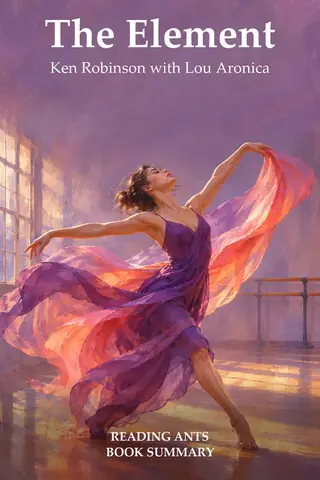
The Element
Ken Robinson argues that people flourish when they find the meeting point of what they are good at and what they love, and that schools and workplaces too often keep us from finding it.
Overview
The Element: How Finding Your Passion Changes Everything was published in 2009 by Sir Ken Robinson, the British education and creativity speaker, with the writer Lou Aronica. Robinson uses the word “Element” for the place where natural talent meets personal passion, the state in which people feel most like themselves. The book is built on the stories of many well-known people, including musicians, performers, athletes, writers and scientists, many of whom Robinson interviewed. It asks why so many people never find what they could do best, and what parents, teachers and employers can do about it. It is a thoughtful, hopeful book rather than a how-to manual.
Full Summary
1. The Element is where talent meets passion
The idea: Robinson says that your Element has two parts. The first is aptitude, a natural ability for something. The second is passion, a real love for doing it. Talent without love is only a skill you happen to have, and love without any talent can still be a lovely hobby, but not an Element. When both come together, people feel absorbed, fulfilled and more themselves, and time seems to disappear. He also says that the word “love” is used too loosely, and that being in your Element is a deeper thing than liking a job or a pastime.
Reported example: Robinson tells the stories of many people who found this point, including the choreographer Gillian Lynne, who had trouble at school as a child and found herself through dance. The sources also describe a bandmate who practiced for hours because he truly wanted to, which showed that his passion was real.
In real life: A boy who is good at drawing but hates it will probably never be an artist. A girl who is only average at football but plays every day for the joy of it may be closer to her Element than he is.
2. Intelligence is broader than school tests
The idea: Robinson argues that intelligence has many forms. It is diverse, since we think in words, pictures, sounds, movement and more. It is dynamic, since breakthroughs often come from linking ideas from different areas. And it is distinctive, since each person’s mix is different, like a fingerprint. Schools that reward only a narrow kind of ability, mostly with words and numbers, miss many gifts and teach talented children to think that they are not clever.
Reported example: The sources say that Robinson uses the examples of Albert Einstein and the designer Buckminster Fuller, who combined different fields to find new insight, and the musician Paul McCartney, whose gift was not noticed by his teachers.
In real life: A student who struggles with essays but can fix any bicycle or organize an entire school event is showing a kind of intelligence that no report card records.
3. Creativity can be learned, like reading
The idea: Robinson treats creativity as something that nearly everyone has and can develop, not a gift reserved for artists. He describes it as the process of having original ideas that are also useful or valuable, and compares it to literacy: most people can learn it, but many never get the chance. Creative abilities grow when we practice them, and a school system that narrows the curriculum can switch them off.
In real life: Someone who learns to come up with five different ways to solve a problem at work or in a homework task is exercising creativity, whether or not anyone calls it art.
4. Find your tribe
The idea: People find their Element faster when they meet others who share it. Robinson calls these groups “tribes.” Being among people who have the same interest makes you feel that you belong, shows you what is possible and pushes you to improve. Many of the people in the book felt out of place until they met their tribe.
Reported example: One reader’s summary says that the actress Meg Ryan did well at school but felt she had found her people among the actors and crews on film sets.
In real life: A shy teenager who joins a robotics club or a choir may find friends who care about the same thing for the first time.
5. Attitude, opportunity and luck
The idea: Having talent and passion is not enough. Robinson says that finding the Element also needs a good attitude, a belief that you can do something about your situation, and chances to try things. Mentors matter, because someone who notices what you can do can open doors. Luck, supportive parents and persistence also play a part.
In real life: A student who asks a teacher for advice on a project, and keeps trying after a first failure, gives luck much more of a chance to appear.
6. Barriers are normal
The idea: Robinson says that almost everybody meets obstacles on the way, both personal and social, such as family pressure, doubt about one’s own ability, or schools and workplaces that do not value one’s kind of ability. He treats these as normal, not as signs that a person has chosen wrongly. Many of the people in the book had a hard time at school, and Robinson suggests that their struggles sometimes helped to shape what they became.
In real life: A young person who wants to study music while the family expects medicine faces both an outer barrier (pressure) and an inner one (doubt about whether it is a safe choice).
7. It is never too late, and it need not be your job
The idea: Robinson argues that finding your Element is not only for the young. Some people find it in mid-life or much later. He also says that living close to your Element does not always mean making it your profession. A person may follow a passion as an amateur while earning a living in a different way.
Reported example: The reviews describe a chapter called “For Love or Money,” which profiles a scholar who is also a serious cellist and who chose a career that lets him play music without financial strain.
In real life: An accountant who plays in a community orchestra every week may be living much closer to her Element than a professional musician who has grown tired of performing.
8. Schools and organizations need to change
The idea: In the last part of the book, Robinson turns to the systems that shape people. He says that public schools grew from an industrial model that sorts students by age and relies on standard tests, which pushes the arts and other subjects aside. He criticizes policies such as the US No Child Left Behind law and calls for education that treats each child as an individual, and for employers who give people room to use their talents.
In real life: A school that lets students choose a project they care about, and that values art and sport as well as math, is acting on this idea.
Why It Matters
The Element brought a very simple question into the public conversation: what are you really good at, and do you love it? Robinson was already well known for his talk on schools and creativity, and the book carried the same message to readers who wanted a fuller account. It helped many parents and teachers to think more widely about what intelligence and talent are, and to see the arts, sport and practical skills as important parts of education. The book is also a forerunner of his later book with Aronica, Creative Schools, which turns the argument toward school reform. Its hopeful tone and its many stories of real people make it appealing to anyone at a crossroads.
Key Takeaways
- Talent and love together. Your Element lies where natural ability and real passion overlap, not in either one alone.
- Intelligence is many things. Narrow tests miss many abilities, and children who are not good at tests may be very gifted.
- Creativity can be grown. Like reading, it is a capacity that most people have and that improves with practice and encouragement.
- People and chances matter. A good attitude, supportive mentors and a community of like-minded people help the Element to appear.
- It is never too late. You can find your Element at any age, and you can live near it without making it your job.
What We Can Learn
Ask yourself two questions and be honest about both: what comes easily to me, and what makes me lose track of time? Where the answers meet, spend more of your time. Try new things, because you cannot find an Element that you have never tried. Look for a group, a teacher or a mentor who shares the interest, and expect setbacks without taking them as proof that you are on the wrong path. If your passion cannot pay your bills yet, keep it alive as a serious hobby while you build a steady life. If you are a parent or teacher, notice what a child does with great energy and offer chances to explore it, and do not judge talent only by exam results. A child who is not good at one subject may simply be waiting for the right door.
Criticism and Counterpoints
Some reviewers found the book inspiring but light on practical steps. Magdalena Ball wrote that it is philosophical rather than a self-help guide, and said that readers stuck in unsatisfying jobs may find it frustrating, and that the link between financial security and personal fulfilment is not always clear. The getAbstract summary also notes that the book makes a strong case for finding your Element but does not say how to get there, and that its many stories of famous people may leave some readers feeling distant. Ben Casnocha thought it spends more time on discovering talent than on the long, hard work of developing it, and that its critique of schools is stronger than its suggested remedies. Because the stories are mostly about people who succeeded, readers may also wonder about those who did not.
Who Should Read It
This book is for teenagers deciding what to do with their lives, for parents and teachers who want to understand children better, and for adults who feel they are in the wrong place. It is easy to read and encouraging. Readers who want a clear, step-by-step method for choosing a career, or hard research on talent, may find it too general and should add a more practical guide.
Want the whole book?
A summary is a taste, not the meal. Here is where to find the full book.
You reached the end 🎉
Nicely done. Mark this one as read, and we will suggest what to read next.
Read this next
Creative Schools
Ken Robinson and Lou Aronica
Ken Robinson and Lou Aronica argue that schools are held back by a factory-style model of standardized testing, and call for an approach built on personalization, creativity and the real interests of students and teachers.
🎓 Parenting & Education
Why Don't Students Like School?
Daniel T. Willingham
Cognitive scientist Daniel Willingham uses research on how the mind works to explain why thinking is hard, why knowledge matters and how teachers and students can make learning more effective and enjoyable.
🎓 Parenting & Education
Flow: The Psychology of Optimal Experience
Mihaly Csikszentmihalyi
Psychologist Mihaly Csikszentmihalyi shows that people feel happiest not when relaxing but when fully absorbed in a challenging activity that matches their skills, a state he calls flow.
🧩 Mind & Psychology
Drive: The Surprising Truth About What Motivates Us
Daniel H. Pink
Daniel Pink argues that, for creative and complex work, carrots and sticks such as bonuses are less effective than the inner drive provided by autonomy, mastery and purpose, and that businesses and schools should be redesigned around them.
🧩 Mind & Psychology
How Children Succeed
Paul Tough
Journalist Paul Tough argues that qualities like perseverance, curiosity and self-control matter more for children's success than test scores alone, and that these qualities can be nurtured, especially for children who face hardship.
🎓 Parenting & Education
How to Talk So Kids Will Listen and Listen So Kids Will Talk
Adele Faber and Elaine Mazlish
Parents can get better cooperation and closer relationships by acknowledging children's feelings, describing problems instead of blaming, and using simple, respectful communication skills.
🎓 Parenting & EducationWant something different?
Pick another topic and we will show you three books to start with.